
MSU Video
2017 MSU University Distinguished Professors
Special | 26m 29sVideo has Closed Captions
MSU celebrates its ten 2017 University Distinguished Professor honorees.
Michigan State University is celebrating its 2017 class of ten University Distinguished Professors in recognition of their achievements in the classroom, laboratory and community. This distinction is among the highest honors that can be bestowed on a faculty member by the university.
Problems playing video? | Closed Captioning Feedback
Problems playing video? | Closed Captioning Feedback
MSU Video is a local public television program presented by WKAR
MSU Video
2017 MSU University Distinguished Professors
Special | 26m 29sVideo has Closed Captions
Michigan State University is celebrating its 2017 class of ten University Distinguished Professors in recognition of their achievements in the classroom, laboratory and community. This distinction is among the highest honors that can be bestowed on a faculty member by the university.
Problems playing video? | Closed Captioning Feedback
Where to Watch MSU Video
MSU Video is available to stream on pbs.org and the PBS app.
More from This Collection
Michigan State University celebrates the 2017 class of University Distinguished Professors in recognition of their achievements in the classroom, laboratory and community. This distinction is among the highest honors that can be bestowed on a faculty member by the university.

Mark Meerschaert - University Distinguished Professor
Video has Closed Captions
Professor, Department of Statistics and Probability, College of Natural Science (2m 37s)
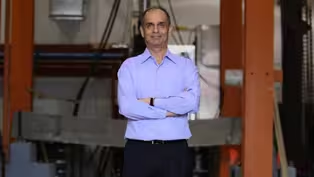
Venkatesh Kumar Kodur - University Distinguished Professor
Video has Closed Captions
Professor and Chair, Dept of Civil and Environmental Engineering, College of Engineering (2m 40s)
Thomas Dietz - University Distinguished Professor
Video has Closed Captions
Professor, Dept of Sociology and the Environmental Science and Policy Program (2m 40s)
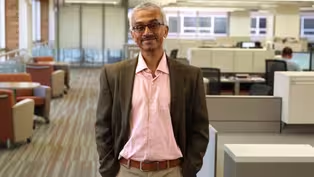
Shanker Balasubramaniam - University Distinguished Professor
Video has Closed Captions
Professor and Associate Chair, Department of Electrical and Computer Engineering, CMSE (2m 50s)
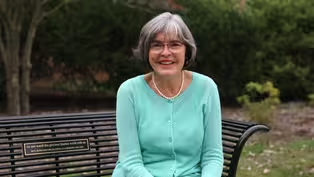
Sandi Smith - University Distinguished Professor
Video has Closed Captions
Professor, Department of Communication, College of Communication Arts and Sciences (2m 50s)

Pero G. Dagbovie - University Distinguished Professor
Video has Closed Captions
Professor, Dept of History, College of Social Science; Associate Dean, The Graduate School (2m 35s)
Gregg Howe - University Distinguished Professor
Video has Closed Captions
MSU Foundation Professor, Plant Research Laboratory (2m 30s)
Douglas Landis - University Distinguished Professor
Video has Closed Captions
Professor, Department of Entomology, College of Agriculture and Natural Resources (2m 25s)
Diane Ebert-May - University Distinguished Professor
Video has Closed Captions
Professor, Department of Plant Biology, College of Natural Science (2m 55s)
Asgi Fazleabas - University Distinguished Professor
Video has Closed Captions
Associate Chair for Research, Dept of Obstetrics, Gynecology & Reproductive Biology (2m 35s)
Providing Support for PBS.org
Learn Moreabout PBS online sponsorship- I'm a plant ecologist and this is my 40th year of teaching.
Of course I started when I was 10.
In this particular plant, when it dries, all the leaves fall off.
Why is that advantageous to a plant?
Totally eliminates it.
I came here 19 years ago.
I wanted to take the research I was doing and test my models in a very, very large university and the reputation of the plant biology department at Michigan State University was second to none.
Remember, when you're taking about doing science, everything has to be organized.
I study how students learn biology and why and how faculty teach biology and why.
So, what's another very common plant, Adam, that we see modified leaves?
- Poinsettia.
- Poinsettia, right.
Don't eat those little red dudes!
I research with my graduate students and my post docs on a mountain top in Colorado and it became clear to me and my colleagues students learn so well in the field, why do we go back into the classroom and turn into Dr.
Jekyll and Mr.
Hyde where in fact we don't engage students, we don't teach them how to conduct science.
One of my colleagues and I wrote a proposal to the NSF to start teaching faculty how to teach science inside the four walls of a classroom.
We coined that phrase scientific teaching.
We said our challenge is going to be bringing that into a classroom with over two or three or 400 students, how do we do that?
And this led to our development of a national document called Vision and Change for Biology Education in the 21st Century and people use this in courses across the United States.
- The objectives for today, first and foremost, we're gonna hit the ground running talking about plant phenology.
- If I'm making the claims that we can do active learning in large enrollment courses, I better put up or shut up.
So, I go to the courses and the individual classes that my graduate students and post docs are teaching to mentor them.
Those are models.
Yeah, you got it, you got it.
So, you make the analogy I'm studying the ecology of a classroom.
It's a very complex system to study but that's no different than my plants and quite frankly, it's harder than studying my plants.
- So, those reds, yellows and oranges are always there but the green is the dominant color because of these chloroplasts.
- My PhD students have PhDs in plant biology so they're experts but they do their research on people.
That has put Michigan State University on the map as a leader in discipline-based biology education research.
I have a world vision of transforming all of biology education and I have well over 200 post docs who have studied with me to do this who are now faculty members at other institutions.
Collectively we can make a difference.
(lively music) - The first test-tube baby was born in 1978 and since that very first discovery, the field has boomed.
And today, we estimate there are about 5 million babies that have been born using the technology over the last 30 years.
This one is the baboon lesion, okay, you're comparing that with the human lesion, right?
One of the biggest barriers with this technology is what we call the take home baby rate.
We're still stuck at about 30%, and since this was an area that was so understudied, I got fascinated with this.
Coming to Michigan State University in 2009 was the best move I ever made in my career.
- This is the control without disease and you can see that the nucleus is very much clear.
- The plan was to develop Grand Rapids with a major focus in women's health research.
And we've been able to hire the most incredible faculty from all over the country.
That I think without a doubt, we are the number one reproductive and developmental sciences program in the country, bar none.
And the new research building in Grand Rapids is only going to make the program even bigger.
(dramatic music) What my laboratory focuses on is trying to understand a disease called Endometriosis.
That effects about 10% of the population.
In about 50% of women that suffer from this disease are infertile.
- Oh and these ones are aisle one data and these ones are (mumbles).
- The goal of my research is really to try to understand the signals that come from an early embryo and how does it communicate with the uterus.
About 60% of the pregnancies are lost long before a woman even realizes that she's pregnant.
So, can we use these signals to predict whether the woman is going to have a successful pregnancy?
And how do these signals enhance and help because it is very heartbreaking when you only have one in three chance of going home with a baby.
Overall, the goal of my research is really to improve women's health.
And it really is something that you do for a living that never has a right answer, there's always a challenge.
And I'm privileged, I get paid to go fishing everyday because I never know what my answer is gonna be.
And I never know what I'm going to catch.
Puts a smile on my face every time when I come to work.
(hopeful music) - One of the fundamental challenges the world is facing is an increasing population, and we're gonna have to be able to produce plants that are yielding more and in a more sustainable manner.
Michigan State University is viewed worldwide as a leading place to conduct plant science research.
That is really one of the things that attracted me to come here 20 years ago, and I think it's one of the things that attracts students and post-docs.
- [Scientist] These horn worms have evolved on the tomatoes for so long they adapted to those trichomes.
- We have a niche in our lab that makes us unique.
We are really interested in how plants respond to different biotic challenges, like an insect attack.
How long will it take this guy to consume the whole plant?
- At the elevated temperature, maybe another three days.
- The tomato plant is an excellent model system.
When an insect is munching on plant leaf, there are chemicals that are produced at that site and those chemicals trigger certain defense responses in that leaf and human cells do something very similar.
Both trigger a rapid and highly specific immune response that will keep those invaders at bay.
- JSQ is obviously hyper sensitive to methyl jasmonate.
- One of the questions that we're really interested in in the lab is how plants balance the need to defend with the need to grow.
- The accumulation of glucosinolates seems to have a similar effect.
- Right.
A well defended plant tends to grow very slowly and a plant that is growing very rapidly tends to be more susceptible to insects and pathogens that are in its environment.
So, we're trying to figure out how those processes of growth and defense are linked and our hope is that, by understanding that, we can produce plants that are both protected and yield better as well.
- We'll see a stronger effect from elevated temperature on younger plants.
- And there could be an interesting angle there.
Being at MSU has allowed me to realize my potential as a researcher.
I get a lot of gratification out of seeing students moving on to bigger and better things and to watching their careers develop and our goal in the lab is really to create better plants that can benefit the lives of people.
(instrumental music) - So imagine flying in a small plane at 10,000 feet and you look down and what you see is this mixture of crop fields, wetlands, forests and it's the combination of all of those elements that make up an agricultural landscape.
- You want to put a fresh one on?
- Oh yeah.
As the agricultural landscape becomes more dominated by crops, it's less suitable for natural enemies and farmers are actually forced to use more insecticides in that case.
(light piano music) Kellogg Biological Station is one of many research stations that Michigan State University has.
There is no other facility like it in the United States.
We're also one of the longest-running agricultural experiments in the world.
My role is to study the biodiversity of the system.
So I think about how insects interact with the environment around us.
- We count the lady beetles at the same time we change out the cards.
- When we had an invasion of the soybean aphid we found that in a few years lady beetles were actually controlling that population quite well.
And so we study their movement among these different elements, then we think about how we can design landscapes that make them more effective at their job.
(intriguing instrumental music) - It's definitely either Laxius or Tetracerus.
- So the spines are on the abdomen there?
Undergraduates sort samples and they learn how to identify insects to species.
And then the ones who are the most keen on entomology go on to graduate school as well.
So we really feel like we're influencing the lives of young people and helping them along their career path.
(light piano music) So these are looking good.
Where'd you catch these?
I also study insects of conservation concern and one of those is the monarch butterfly.
Monarchs have declined in recent decades.
- They seem to lay up to 50 eggs in a day.
- It's surprising there's so few of them in the field.
Their host plant the common milkweed has become much less abundant in agricultural landscapes.
(lively instrumental music) They don't mind the tropical milkweed?
- They seem to like it.
- We're sort of reverse engineering these systems, and we're trying to come up with ways to grow milkweed so that more of their offspring survive.
- I've been withholding the plant from them and getting the eggs when I need them.
- Ultimately, what we'd like to achieve is a balance in agricultural landscapes between productivity but also their conservation values.
Beautiful and cooperative.
No one else in the world has a long-term research site where agriculture is studied in the depth that we do here at MSU.
I love working with insects and I love working with students and I'm always happy to go to work.
(uplifting piano music)
 New Episode
- News and Public Affairs

Top journalists deliver compelling original analysis of the hour's headlines.

- News and Public Affairs

FRONTLINE is investigative journalism that questions, explains and changes our world.

 New Episode
 New Episode
 New Episode
 New Episode
 New Episode
 New Episode
 New Episode
 New Episode
Support for PBS provided by:
MSU Video is a local public television program presented by WKAR