
Ani Liu: Eye Heart Womb
Special | 16m 15sVideo has Closed Captions
Artist Ani Liu creates provocative artifacts at the intersection of art, science and technology.
Explore the work of New York-based artist Ani Liu as she creates provocative artifacts at the intersection of art, science and technology. From neuroscience to motherhood, her practice challenges understandings of bodies and gender.
Problems playing video? | Closed Captioning Feedback
Problems playing video? | Closed Captioning Feedback
Support for American Masters is provided by the Corporation for Public Broadcasting, AARP, Rosalind P. Walter Foundation, Judith and Burton Resnick, Blanche and Hayward Cirker Charitable Lead Annuity Trust, Koo...
Support provided by:

Ani Liu: Eye Heart Womb
Special | 16m 15sVideo has Closed Captions
Explore the work of New York-based artist Ani Liu as she creates provocative artifacts at the intersection of art, science and technology. From neuroscience to motherhood, her practice challenges understandings of bodies and gender.
Problems playing video? | Closed Captioning Feedback
How to Watch American Masters
American Masters is available to stream on pbs.org and the free PBS App, available on iPhone, Apple TV, Android TV, Android smartphones, Amazon Fire TV, Amazon Fire Tablet, Roku, Samsung Smart TV, and Vizio.
Buy Now
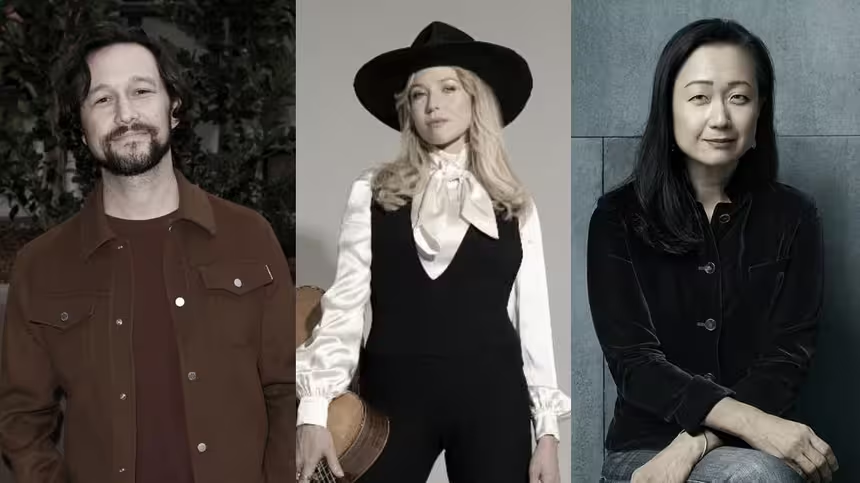
A front row seat to the creative process
How do today’s masters create their art? Each episode an artist reveals how they brought their creative work to life. Hear from artists across disciplines, like actor Joseph Gordon-Levitt, singer-songwriter Jewel, author Min Jin Lee, and more on our podcast "American Masters: Creative Spark."Providing Support for PBS.org
Learn Moreabout PBS online sponsorshipMore from This Collection
This documentary shorts series from American Masters and Firelight Media follows emerging cultural icons – creators who bring insight and originality to their craft – on their journeys to becoming masters of their artistic disciplines.
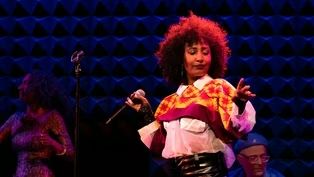
Video has Closed Captions
Follow Sudanese musician and ethnomusicologist Alsarah as she leads Alsarah and the Nubatones. (17m 36s)
Providing Support for PBS.org
Learn Moreabout PBS online sponsorship(ethereal music) - There's such a stigma around being a female artist with kids.
For me to lean into it sometimes I feel very self-conscious about it.
(child struggling and laughing) The assumption is that I can't give it my all in the studio or my brain is constantly distracted.
There's a reality to me being a parent for sure, but I feel like nobody gets things done more than a mother.
(ethereal music) My name is Ani Liu.
I'm a research-based artist working at the intersection of art, technology, and science.
I'm currently an assistant professor at the University of Pennsylvania.
I have a very interdisciplinary art practice.
I make artifacts as an artist.
The artifacts in our life tell stories and encode values.
Having been trained as an architect, I'm always asked the relationship between design and art.
And for me, it's a very permeable spectrum.
In my own practice, design isn't just problem solving, but it's problem making.
Everyone wants to make the world a better place, but what does it mean?
What is better?
(ethereal electronic music) I made this artwork where I controlled the movement of sperm with my mind by changing the electrical field that it's in.
And I remember showing this work, and men would come up to me and they would say, "That's totally horrifying.
You can't control sperm.
That's very violating."
And I was like, think about all the ways that women's bodies are violated.
Think about what it means to have restricted access to healthcare, or forced sterilization, or just straight up sexual assault.
This notion of control over the body and whose bodies get controlled and what is normalized, it's a cultural phenomenon that continues to be made and remade.
(bright music) One of my first desires as a child was to become a poet.
I remember telling my parents that, "My teacher said I could be anything I want to be when I grow up.
It's a big American ideal.
You can do anything, and I wanna be a poet."
And my mom was like, "You can definitely not be a poet."
What?
I grew up in New York City.
Growing up my mom cleaned hotel rooms for a living.
My dad worked in a Chinese restaurant cooking and cleaning.
I remember visiting my mom at the hotel she worked at, and I never walked up the front steps because we always just entered through the service elevator.
(upbeat music) (people faintly talking) I went to a public high school where math and science were at the top of the hierarchy.
For everyone around me, my parents included, there was an expectation of what success looked like.
(contemplative music) Then I went to Dartmouth College and it was such a revolutionary moment for me.
(Mindy speaking foreign language) (Mindy and Henry laughing) (Mindy speaking foreign language) (Mindy speaking foreign language) I studied sculpture at Dartmouth, architecture and design at Harvard, and biotechnology and ethics at the MIT Media Lab.
And this all informs my art practice.
(bright music) I'm someone who really believes in evidence-based truth and I love science, but I also wonder sometimes what is unknowable in the world?
I've been obsessed with a body my whole life.
I became really interested in working with culturally loaded materials like sperm, like spit, like blood, like hair.
For me, synthetic biology had to be hand in hand with ethics.
I had a really deep interest in the relationship between humans and technology and how that relationship co-makes us.
These existential philosophical notions of life and intelligence from the lens of the technological developments that were happening at the time.
(quirky synthesized music) And then in 2019 I became pregnant for the first time.
And I must admit, it kind of took me by surprise.
And I was continuing to make this work about neuroscience and AI and consciousness.
But I would be reading something really heady and then a little foot would kick me in the gut.
During my pregnancy I made a lot of artifacts that were just me trying to understand what was happening to me.
No one had ever talked to me about how difficult the transformation of incubating a new life would be.
At the end of the day, I have to do all of this labor.
Why is it easier to imagine and build an artificial womb than it is to give a universal parental leave in the US?
What is sex equality?
(plaintive electronic music) I love my kids so much, and I don't take it for granted the ability to hold them and kiss them, but sometimes I'm just overwhelmed.
So I've been making a line of mommy kisses.
(paint cans rattling) I feel like as a mom, you're never supposed to outsource anything, especially not a kiss or a hug.
(paint can spraying) What is it like to hug someone remotely?
And these are really early prototypes.
They're hybridized with treats that are relevant to my culture, part moon cake, part kiss.
I was thinking a lot about the ways my parents loved me.
I remember telling my parents like, "How come you never kiss me or hug me?
Like, you've never said 'I love you.'"
And they're like, "Well..." They gave me a lot of food.
(laughing) So I think that's why it's like half kiss, half food.
Hey, how's it going?
- [Child] Good.
- Did you have a nice time at Park?
We're not watching TV right now.
It's not the weekend.
Why are you wearing socks on your hands?
For me, a really transformative moment was when I finally took a Chinese history class.
For the first time I understood the depth of the trauma that my parents experienced with the Cultural Revolution, with a famine.
I got a grant to make work in Shenzhen, China, which is close to where my parents grew up.
I made a portrait of a specific worker.
When she was more anxious, the machine, I programmed it to knit more tightly, and when she was more relaxed, more relaxedly.
And so it's a portrait of the invisible labor behind the work.
During the Cultural Revolution, my dad was sent to the countryside for reeducation.
Towards the end of the project, I was Skyping with my dad and we realized that I was making a piece about labor in the very same land that he had been sent to farm rice.
I'm gonna make a (speaking foreign language) (Child indistinctly talking) Yes, and then we're gonna put a little bit of (speaking foreign language) inside, and then we're gonna put a little bit of water around the circle and then we're gonna close it.
I think that certain generations experience a collective trauma together.
(weaving machine humming and clattering) For me, it's not just a person working a machine, it's a person who has all of these edges of personal or family history.
It's funny 'cause I made this piece before I became a parent, and now it's very overt.
But even then, it was making work about labor in these different ways, and the relationship between the human and the machine.
As I did become a parent I made a piece about the labor of pumping.
(pump whirring) I realized until I started to lactate myself, I had never seen someone breastfeed before.
I had never seen someone pump before.
After my daughter was born, we tracked all of her feeding sessions and diaper changes.
At the end of those first few months, I was just looking back on this portrait of this incredible amount of labor that it took to bring her to where she is today.
And I was inspired to make a sculpture about it.
The sculpture has vials filled with diaper fragments, breast milk, and formula to mark the passage of time for every time she was fed and every time her diaper was changed.
(upbeat electronic music) I calculated the amount of milk that I made and I circulated it to show in volume in this visceral way the hidden labor that it takes to nourish a person.
(pump pulsing) I realized that it wasn't just a portrait of my own experience, but really a portrait of anyone who's ever had to care for a baby.
(ethereal music) I had a show at Cuchifritos Gallery.
I remember my mom asking, "What is success?
Are you gonna sell all of it?"
And I was like, "I don't think it's a commercial gallery.
I don't think selling it is even an option."
And she was like, "So what's the point?"
I have no idea what to tell her about what success is.
- The significance of Ani's exhibition was far greater than we could have anticipated.
Ani's show happened to be the period of time where there were major legislative changes made to the reproductive rights of women.
That really allowed a certain amount of catharsis and collective conversation around essential labor.
What Annie does so beautifully in her work, she finds a way to materialize all of this data that she's collecting in materials that are soft and inviting and presented in a way that is not only simple and accessible, but deeply relatable.
- I was so lucky because that show happened to be reviewed in Artforum and the The Brooklyn Rail and all these places, but there was a small picture in the New York Times, and I got to show my mom.
The next day she was like, "I couldn't sleep because I felt so happy for you."
(ethereal music) (sirens blaring) One of the projects that I'm working on right now has to do with microplastics and breast milk.
I've been doing this over the course of a year, distilling microplastics from my body and figuring out what kind of sculpture I can make from that plastic.
A few years ago in 2022, I read this paper about microplastics in breast milk.
It was so shocking.
I had known that there are microplastics in the ocean, in the air, in the environment, but somehow it being in my body being passed to my infant made it violating and very urgent for me.
After reading this paper, my whole body lit up and I knew I had to make work about it.
There's certain moments in parenthood where I feel like I'm just being punched in the face or something and you just wanna like lay down and like, oh, what's the point of anything?
I finally figured it out how to distill microplastics in my home studio, and also at Rockefeller University, but it hasn't transcended itself to become art yet.
It's something that keeps me up at night.
I need to figure out the right way to communicate the direness of it.
(bright electronic music) For me, it always starts with the deep emotion, and then after you're hit like a truck with feeling to revisit the thing and ask what it makes you think, and feel, and wonder about the world.
Such a good mood after a nap.
Both science and art, it's just a portal to more wondering.
I wanna make work that makes me feel the way I feel when I look at the night sky.
There's just an endless eternity to it.
(upbeat electronic music) (upbeat electronic music continues) (upbeat electronic music concludes)










Support for PBS provided by:
Support for American Masters is provided by the Corporation for Public Broadcasting, AARP, Rosalind P. Walter Foundation, Judith and Burton Resnick, Blanche and Hayward Cirker Charitable Lead Annuity Trust, Koo...