
Antartica: Life at the Edge
Episode 1 | 22m 50sVideo has Closed Captions
An explorer undertakes a solo Antarctic expedition to document the life beneath the ice.
Antarctica, often perceived as barren and lifeless, is in fact a dynamic ecosystem teeming with life. Hosted by explorer Ariel Waldman, the episode follows her solo expedition through Antarctica’s extreme environments as she documents the thriving microscopic wildlife, including tardigrades, hidden beneath the ice.
Problems playing video? | Closed Captioning Feedback
Problems playing video? | Closed Captioning Feedback
Antartica: Life at the Edge
Episode 1 | 22m 50sVideo has Closed Captions
Antarctica, often perceived as barren and lifeless, is in fact a dynamic ecosystem teeming with life. Hosted by explorer Ariel Waldman, the episode follows her solo expedition through Antarctica’s extreme environments as she documents the thriving microscopic wildlife, including tardigrades, hidden beneath the ice.
Problems playing video? | Closed Captioning Feedback
How to Watch Life Unearthed with Ariel Waldman
Life Unearthed with Ariel Waldman is available to stream on pbs.org and the free PBS App, available on iPhone, Apple TV, Android TV, Android smartphones, Amazon Fire TV, Amazon Fire Tablet, Roku, Samsung Smart TV, and Vizio.
Providing Support for PBS.org
Learn Moreabout PBS online sponsorship[mellow string music] Antarctica.
It's a vast land that's unlike anywhere else we know.
From the depths of its frozen lakes to the towering peaks of its spectacular mountains, it's a place of unparalleled wonder and hidden mysteries.
I want to tell the story of a continent that's waiting to be seen.
To truly see this world, though, you need to view it from a different perspective.
From the dizzying heights of an orbiting spacecraft all the way down through the lens of a microscope.
I'm on an expedition in Antarctica to uncover the extreme environments that host the smallest animals on the planet.
As a researcher, for two months, I'll be hiking glaciers, traversing frozen landscapes, flying above mountains, and camping in one of the most otherworldly places on planet Earth.
And if that wasn't enough to keep my hands full, I wanted to see if I could film it all by myself, using a suite of drones, and microscopes to reveal the unusual nature of a unique area of Antarctica.
A lot of people think of Antarctica as a place that's barren and mostly lifeless.
But really, this is a continent that's absolutely dynamic, filled with so many ecosystems, hundreds of species, and it's at the precipice of change.
Welcome to an extraordinary journey to an unlikely oasis at the edge of our world.
[calm string music] From space, it doesn't look like much: a vast, featureless landmass at the edge of our world.
An entire continent cloaked in ice.
This is Antarctica, one of the most remote and untouched places on our planet.
Famous for its freezing temperatures, it's also the driest continent on Earth.
A seemingly desolate landscape that stretches across an area larger than the U.S.
and Mexico combined.
Yet here, in this extreme environment, against all odds, life endures, even if only at the smallest of scales.
[deep synth music] To get to see the southernmost continent up close and personal is a long road.
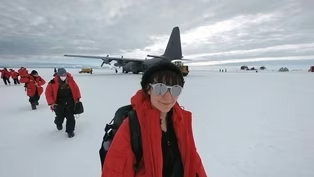
Weeks of equipment shakedowns, medical tests, and cargo logistics all blur into one long fever dream until you wake up to find yourself miles from home on a C-130 military aircraft, crammed in knee-to-knee with the other tired souls making the eight hour journey from New Zealand to Antarctica.
[guitar music] There are no window seats or in-flight entertainment.
There's not even really any seats, just cargo netting, a couple of portholes to peer through, and if you need to go to the bathroom, a literal bucket with a curtain around it is provided.
It's a loud, cramped, and fundamentally awkward experience.
Cleared for landing on a runway of compacted snow.
We lug our bags across the slippery terrain and prepare for the last leg of our journey into the frozen abyss.
[calm inquisitive music] Our final stop is a remote area 60 miles away that's only accessible by helicopter.
There are no roads, no runways, and no docks.
To get there, we must fly across Antarctica's expanse of sea ice.
The seemingly endless blanket of ice nearly doubles the size of the continent as it reaches out into the Southern Ocean each winter.
But in the summer, miles long cracks splinter the ice, giving penguins and seals an opportunity to take a break from swimming and bask in the 24 hour sunlight.
From the viewpoint of our helicopter, these animals appear as little more than tiny specks.
But you can spot them if you look closely.
Beyond the sea ice, our destination comes into view: the Dry Valleys.
[mysterious music] A polar desert so inhospitable that even the hardiest of penguins are unable to survive in this region.
Ice here is rare.
Instead, a deep brown expanse of earth stretches out for miles.
I'm here on a mission to study the animals that miraculously not only survive, but thrive in this extreme environment.
To find these creatures, though, requires looking even more closely.
I'm here in the Dry Valleys of Antarctica because it's one of the most unique places on the entire planet.
It's actually the largest area of Antarctica that's not totally covered in snow and ice.
And so it's a unique opportunity for researchers to actually be able to study the continent itself.
[calm orchestral music] Glaciers and frozen lakes freckle the region, but it's a rare place where the continent's enormous ice sheet yields to the epic landscapes carved beneath it.
And because it's a desert, it only receives an occasional l light dusting of snow.
Since 1993, the McMurdo Dry Valleys Long Term Ecological Research team has been continuously studying the terrestrial and aquatic ecosystems in this area.
They've measured how it's been growing warmer, wetter, and windier in just the last few years.
To tackle such a dynamic ecosystem, they enlist an interdisciplinary group of researchers to study everything, from the glaciers and their melt streams to the frozen lakes and even the wind.
I've arrived here as an embedded researcher on the Soils team, where we'll spend the next several weeks closely investigating the changes occurring in this environment.
This is part of the driest and windiest place on Earth, and temperatures here in the Dry Valleys can dip as low as -90F.
I thankfully haven't been here when it's -90F.
That would be really brutal.
Right now where I'm camping at, it's just me and six other people for as far as we can see, for the most part.
[serene piano music] This area is able to stay relatively ice free, thanks in part to the mountains behind me.
The Transantarctic mountain range divides the east and west ice sheets of Antarctica, and blocks a lot of them from entering this area.
Nearly all the mountains across the continent are buried under a mile or more of snow and ice, rendering them forever hidden from view.
But here, we can bear witness to their towering summits.
Along some of their peaks, intricate sculptures are carved into the rock by the prevailing winds, blowing bits of sand and ice into their exposed surfaces over centuries.
This particular one has been dub Gargoyle Ridge for the eerie, warped nature of its wind carved rocks that look over the valleys below.
For a continent shrouded in ice, getting to see the soil that otherwise lies hidden beneath all of it is a rare treat.
The rich shades of brown stretch across the valleys in stark contrast to the surrounding glaciers.
The Dry Valleys of Antarctica are really just a rich tapestry of soils.
The ground out here is millions of years old, largely untouched by humans.
I'm one of the very few.
But it's not untouched by sentient life.
The soils here are full of life.
Beneath my feet here, and really just even in handfuls of soil, there are all types of life here in the Dry Valleys.
From tardigrades and nematodes, rotifers, diatoms, all kinds of life.
And so much of it finds a home here in the soils.
[inquisitive synth music] How life survives in these polar desert soils is clever.
With limited access to water, these microscopic creatures are able to live inside a thin film of water that clings to small grains of sand in the summer months.
These otherwise aquatic animals have found a tiny oasis to stretch out and relax.
Chief among the tiny animal kingdom in this region is the tardigrade.
Also known as a water bear, these microscopic animals are able to survive extreme cold, drought, and low oxygen environments in a state of suspended animation, making them well-suited for life in Antarctica.
In the summer, when temperatures tick just above freezing, they reanimate and begin looking for food.
Unlike some tardigrades, who are a plant and bacteria eaters, this species is hunting for meat.
A carnivorous predator, Milnesium tardigrades prey on other animals, even sometimes feasting on smaller tardigrades.
This tardigrade is especially intimidating in size for the microscopic world, clocking in at three quarters of a millimeter in length.
Like a lumbering lion navigating the grasslands, it wades through the field to seek out its prey.
Unlike a lion, however, tardigrades can't follow their nose to a good meal because they don't have one.
They can't exactly see either.
Their eye spots are only able to make out light and dark, but not much detail.
Instead, this tardigrade uses the protruding bulbs on the end of its snout to feel out its environment.
A large nematode wiggling nearby could make for a significant snack.
[suspenseful music] It creeps closer to get a feel.
Tardigrades like this one have piercing mouthparts that they use to stab their prey and suck out their insides.
But this large of a nematode might just feel like more work than it's worth.
Oh well.
The hunt goes on.
[calm string music] In the harsh conditions of the Dry Valleys, microorganisms have developed strategies for how to survive by working together.
Along the shorelines of frozen lakes, clumps of what appears to be slime accumulate.
Known as microbial mats, they're formed by billions of bacteria and other living creatures assembling themselves together into a vibrant metropolis.
Within these micro cities, you can find the smallest animals that exist on planet Earth.
Microbial mats are an ancient form of life here on Earth that are able to really provide a home and a shelter for so many forms of life.
And it's in microbial mats that you find a whole host, a whole ecosystem, a whole Serengeti of microbial life.
And it's really exciting to look at.
[playful synth music] A Plectus nematode.
This one is moving a little slower than usual as it checks out its surroundings.
She's pregnant with seven eggs, which she will lay in due time.
If I bring up the lights under my microscope, you can see the eggs even better.
But these eggs aren't what you might think.
There are seven precise clones of herself.
Finding a mate in an extreme environment can be challenging.
So this nematode survives by simply making copies of herself.
It's not the only one that employs this survival strategy.
Rotifers are another microscopic animal that make their home in microbial mats of the Dry Valleys.
They're famous for their Roomba-like heads that they use to sweep in food.
This species' bright red color is theorized to come from their diet.
Much like flamingos turning pink from eating shrimp and algae.
Like the Plectus nematode, they too create clones of themselves.
However, their eggs hatch inside of them before they then give birth to live young.
They will carry their increasing active young around inside for a few days while they continue to search for food.
In another corner of a microbial mat is a tardigrade.
This particular species are herbivores and are endemic to Antarctica.
They like to feast on moss, algae, and bacteria, which are plentiful in microbial mats.
She's found a big, tasty treat.
This squishy orb is known as a Nostoc.
The long strands that look like a green pearl necklace are cyanobacteria, a form of photosynthetic bacteria.
They're held suspended in a protective, gelatinous sack of goo that makes up the Nostoc.
Now she just needs to find a way to open it up.
Her claws on all eight legs help her cling to the otherwise slippery surface while she searches for a weak point to bite through and slurp out the bacteria.
But this free lunch can prove tricky to penetrate.
Oh well, maybe next time.
In microbial mats, different types of microorganisms stratify into different layers.
More photosynthetic organisms higher at the top, but each layer of organisms helps provide nutrients and support to each other.
So you can think of it, I guess, as kind of a mini food chain in action.
[thoughtful string music] I kind of like to think of the microbial mats here as like a coral reef in the ocean.
They provide a protective shelter that a lot of different creatures are able to utilize and live harmoniously with one another in.
So in a way, Antarctica has its own coral reefs, but just in a much slimier version.
[serene string music] In a polar desert with no rain, the microbial mats here are primarily fed through a network of glacial melt streams.
In one part of the Dry Valleys, glacial melt streams join together to form the longest river on the continent.
Fed by an overflowing glacial lake, along with half a dozen glacial streams, the Onyx River stretches 20 miles, snaking across an otherwise arid landscape.
In its path, countless microbial mats flourish, each filled with billions of individual creatures like little galaxies spread out across the cosmos.
The exposed soils of the Dry Valleys regularly interact with the prevailing winds that are known to carry wayward microorganisms from nearby, but also, crucially, from far away.
Really, the soils out here are a connective tissue, both in Antarctica itself, to connect different parts of the Dry Valleys to one another, but it's also a connective tissue that connects it out to the rest of the world.
Tiny particulates kicked up into the air from dust and wildfires from one continent are able to make their way to the shores of another.
From space, NASA has tracked how smoke from increasingly large wildfires, like the one that ravaged Australia in 2020, can circumnavigate the entire globe and affect the atmosphere above Antarctica.
We can also see Antarctica's connection to the rest of the world farther back in time, in the depths of ice cores.
We've been able to actually trace back wildfires that happened long ago in New Zealand, 700, 800 years ago.
And we've been able to see the ash of those fires in glaciers here in Antarctica.
Crucially, recent research has shown that within the ash of wildfire smoke exists not only dead debris but also living microorganisms that can be transported through the air from one location to another.
So far, these atmospheric interactions with the rest of the planet haven't resulted in significant changes to the exclusive club of creatures that have lived in the Dry Valleys for thousands of years.
Antarctica's extreme cold and dry conditions act as a massive barrier, killing off microorganisms that get blown in from elsewhere.
But that barrier is expected to weaken in the future.
In a changing climate, we might get more microbes here in Antarctica, both because of the natural distribution of how our world is interconnected, but also because of increased wildfires.
And if Antarctica warms and becomes wetter, it might actually become more habitable.
And all those microbes that land here might one day be able to call this place home.
[wistful orchestral music] Any new additions to this well-protected ecosystem could alter it significantly.
Animals like tardigrades, rotifers, and nematodes may see increased competition for resources, or larger predators could wipe out entire species.
The story of climate change in this region of Antarctica is really about what happens when it's increasingly habitable.
This is why it's so exciting and also critical for me to be here right now, documenting the life and ecosystems of the Dry Valleys.
We're at a really important point in its history where things might begin to change.
They're expected to change.
And if we don't document the life and ecosystems and world that exist down here, we might lose things without even knowing about it.
And that would be really sad.
The story we so often tell ourselves of Antarctica as a barren and lifeless land begs to be rewritten.
[hopeful orchestral music] Our exploration of the continent has revealed it to be an oasis of life on our planet.
An abundance of exciting, strange, and delightful creatures worthy of our attention live here.
And we can see them, if we're willing to look from a different perspective.
[reflective piano music] ♪
Video has Closed Captions
Clip: Ep1 | 2m 56s | Getting to Antarctica is a long road. Life manages to thrive in this extreme environment. (2m 56s)
Video has Closed Captions
Preview: Ep1 | 30s | An explorer undertakes a solo Antarctic expedition to document the life beneath the ice. (30s)
Providing Support for PBS.org
Learn Moreabout PBS online sponsorship
- Science and Nature

Explore scientific discoveries on television's most acclaimed science documentary series.

- Science and Nature

Capturing the splendor of the natural world, from the African plains to the Antarctic ice.
Winnipeg In Bloom











Support for PBS provided by: