
Brooks and Capehart on Trump's warm welcome for China's Xi
Clip: 9/25/2026 | 10mVideo has Closed Captions
Brooks and Capehart on Trump's warm welcome for China's Xi Jinping
David Brooks of The Atlantic and Jonathan Capehart of MS NOW join Amna Nawaz to discuss the week in politics, including Chinese President Xi Jinping's state visit, President Trump's warm welcome for the Chinese leader and Trump banning some journalists from the White House.
Problems playing video? | Closed Captioning Feedback
Problems playing video? | Closed Captioning Feedback
Major corporate funding for the PBS News Hour is provided by BDO, BNSF, Consumer Cellular, American Cruise Lines, and Raymond James. Funding for the PBS NewsHour Weekend is provided by...
Brooks and Capehart on Trump's warm welcome for China's Xi
Clip: 9/25/2026 | 10mVideo has Closed Captions
David Brooks of The Atlantic and Jonathan Capehart of MS NOW join Amna Nawaz to discuss the week in politics, including Chinese President Xi Jinping's state visit, President Trump's warm welcome for the Chinese leader and Trump banning some journalists from the White House.
Problems playing video? | Closed Captioning Feedback
Where to Watch PBS News Hour
PBS News Hour is available to stream on pbs.org and the PBS app.
Providing Support for PBS.org
Learn Moreabout PBS online sponsorshipAMNA NAWAZ: Chinese President Xi Jinping wrapped up his visit to Washington today after a warm welcome from President Trump and high-stakes talks at the White House.
In the same week, Trump banned some journalists from the White House, citing reports he says threatened national security.
Their access was restored temporarily by a federal judge.
To discuss all that and more, we turn now to the analysis of Brooks and Capehart.
That is "The Atlantic"'s David Brooks and Jonathan Capehart of MS NOW.
It's great to see you both.
Jonathan, let's start with Chinese President Xi Jinping's visit.
He toured the National Archives today with President Trump before his departure.
But when he first arrived, Trump literally rolled out the red carpet for Xi.
There was a rare planeside greeting for the Chinese president, a lavish state dinner.
At the White House, we know they talked about trade and AI and Taiwan, but there wasn't much substance out of those meetings.
We haven't had a readout from the White House.
So, look, experts tell us it's good that they met, it's good they continue to talk.
If stability was the goal, was this mission accomplished on this visit?
JONATHAN CAPEHART: I mean, maybe.
It'd be great to read those, the readouts of those meetings and what they actually talked about and what plans they might have put in place for when they meet again.
I believe it's in no in November in China.
But it seems to me the President Xi came to Washington on very strong - - with very strong footing, in the sense that the president of the United States rarely, if ever -- and someone reported that it's usually for the pope that the president leaves the White House to go greet a foreign.. AMNA NAWAZ: Planeside on the tarmac.
JONATHAN CAPEHART: Planeside on the tarmac.
It's usually the chief of protocol or someone from the Protocol Office.
And I know this because my husband used to be assistant chief of protocol during the Obama administration.
And so for -- it's one thing for the president to literally roll out the red carpet.
It's another for him to do that and be at the airport.
So I wonder, going into these meetings, who had the stronger hand?
And it's quite sad that I can't say the United States really went in there and argued hard on -- argued hard on AI, Ukraine, Iran, trade.
It's a whole host of things to talk about.
And I have no confidence that the United States is any better -- in a better position now than before President Xi got here.
AMNA NAWAZ: So, David, Jonathan is articulating some concerns we heard from other regional watchers and experts.
They say the pageantry and the fanfare has them believing that the U.S.
is treating its adversaries better than it's treating its allies.
How do you see it?
DAVID BROOKS: Well, it is the most important relationship in the world right now.
So I'm sort of glad Trump went out there and met him at the airport, standing up on -- there on the other side of TSA with a name card thing.
(LAUGHTER) DAVID BROOKS: But I -- like Jonathan, I worry that this is all just a spectacle.
And then this is the problem with the no -- Trump policy process.
This is the most important relationship, and yet are we making progress on trade?
Are we making progress on economy?
Are we making progress in Taiwan?
And, to me, the most urgent issue is AI.
We only regulate AI if China and America come together and issue some joint regulations.
And yet I'm very dubious we're going to be able to do that.
And the independent journalist Derek Thompson did some reporting on this, and he wanted to know what -- in the Chinese community, what do they think about AI?
Are they as alarmed as we are?
And the answer tends to be no.
The Chinese scientists and the Chinese community is not as interested in AGI, artificial general intelligence, as we are, and they're not as much freaked out about it.
They're also not as freaked out about it as recursive self-improvement, which is that -- when the bots begin to train themselves.
That's when they really get out of control.
And I think, since the Hugging Face thing, that's what Americans are really concerned about.
Apparently, the Chinese community is not as worried about that.
And so we may not -- it may not only be a leadership thing.
It may be the two communities are not seeing the situation in the same way.
And if we don't get together on AI, in my view, that's tremendously bad news for the world.
AMNA NAWAZ: I also want to underscore, Jonathan, this was the same week that President Trump banned reporters from three outlets, CNN, Politico, and your outlet, MS NOW, from the White House.
JONATHAN CAPEHART: Right.
AMNA NAWAZ: He said White House access is a privilege.
He cited national security concerns.
They sued.
A judge sided with them.
I believe some still had trouble getting back into the White House on Thursday morning.
But Peter Baker of The New York Times called it a surreal week in Washington.
He wrote this: "The president of the United States barred American reporters because he labeled them a threat to national security, while welcoming Chinese reporters who answer to the communist dictatorship in Beijing."
How did you look at all this?
(LAUGHTER) JONATHAN CAPEHART: Everything is upside down, Amna.
One, covering the White House, access to the White House is a right.
It is a public facility.
The press is the only profession protected in the Constitution because of our role of informing the citizenry.
And so this is another example of the president sort of warping what it means to be in the White House, to be president of the United States.
Our journalists, all journalists should be there.
And I was actually very heartened to see the White House press pool leave - - excuse me -- in solidarity.
So -- and I'm glad that our network, CNN, Politico, and others pushed back again against this.
But the other thing that I found fascinating is that the president chose to pick this fight with the press in probably one of the most consequential weeks for him in his presidency.
He had the unveiling of his new helipad that he would have loved to have had pool coverage.
Then he went to New York for the United Nations General Assembly, and no press pool around him to chronicle him being a leader on the world stage.
Then he comes back for the state visit of President Xi.
Now, there was some maneuvering and the reporters got back.
But this is a president who lives on television.
He's watching it.
He wants to see himself on it.
And this is a moment -- this was a moment when pictures, television would have been supreme for him, and this was just a cell phone, what he did.
AMNA NAWAZ: David, how did how did you look at this?
We should note Trump at one point praised the Chinese-controlled press as the friendliest press as well.
Did that split-screen moment strike you?
DAVID BROOKS: Yes, I'm sure he'd love to have a state-controlled press in this country just as much.
Yes -- and I Jonathan mentioned it's a -- it's our house.
It's not his house.
And so the public should have a right to choose.
And then, most importantly, this is a democracy.
You have to have some respect for the people.
And if people want to watch MS NOW or CNN or anybody else, and you want to talk to the people, you have got to have those outlets.
And so it's just ridiculous and outrageous that he would ban these places.
But if I could vent one pet peeve about us, starting in 2015, we in the mainstream media learned that, if you bash Donald Trump, the clicks go up, the ratings go up.
It became the business model.
And I'm not saying we're -- we play it straight.
We do our job, but it's become the business model.
And I get -- we get to go, or at least to dinners, sometimes off-the-record dinners between journalists, columnists, and politicians.
And I would say, over the last two years, used to be, when you were at a dinner, an off-the-record dinner with the Democratic politician, there was distance between the journalists and the Democrats, because they're politicians.
Our job is to keep some distance.
In my view, at many places and in many of the dinners I have been to, there's no distance anymore.
And that is a problem for the media.
And that is our problem.
We have got to reestablish some distance from the Democratic Party.
These are people we cover.
They're not people we root for.
They're not people we're spin doctors for.
They're people we cover.
And I do think we have done a not ultimately excellent job at maintaining as much distance from the Democrats as we keep from the Republicans.
AMNA NAWAZ: There's a whole lot there I hope to unpack in more conversations.
I know we need to talk about this a lot more.
But before both of you go, I do want to put to you some of the new findings from our new PBS News/NPR/Marist poll that was out this week.
We saw some expected divides there when it comes to how people are voting for their congressional members, a lot of MAGA Republicans saying they're voting to support Trump, Democrats voting to oppose him.
Jonathan, it was the independents number that struck me.
More than half of independents said they're planning to cast their congressional vote to oppose the president.
And when we asked about the issues specifically, Democrats now have the advantage on every issue we asked about.
That includes the economy and immigration.
What do you take away from that?
JONATHAN CAPEHART: Well, the president said in South Carolina a few weeks ago to his supporters, pretend I'm on the ballot.
Just pretend I'm on the ballot.
And we have seen poll after poll after poll, including this one most starkly, that, yes, people think that he's on -- he is on the ballot.
And they don't like what they see, and they're letting pulse the pollsters know.
AMNA NAWAZ: David, we have got about 30 seconds left.
I will give you the last word here.
What do you take from these numbers?
DAVID BROOKS: Three quick lessons.
First, when the electorate turns against the party in power at the last minute, it tends to turn really hard, way more than the polling shows.
And that's what's happening, turning against Donald Trump.
Second, when the economy is bad six months out, it's bad for the for the president, and that's what's happened.
And, finally, you look at Texas, Talarico's doing really well.
You look at Michigan, El-Sayed is doing really well.
I think we're looking at a wave.
AMNA NAWAZ: David Brooks, Jonathan Capehart, great to see you both.
Thank you so much.
JONATHAN CAPEHART: Thanks.

GOP's bet on Texas Latino voters could backfire in midterms
Video has Closed Captions
GOP's big bet on Texas Latino voters could backfire in midterms (5m 50s)

Health care costs a concern for voters ahead of midterms
Video has Closed Captions
Health care costs a major concern for voters ahead of midterms (6m 34s)

Mexico's foreign secretary on Trump and U.S. trade talks
Video has Closed Captions
Mexico's foreign secretary on Trump, cartel violence and U.S. trade talks (6m 13s)
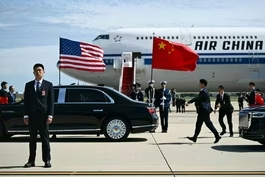
News Wrap: Xi wraps up 3-day state visit with Trump
Video has Closed Captions
News Wrap: Xi wraps up 3-day state visit with Trump (6m 30s)

Syrian dancer escaped ISIS and found freedom through ballet
Video has Closed Captions
Syrian dancer reflects on escaping ISIS and finding freedom through ballet (5m 37s)

What Supreme Court's SAVE database ruling means for midterms
Video has Closed Captions
What the Supreme Court's voter-citizenship database decision means for the midterms (4m 24s)

Wrongfully detained journalist still jailed in Iran
Video has Closed Captions
Wrongfully detained Iranian American journalist remains jailed in Iran after 2 years (6m 6s)
Providing Support for PBS.org
Learn Moreabout PBS online sponsorship New Episode
- News and Public Affairs

Today's top journalists discuss Washington's current political events and public affairs.
 New Episode
- News and Public Affairs

FRONTLINE is investigative journalism that questions, explains and changes our world.
 New Episode
 New Episode
 New Episode


 New Episode
 New Episode

 New Episode
Support for PBS provided by:
Major corporate funding for the PBS News Hour is provided by BDO, BNSF, Consumer Cellular, American Cruise Lines, and Raymond James. Funding for the PBS NewsHour Weekend is provided by...