
Evolution: Brain Power
Season 53 Episode 13 | 53m 39sVideo has Audio Description
The story of the dolphin reveals how intelligence evolved, step by step, over billions of years.
Intelligence is the defining trait of our species. Discover how our sophisticated human brains—and those of our clever animal cousins like the dolphin—evolved from the time when our ancestors were tiny senseless sea creatures.
See all videos with Audio DescriptionADProblems playing video? | Closed Captioning Feedback
Problems playing video? | Closed Captioning Feedback
National Corporate funding for NOVA is provided by Carlisle Companies. Major funding for NOVA is provided by the NOVA Science Trust and PBS viewers.
Support provided by:


Evolution: Brain Power
Season 53 Episode 13 | 53m 39sVideo has Audio Description
Intelligence is the defining trait of our species. Discover how our sophisticated human brains—and those of our clever animal cousins like the dolphin—evolved from the time when our ancestors were tiny senseless sea creatures.
See all videos with Audio DescriptionADProblems playing video? | Closed Captioning Feedback
Where to Watch NOVA
NOVA is available to stream on pbs.org and the PBS app.
Buy Now
NOVA Labs
NOVA Labs is a free digital platform that engages teens and lifelong learners in games and interactives that foster authentic scientific exploration. Participants take part in real-world investigations by visualizing, analyzing, and playing with the same data that scientists use.Providing Support for PBS.org
Learn Moreabout PBS online sponsorshipNARRATOR: It's the most enigmatic structure in all of biology.
The brain is everything that we are.
♪ ♪ It's headquarters, it's, it's mission control.
NARRATOR: Though we still don't fully understand how brains work.
SEAN CARROLL: The number of connections is incredibly daunting.
They're still, in many ways, black boxes to us.
NARRATOR: Scientists are beginning to understand how they evolved.
LARS SCHMITZ: I think intelligence is perhaps unavoidable, in terms of evolution.
NARRATOR: The role played by the senses... JESSICA WARE: Visual systems would definitely drive the evolution of a brain.
NARRATOR: The chance events that rewired ancient brains.
ROBIN FRANKLIN: The virus led to a quantum change in the sophistication of the brain.
NARRATOR: And the evolutionary forces that boosted problem-solving powers.
BHART-ANJAN BHULLAR: Relentlessly, brains are driven to expand and become more and more and more elaborated.
NARRATOR: How did brains, as we know them, come to be?
"Evolution: Brain Power."
Right now, on "NOVA."
♪ ♪ ANNOUNCER: Major funding for "NOVA" is provided by the following: ♪ ♪ (birds chirping) NARRATOR: One of the most successful families of mammals isn't found on land.
♪ ♪ They live in Earth's oceans.
(echolocating) ♪ ♪ (echolocating) BHULLAR: Dolphins have taken the ancestral mammalian body form, which is a land-adapted body, and made it into something that's exquisitely designed for moving around in the water.
Dolphins can slow their heart rate when they're diving, so they use less oxygen.
MARK UHEN: They have a sensory system called echolocation.
(echolocating) They send out pulses of sound and they listen to the echoes and they perceive their environment.
They can see with sound.
(echolocating) NARRATOR: Dolphins are actually a type of toothed whale.
And though their physical adaptations to life under the waves are impressive... ...there is something even more extraordinary about them.
BHULLAR: Dolphin behavior, if you observe it for any length of time, just screams intelligence.
KIERSTEN FORMOSO: They're very social, they learn from each other, they teach each other.
They have a system of communication which appears very much as if it's language.
(echolocating) They plan, strategize, collaborate, coordinate with other members of their group and that takes enormous cognitive ability.
They are thinking.
They're playful as well, which is something which we strongly associate with human intelligence.
♪ ♪ CARROLL: They almost seem like they're enjoying themselves in the water rather than just making a living.
UHEN: Intelligence is a very elusive concept-- it's very difficult to measure, even among humans, much less between humans and animals.
NARRATOR: Though intelligence might be hard to define, scientists agree humans aren't the only ones that have it.
BHULLAR: There is absolutely no question in my mind that dolphins are among the most intelligent animals ever to have lived.
NARRATOR: Underpinning dolphin intelligence is an extremely complex brain.
One of the largest in comparison with their body size of any mammal on Earth.
So, how did dolphins come to be so smart?
♪ ♪ To answer that question, we need to turn back the clock... ...and meet the ancient relatives of the dolphin whose minds were reshaped by their struggle for survival.
Uncover the forces that led to the earliest brains, and discover how the first senses put life on the long road to intelligence.
This is the amazing story of how the dolphin and its giant brain came to be.
♪ ♪ The story of intelligence begins long, long ago.
Long before the first spark of thought.
Before there were even animals on the planet.
Mostly simple single cells live in these oceans, and they quite literally do not have a single brain cell between them.
Yet... ...there is a process underway here that in time will come to be intimately tied with the evolution of the earliest minds.
Something that may seem simple, but around three billion years ago, is revolutionary.
♪ ♪ These cells can sense the light of the sun.
If an organism can't sense light, then essentially it doesn't have any sense of the rhythm of the Earth, right?
Sunrise, sunset, and that's gonna have a lot of effects on, you know, temperature conditions, the immediate environment that that cell finds itself.
So just being able to sense light, that would be a huge, huge step in evolution.
RICHARD WINGATE: If they're photosynthetic cells, they could move towards a source of light, and that light's going to provide them with energy.
But moving away from the light might be an advantage as well.
Sunlight, we may perceive it as very nice and pleasant, actually contains harmful radiation, the UV radiation.
With the ability to sense light, these single cells could detect if that light was present and could move away from that light.
NARRATOR: Key to these ancient cells being able to sense light is a molecule called retinal, which changes shape as it absorbs a photon of light.
This acts as an on or off signal, which tells the cell to move.
WARE: Sensing light and being able to move away from it, um, that is a behavior.
I don't think there's any real computation involved.
It's, it's kind of fundamentally chemistry.
NARRATOR: It may be simple, and it certainly isn't thinking, but three billion years ago, this ability to sense light with retinal, will change everything.
WINGATE: Once retinal is in play, we have a molecule which allows early cells to detect light that they can then respond to, and that eventually leads to more complex behavior and possibly the development of the brain itself.
NARRATOR: Sensing light had set life on a new path.
♪ ♪ Over the next two-and-a-half billion years... ...life diversifies.
From single-celled to multicellular forms.
And along with some of the earliest animals... ...the first nervous systems arise.
♪ ♪ This tiny, soft bodied creature is, unbelievably, a distant ancestor of the dolphin.
And it's searching for a place to hide.
Not from any predator, but from the punishing UV radiation of the rising sun.
Thanks to retinal, it can still sense the light intensifying.
Retinal found in two simple spots at the front of its body, known as eye spots.
An eye spot is just like a collection of light sensing cells that are kind of clustered together in one place.
These eye spots would have been connected to excitable cells, primitive neurons, nerve cells, which would have allowed information about light in the environment to be transmitted from the eye spot to the rest of the animal.
That light signal is essentially like a stoplight, you know, green, go, you know, red, stop, in terms of the movement of the animal.
And so this is a simple behavior, but important behavior, because it can determine the orientation of the creature and where it is in the water column and things like this.
WINGATE: This process doesn't require any huge evaluation of the signals, but it's getting close to the beginnings of thought.
NARRATOR: Yet among this population of shade-seeking animals, the dolphin's ancestor has a slight edge.
It has inherited a series of mutations.
Genetic changes which mean that instead of being flat... ...its eye spots cave ever so slightly inwards... ...becoming little dimples.
This difference might seem insignificant.
But it is in fact a superpower.
So if we look at a flat plate like this, and I shine a light on it, when the light's on the plate, it's fully illuminated.
But when I rotate it, the light switches off completely.
And then I rotate back again, and it's fully illuminated.
So, by contrast, this is a curved surface.
As the curved surface starts to move, you see shadows appearing and you can kind of sense the direction of the light, 'cause the light is not going to be bathing the entire surface at all times.
SCHMITZ: The significance of having an eye spot with a slightly curved surface is huge.
This is the first step of allowing these animals to have a sense of where more precise light is coming from.
In a way that is a big step towards real vision.
NARRATOR: Little dimples like these ones may well have been the first simple eyes.
(birds chirping) It's an intriguing theory.
But one for which there is no fossil evidence.
♪ ♪ CARROLL: The early stages of eye evolution were happening in soft, small creatures that don't fossilize very well.
So, we're not going to have, you know, a perfect historical record.
NARRATOR: However, fossils aren't the only clues available to scientists studying evolution.
Oh, wow.
This species of butterfly, we call them morpho.
If you see their eyes, like most insects, they're made of many different lenses.
This is what we call compound eyes.
NARRATOR: For tropical biologist, Stephanie Valle Cubero, Costa Rica's jungles are a paradise for studying eyes.
CUBERO: This is a poisonous frog.
Their eyes are just like our eyes-- they have just one lens and this is what we call camera eyes.
NARRATOR: But one animal here can offer insight into what vision was like over half-a-billion years ago.
Velvet worms are very, very bizarre.
That name, velvet worm, comes from the fact that they have this soft, velvety skin.
However, the problem that they have is that because they breathe through their skin, they can lose humidity as they're breathing.
NARRATOR: To keep their skin moist, velvet worms seek shady places to hide.
Something they do using their unusual eyes.
CUBERO: So, if you look at a velvet worm, the eyes are just beneath these antennae on the base.
It's these tiny, tiny pinpricks.
Tiny black spots that you see right on the base of the antenna.
NARRATOR: The velvet worm doesn't have complex camera eyes.
Instead, it has simple eyes, similar in function to those thought to exist over half-a-billion years ago.
And these eyes give the velvet worm basic vision.
Here I have a video where we can compare the way we see the world on the left, and the way a velvet worm would perceive the world on the right.
Instead of seeing all the details of the objects around it, the velvet worm sees a very blurry image.
However, this image does allow for the velvet worm to perceive where there is more and less light, to find spots where there isn't as much light and where it can avoid dehydration, which is actually what the velvet worm needs to be able to survive.
♪ ♪ NARRATOR: Eyes like those of the velvet worm suggest that the dolphin's ancestor can also see blurry images.
And the theory goes that compared to the others of its species, this vision allows it to more rapidly find a place to shelter.
An advantage that is passed on.
So, over the years, further mutations drive the dimples to become deeper.
Protective cells grow over the opening, forming a lens, which focuses light onto a layer of light sensitive cells we now call a retina, producing a sharper image.
Over countless generations, simple eye spots transform into one of the most complex biological instruments evolution has ever produced.
Eyes, as we know them, have arrived.
♪ ♪ Over millions of years... ...eyes begin to appear across the animal kingdom.
And by the Cambrian Period... ...complex eyes are everywhere.
♪ ♪ Coming in many forms... ...and many numbers.
Eyes change the dynamics of life entirely.
Because if animals can see the world more clearly... ...they can see one another.
Meaning life is no longer just focused on seeking shade.
It is now about strategy.
♪ ♪ (birds chirping) Paleontologist Karma Nanglu studies fossils from the Cambrian Period.
NANGLU: During the Cambrian, we see a huge diversity of eyes start to develop.
And a big part of this is the relationship between predator and prey.
So as one group starts to develop larger and more complicated eyes to see the other, the other groups like the prey might develop larger eyes to sense their predators and escape them.
One of the first groups of animals to evolve eyes are the trilobites.
So this is a trilobite from Utah.
It's about 506, 507 million years old, called "Elrathia kingii."
And we can see all sorts of beautiful features on the surface of this fossil.
But one of the most notable ones are two very prominent eyes.
Here is a fossil from China called "Lyrarapax."
And really most notable in this fossil... ...is the front, where you can see two very prominent eyes that are preserved very darkly here.
NARRATOR: But Cambrian fossils don't just give us the first tangible evidence of complex eyes.
NANGLU: These dark bands running towards the center are what we think are actually neural tissue.
And in the center then we have a large, sort of, blob-like area, kind of like a dark blue color.
That's the central nervous system or brain.
♪ ♪ The idea that you can have such exceptional preservation of any of these animals from so long ago that we can actually get a direct look at their brains is really astounding.
And honestly, it's pretty much a minor miracle every time one of these fossils is uncovered and described.
NARRATOR: It's no coincidence that on the rare occasions fossilized brains are found, eyes are often found, too.
WARE: Vision is a lot of information, right?
So vision involves color, it involves light, it involves direction, it involves movement.
CARROLL: And that information starts to need to be processed by something like the brain.
♪ ♪ SCHMITZ: There must be a very strong relationship between the evolution of complex eyes and complex brains.
If you had the best optics and the best camera in the world, if you wouldn't know what to do with the information, it would be useless.
NARRATOR: Though other senses such as touch and smell also helped drive the evolution of early brains, scientists believe vision played a major role.
♪ ♪ Today, the world is full of different kinds of complex eyes and brains.
Attuned to perceive the world in whatever way is most useful to them.
Compound eyes give a wide field of view to smaller brains.
♪ ♪ Giant camera eyes gather information in the darkest depths.
And forward-facing eyes help some of the largest brains judge depth as they navigate their jungle homes.
♪ ♪ But half-a-billion years ago, animals and their newly evolved brains, are just waking up to the world around them.
Leaping forward 75 million years, as the ancestors of insects begin colonizing the land... ...under the waves... ...brains are getting more complex.
Welcome to the Silurian.
Where some fish have now evolved into hunters.
This fierce looking creature is a primitive form of a placoderm.
A group of fish for whom the predator-prey arms race is so acute... that it has changed the way their entire bodies are built.
NANGLU: This is a fossil of a placoderm called "Coccosteus cuspidatus," and it's a really beautiful fossil.
It was discovered in Scotland, and what you can see is basically the entirety of its body is preserved.
You can see a very long looking tail.
You can see actually little bits of what looks like a dorsal fin.
And so, from that perspective, very much like a modern fish.
NARRATOR: But there is one feature above all that makes placoderms special.
The whole head region is covered in these bony plates that would have served as armor to protect some of the softer, more sensitive parts of the animal's body like its eye, but ultimately, that most important part of the animal, which is its brain.
NARRATOR: Placoderm fossils have been found on every continent on Earth.
Coming in many shapes and sizes.
All with heads covered in thick armor to protect their precious brains.
GILES: Placoderms are the sister lineage to living, jawed vertebrates.
And they can tell us a lot about brain evolution because inside their thick armor, they have a proto skull that surrounds the brain.
NARRATOR: Though the brains of placoderms are seldom preserved directly, the cavities left inside their proto skulls are.
And they can be studied, thanks to an innovative, modern technique.
BHULLAR: There is no modern study of the brains of fossil animals without CT scanning.
♪ ♪ You would have to utterly destroy a fossil, a fossil skull, to get at the brain cavity.
Even then, whatever you did would be a very incomplete reconstruction, but, with CT scanning, effortlessly, with no damage to the fossil, we can see inside all of these spaces.
GILES: After we CT scanned the placoderm, we can use that 3D data to build up a 3D model of the internal structure.
Here is a 3D print of a placoderm brain.
So these two bulges here, these are the cerebellum, so this is the part of the brain that's involved in cognition, in thinking, and in movement.
These are really large, so placoderms are the first group of animals to have this really developed cerebellum.
These are the semicircular canals, which are used for balance and orientation.
These are cranial nerves.
So, they link the brain to the different organs.
So, this one here is called the optic nerve, and it links the brain to the eye.
So, taken together, this tells us that placoderms had really sophisticated brains, even though they lived 400 million years ago.
They were much more developed than brains from animals that diverged from the evolutionary tree just a few million years earlier.
NARRATOR: There is a theory that part of the reason for this leap in brain complexity... ...was a bizarre fluke of biology that happened in the ancient seas.
♪ ♪ Despite its armor, this primitive placoderm has been attacked by a tiny invader.
A virus.
One whose impacts would ripple through time.
Viruses are really curious entities.
They contain many of the components that you would find in a living cell, and yet they are not themselves living.
And the reason being is that by themselves, they can't make copies of themselves, and being able to replicate is one of the definitions of being alive.
WARE: So, viruses, in order to replicate themselves, they go into the living cell and they're kind of hijacking the living cell's machinery to make copies.
Eventually, they've made enough copies that now they want to go and infect the next living cell, and in order to do that, they burst out of the cell and that actually can kill the cell.
That triggers an immune response, and that's why we end up with kind of a runny nose and sneezing and all of the things you might expect from the common cold.
NARRATOR: But other viruses use a more sophisticated approach.
Retroviruses are a very cunning type of virus.
What they do is they enter the cell and then put their genes into the DNA of the host cell, and then use that as a mechanism for making copies of themselves.
NARRATOR: But it's on the rare occasions that retroviruses infect the cells that give rise to eggs and sperm that they have the longest lasting impact.
That means that bit of retroviral DNA will get propagated or transmitted from one generation to the next.
NARRATOR: Luckily for this ancient fish, her immune system kicks into gear, and she recovers from the immediate effects of the infection.
But because the virus is a retrovirus, she never quite clears it from all of her cells.
And by chance, it makes its way into her eggs and is integrated into her offspring's entire genomes.
Over generations, the hidden viral DNA does something extraordinary.
♪ ♪ It triggers one of the fish's genes to go into overdrive.
Altering the way neurons develop.
Causing areas of the brain to fade from grey, to eerily pale.
But these new pale areas aren't damaged-- instead, they change how the brain functions forever.
When we look at brain scans, there are two obvious regions.
There's an outer layer of grey matter, which is where the neuron cell bodies sit and where they make connections with other brain cells.
And then on the inside, there's white matter.
FRANKLIN: The reason the white matter is called white matter is because the nerve fibers are covered in a fatty insulating material that we call myelin.
NARRATOR: Myelin coats the long fibers of neurons, called axons, in the body, as well as the brain in structures known as myelin sheaths.
FRANKLIN: Myelin sheaths are lined up along a nerve fiber, like a string of sausages, and the impulses are actually generated between the myelin sheaths, so the gaps between the sausages on the string.
Without a myelin sheath, an impulse will move along a nerve fiber very slowly-- badoom, badoom, badoom, badoom, badoom, badoom.
With a myelin sheath, it whizzes along the axon-- b'dum, b'dum, b'dum, b'dum, b'dum, b'dum.
And the increase in speed of impulse conduction is about 200-fold.
♪ ♪ NARRATOR: It's thought the retrovirus infection that led to the evolution of myelin happened many times, across several vertebrate lineages.
And it was a gamechanger, as faster conduction times meant bodies could grow bigger.
♪ ♪ (birds chirping) But the evolution of myelin had another profound effect on vertebrate life.
(squawking, trilling) So, throughout evolution, there has been a very great pressure for impulses to be transmitted along nerve fibers more rapidly.
The invertebrates have come up with a solution of making impulse conduction more rapid, by making the nerve fibers bigger.
And that reaches its zenith in giant squids, where the largest nerve fibers are about a millimeter in diameter.
NARRATOR: In contrast, the widest nerve fibers found in jawed vertebrates are up to one-tenth of a millimeter.
Myelin means they are far less reliant on thick neurons to achieve fast conduction.
(splashing) So, there is a huge advantage in terms of saving space.
So, when myelin appeared, it led to a quantum change in the sophistication of the brain, like the invention of microprocessors in computing.
WINGATE: It's possible that we would not be able to have any form of conscious decision-making without myelin.
Myelin enables rapid thought to transfer across the brain, and that's what consciousness relies on.
The best you could do would be an octopus brain... which is quite sophisticated, but it hasn't written Shakespeare's sonnets or, you know, got us to the moon and back.
(burbling) ♪ ♪ NARRATOR: Armed with turbocharged nervous systems, jawed vertebrates get bigger.
And survival strategies grow more complex, leading some to leave the oceans entirely.
On land, they are faced with an unfamiliar world.
And as they adapt, their brains are forced to reshape once more.
FORMOSO: Compared to today, the Triassic was a vastly different environment.
The continents were smashed together in a great continent called Pangaea.
BHULLAR: Pangaea was especially warm and dry, or arid.
And in those conditions, there is a... a heightened struggle for existence, because of the scarcity of all kinds of food.
NARRATOR: During the Triassic, on land, two notable vertebrate groups included the archosaurs, meaning "ruling reptiles" in Greek, and the cynodonts.
BHULLAR: During the Triassic, the archosaurs truly became ruling reptiles, in that they rapidly became much larger, and they started to diversify, and one part would be the dinosaur line.
(growls) Some of the cynodonts responded very differently.
They evolved smaller and smaller body sizes, which helped them be more efficient in a world with limited resources.
So what I have here is a skull of one of these animals.
This is a kind a cynodont called a Thrinaxodon, and as you can see, it's really small.
This would have probably been about the size of a rabbit.
FORMOSO: And so imagine what it was like being a cynodont in the Triassic.
You're this tiny little thing in this world of big, scary reptiles.
♪ ♪ NARRATOR: This little creature is one of those cynodonts, and an ancestor of the dolphin.
(cynodont squealing) She's hungry, but she knows the archosaurs patrolling outside are hungry, too.
But as night falls, the threat seems to lessen.
She's spotted an opportunity.
♪ ♪ Cynodonts seem to have dealt with the existence of huge imposing reptiles by separating themselves, and part of the separation was their development of the ability to burrow... but it may well be that during this time too, Cynodonts became increasingly nocturnal, or active in the night.
(cynodont snuffling) FORMOSO: So, cynodonts would forage for food at night, when it was safe.
NARRATOR: But of course, the sense that had helped drive much of the evolution of the brain-- vision-- was now much less useful.
In becoming nocturnal, cynodonts' senses had to do very different things.
BHULLAR: So, you can imagine a big population of little snuffling cynodonts.
And some of them might have had, genetically, a somewhat greater ability to find their way around using touch, or slightly better senses of smell.
And if those things conferred some kind of advantage that would ultimately allow those individuals to be more successful in reproducing, then eventually those characteristics would come to be present in most or all of the population.
FORMOSO: And so, with these changing and improving senses, there was so much more information, and thus more evolutionary pressure on the brain to develop in tandem.
(rustling) NARRATOR: It was this flood of new information, gathered by senses sharpening to the night that scientists think helped drive a monumental change in the brains of those cynodonts.
♪ ♪ Over tens of millions of years, the brain changes shape.
Areas involved in smell and touch expand.
And the brain increases in size by over 40%.
And to process all the extra information, a game-changing region of the brain develops.
And alongside it, a new type of animal emerges.
FRANKLIN: So in this little bottle here is the preserved brain of a rabbit, which is, of course, a modern mammal.
This large bulbous part that we see here is called the neocortex.
This is a uniquely mammalian part of the brain.
The neocortex contains a bewildering number of neural circuits.
It's the area of the brain that allows them to process all that additional really complex sensory information.
WINGATE: Here is the brain of a boar, which is a member of the pig family, and what you can see is that the neocortex is highly folded.
And this means that the surface area is much larger, which means that you can contain many more neural circuits and therefore a much greater level of sophistication in neural processing.
NARRATOR: Though it was driven to expand in part by improving senses of smell and touch, today, the neocortex does much more than aid in sensory processing.
Mammals... the group of animals with a neocortex, have an enormous range of complex behaviors that are really unmatched almost anywhere else among vertebrates.
MARINO: The neocortex is generally involved in very high-level processing.
Self-awareness, social cognition, some forms of memory, problem solving.
FRANKLIN: So, the evolution of the neocortex was absolutely essential for what we think of now as the high intelligence of mammals.
NARRATOR: Of course, today, mammals aren't the only ones to display higher levels of intelligence.
Other groups have taken their own evolutionary routes to problem-solving brains.
(cracking) But for mammals, the neocortex has been truly transformational.
♪ ♪ BHULLAR: It's interesting, because the neocortex in particular is incredibly expensive energetically, both to develop and to maintain.
But I think that the power of being able to think your way through problems is just so immense, that the advantages conferred by that power override nearly any cost that you can imagine.
♪ ♪ NARRATOR: Fast forward through the next 150 million years.
♪ ♪ Fueled by warm blood and milk, mammalian brains keep developing, until... it's the mammals' turn to take center stage.
♪ ♪ Then, 50 million years ago, we find one lineage... on the verge of an extraordinary metamorphosis.
♪ ♪ This little mammal is called Indohyus.
The size of a domestic cat, with spindly, deerlike legs and the snout of a dog.
Quite frankly, she's a bit of an oddball.
Tiptoeing on her little hooves, she's on the lookout for lunch.
♪ ♪ (cawing overhead) But she's not the only one.
As a small herbivore, she would be easy pickings for the giant predatory birds that circle above... if it weren't for one advantage scientists think Indohyus has on her side.
This is a thigh bone of Indohyus, and from the size, you can tell that this was a small animal, this is actually similar in size to the thigh bone of a cat.
In addition to these complete thigh bones, we also found some broken ones, so here's the same bone, but now the broken part.
And yet this is very important for us, because on the cut section of this bone, you can tell that the outside of the bone is very thick.
♪ ♪ NARRATOR: Compared with related species, the leg bones of Indohyus are unusually thick, making the bones heavy.
FORMOSO: As far as the purpose of the heavy leg bones of Indohyus, we have clues in the animal kingdom when we look at the bones of hippos.
(splashing) MARINO: Hippopotamus have heavy leg bones, and it helps them to move along by walking on the bottom of a lake, and I think it's possible that Indohyus did the same thing.
NARRATOR: Scientists think that for Indohyus, water is a refuge.
♪ ♪ And for the individuals most adapted to an aquatic lifestyle, this new world also offers up plenty of new food sources.
♪ ♪ So, over generations, Indohyus's relatives become more streamlined.
Limbs gradually transform into flippers.
Nostrils migrate farther away from their long snouts.
Tails get flatter and more powerful, in one of the most remarkable transformations in the history of life on Earth.
♪ ♪ KEL MELILLO SWEETING: So, in just 10 to 15 million years after Indohyus, the little deer-like creature at the edge of the water, we have this massive aquatic predator.
NARRATOR: Biologist Kel Melillo Sweeting studies the behavior and communication of marine mammals.
Here is a model skull of Dorudon.
It's no longer breathing out of the tip of its snout.
Its nostrils have shifted farther up, closer to the eyes, to be more efficient.
So that it can stay submerged while it takes a breath.
It's living its entire life in the water.
The transformation from Indohyus to Dorudon was incredible, but in only a few more million years... Simocetus.
NARRATOR: Simocetus belonged to a group of pioneering marine mammals.
The first toothed whales.
A group who developed an extraordinary new sensory capacity.
SWEETING: It has this concave area at the front of its skull.
This is suggestive that it had space for an organ called the melon.
The melon is a fatty tissue, and is indicative of echolocation.
♪ ♪ NARRATOR: The melon allowed Simocetus to focus the soundwaves of its echolocation calls.
♪ ♪ A vital body part that has been passed down... (dolphins squealing) ...allowing Simocetus's modern relatives to echolocate today.
(dolphins clicking) ♪ ♪ We've got dolphins at 3:00.
Some dorsal fins and they're coming to the boat.
They're coming, and they're riding the bow.
Oh man, they are so graceful.
(dolphins clicking and squeaking) It's just amazing to see them this close.
(dolphins clicking) Dolphin communication is very complex, just as our communication is very complex.
You have friendships between individuals that extend over not just days or weeks, but over years, allowing information to be passed on between individuals and also passed down through the generations.
NARRATOR: Tens of millions of years ago, as the ancestors of these dolphins took to hunting together, their brains began to change.
Regions likely involved in bonding, emotions, and communication underwent rapid expansion.
Meaning that today, the dolphins' most remarkable adaptation of all is the one hidden inside their skulls.
GILES: So, this is the, the brain of a common dolphin.
It's really large.
It's probably bigger than my brain.
So, the complex structures and crinkliness of this brain tells me that this animal would have had a huge surface area in its neocortex.
It would've been able to process really complex thoughts and really complex information.
It's really quite astonishing to think that everything that makes an animal what it is and how it behaves is held in a structure like this.
MARINO: When you're looking at a dolphin brain, you're looking at someone.
You're looking at someone's mind.
♪ ♪ NARRATOR: Just like for human beings, intelligence is a trait that has paid enormous dividends for dolphins.
(splashing) NARRATOR: Today, 38 species of oceanic dolphin are found across the planet.
Ranging from smaller species... ♪ ♪ up to the mighty orca.
Different dolphin groups have regional quirks and specificities, the triumphs and traumas that other groups don't have.
And, in whatever way... those elements are transmitted down the generations and persist, that's culture.
♪ ♪ SWEETING: It's always exciting to see them riding the bow of the boat, getting a free ride, having some fun.
♪ ♪ Scientists, we're often told we need to be very objective and very serious and all of that, but if you love your work, how could you not look at dolphins and see ourselves in them, right?
Someone once said they're, they're what human beings might have been had we returned to the sea... and I think that that's true.
MARINO: Dolphins have a level of social cohesion that is really, I think, in many ways, beyond what we have as humans.
Um, they not only care for each other, but they stay together.
So, if a mother has a calf, there are other female dolphins around who attend to her like midwives.
We've even observed orcas, feeding disabled individuals of their pods.
BHULLAR: I think it's pretty clear that dolphins are an empathetic species.
Something that I find very inspiring is that, that empathetic characteristic seems to be more and more developed, the more intelligent a mammalian lineage becomes.
♪ ♪ NARRATOR: An evolutionary journey, which began with the first tentative steps towards sensing a world bathed in light, produced the first neurons... and primitive brains, supercharged by myelin, to finally form the mammalian neocortex.
And in a few select lineages... this gave rise to problem-solving, cooperative, and deeply emotional brains.
I, personally-- and perhaps this is because I'm a vertebrate biologist and an animal biologist in general-- have absolutely no problem asserting that the brain is more or less the pinnacle of what evolution can do with life's natural biotechnology.
Brains are complex.
They just are.
And then what you have in the dolphin is just a brain that is one of the most complex on earth.
(dolphins clicking) ♪ ♪ ♪ ♪ ♪ ♪ ♪ ♪ ♪ ♪
Evolution: Brain Power Preview
Video has Closed Captions
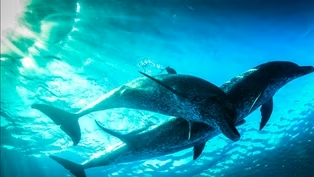
Preview: S53 Ep13 | 1m | The story of the dolphin reveals how intelligence evolved, step by step, over billions of years. (1m)
Providing Support for PBS.org
Learn Moreabout PBS online sponsorship












Support for PBS provided by:
National Corporate funding for NOVA is provided by Carlisle Companies. Major funding for NOVA is provided by the NOVA Science Trust and PBS viewers.