
February 6, 2026
2/6/2026 | 55m 49sVideo has Closed Captions
Volker Türk; Wagner Moura; Kleber Mendonça Filho; Jodi Kantor
United Nations High Commissioner for Human Rights Volker Türk describes the violence he witnessed in Sudan and discusses other conflicts happening around the world. Actor Wagner Moura and director Kleber Mendonça Filho discuss their Oscar-nominated non-English film "The Secret Agent." NYT reporter Jodi Kantor reveals what the Supreme Court has been doing to make the Court "even more secretive."
Problems playing video? | Closed Captioning Feedback
Problems playing video? | Closed Captioning Feedback
February 6, 2026
2/6/2026 | 55m 49sVideo has Closed Captions
United Nations High Commissioner for Human Rights Volker Türk describes the violence he witnessed in Sudan and discusses other conflicts happening around the world. Actor Wagner Moura and director Kleber Mendonça Filho discuss their Oscar-nominated non-English film "The Secret Agent." NYT reporter Jodi Kantor reveals what the Supreme Court has been doing to make the Court "even more secretive."
Problems playing video? | Closed Captioning Feedback
How to Watch Amanpour and Company
Amanpour and Company is available to stream on pbs.org and the free PBS App, available on iPhone, Apple TV, Android TV, Android smartphones, Amazon Fire TV, Amazon Fire Tablet, Roku, Samsung Smart TV, and Vizio.
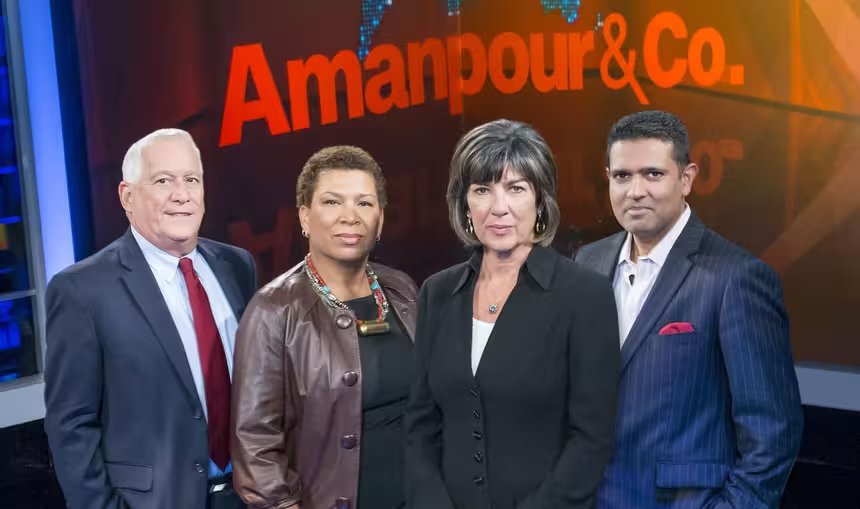
Watch Amanpour and Company on PBS
PBS and WNET, in collaboration with CNN, launched Amanpour and Company in September 2018. The series features wide-ranging, in-depth conversations with global thought leaders and cultural influencers on issues impacting the world each day, from politics, business, technology and arts, to science and sports.Providing Support for PBS.org
Learn Moreabout PBS online sponsorshipHello everyone and welcome to Amanpour and Co.
Here's what's coming up.
We are the lifeline of millions of people.
If you cut that lifeline, you will have more chaos and anarchy in the world and that we cannot afford.
Conflict rages around the world, devastating countries like Sudan.
The UN's High Commissioner for Human Rights tells me why the work his office does is more vital than ever.
Then, The Secret Agent, the Oscar hopeful sparking conversations about corruption, dictatorship and how we stop them.
I speak to star actor Wagner Moura and director Kleber Mendoza Filho and how the Supreme Court made itself more secretive.
Investigative reporter Jodi Kantor speaks to Michel Martin.
[Music] Amanpour and Company is made possible by the Anderson Family Endowment, Jim Attwood and Leslie Williams, Candace King Weir, the Sylvia A. and Simon B. Poyta Programming Endowment to Fight Antisemitism, the Straus Family Foundation, the Peter G. Peterson & Joan Ganz Cooney Fund, Charles Rosenblum, Monique Schoen Warshaw, Koo and Patricia Yuen, committed to bridging cultural differences in our communities, Barbara Hope Zuckerberg, and by contributions to your PBS station from viewers like you.
Thank you.
Welcome to the program, everyone.
I'm Bianna Goldriga in New York, sitting in for Christiane Amanpour.
Displacement, geopolitical tensions and warfare.
Conflict is raging in more than 30 countries around the world.
That's according to the Institute for Economics and Peace, with fighting in Ukraine, Haiti, Myanmar and the Democratic Republic of Congo, just to name a few.
And each conflict is creating a dire humanitarian situation for innocent civilians.
Just look at Sudan.
Many aid organizations now call the situation there the world's worst humanitarian crisis.
The UN's World Food Program reports more than 24 million people suffer from acute hunger and 2 million face famine or the risk of famine.
More than 11 million are displaced.
These are just staggering figures.
Both warring parties, the Sudanese Armed Forces and the paramilitary RSF, continue to obstruct aid from reaching a truly desperate population.
People are subjected to harrowing atrocities, including mass killings and sexual violence.
It is a war that needs far greater attention.
Volker Türk is the UN's High Commissioner for Human Rights.
He just visited Sudan personally and told me what he saw there when we spoke earlier this week.
Mr.
High Commissioner, thank you so much for taking the time to join us today.
Let's start with the horrific situation in Sudan.
This war has now been ensuing for years.
I know you just returned after a five-day trip there.
The last time you were there was prior to the war, so you have real perspective in the before and after.
Just tell us what you saw and how horrific that situation currently is right now.
So it's an all-out war and it's the situation at the moment is really characterized by massive human rights violations, especially in Darfur, which we heard what happened last year in Al-Fasher.
Within three days, thousands of people got killed.
We have accounts of and I myself have these accounts because I had a chance to interview nine survivors of sexual violence, women and girls.
So it's a horrific situation.
And I remember so vividly when I first went, it was the first country to visit when I took over as High Commissioner for Human Rights.
And I wanted to meet the people, the young people and the women who were leading the revolution against a 30-year-old military dictatorship under Al-Bashir.
And there was so much hope.
And there was so much, I would say, freedom, a struggle for freedom that was so palpable.
And to see four years, three years later, the country in total disarray and basically fighting each other is really horrific.
And it's essentially these two armies that fight each other and all their allied militias along with it.
And the people suffer enormously.
And I met some of the ones who had been part of that revolution, especially some young people.
And they were telling me that, yes, some of what they had been doing had been crushed, but their spirit has not been broken.
So it also gives me hope that within that society, you have people who still believe that Sudan will emerge and come out as a country where there is a vision that actually brings people together, despite a very gloomy environment.
That is amazing that people are still telling you they are willing to fight for their country and for their own freedom and self-determination.
The UN, as you know, now calls Sudan the worst humanitarian crisis in the world.
In concrete terms, just tell us what daily life is like there from what you saw, from what you heard from some of those civilians.
So I went to a camp for internally displaced people.
These are people who had fled al-Fasha.
So first of all, they had to get out of al-Fasha.
And let's not forget, al-Fasha was under siege for 18 months.
They were telling me that during that siege, at the end in particular, the only thing they could eat was animal feed.
Peanuts, you know, peanut type things on the ground that they found.
I mean, horrific situation.
When al-Fasha was attacked and taken over by the RSF, there were horrific massacres that were conducted.
Some people could not flee.
They were actually shot.
Some people were abducted for ransom.
I mean, I heard stories from women who told me that their husbands either were shot in front of them or their brothers and sons were taken away and they had not heard of them ever since.
When they finally some of them managed to get out, I met them in this camp, in this IDP camp in northern state of Sudan.
I mean, their conditions, they live in plastic sheet in tents, basically.
The humanitarian assistance is not very advanced because we don't have enough funding.
And you probably have heard this from our humanitarian colleagues.
They are traumatized.
I've rarely seen a population that is so traumatized.
You can feel it.
I mean, I met children and they wouldn't talk to you.
They wouldn't even smile because the normal reaction would be, you know, they smile, but they wouldn't smile.
Mothers told me that some of them are basically in a state of shock and they haven't come out of it.
So that really gives you a picture of what it is like to have been affected by this horrific war.
- You mentioned that unspeakable brutality committed in al-Fasher and just some of the witness accounts that you've relayed to us right now, and more figures have come in over the past few weeks, just in terms of the death count alone.
What is the official death count from the massacre at al-Fasher that you know of?
And would you call this a genocide committed at the hands of the RSF?
So we don't have exact figures, but we know that at least 5,000 people got killed.
But the death toll is probably much higher because we are only really putting the pieces of the puzzle together.
And, you know, that's part of our work.
We have, when we document, when we monitor, we need to do it on the basis of verified information.
So we are always lagging behind what the reality is, because that's just the work that we do.
But this is extremely important, including for accountability purposes.
What we have seen, committed, definitely war crimes, potentially crimes against humanity, whether or not it's genocide is not for us to decide, because usually that's decided by courts.
But I have to say that the elements of the ethnically motivated violence that we have seen is definitely an element to take into account, as well as the hate speech that we have heard from those who had suffered this, and the way that these things were conducted.
So, indeed, we are talking about atrocity crimes here.
And so many experts we've had on, we've spoken to, and I believe that you are in the same camp now, are warning and very concerned about the same atrocities that were committed in El Fasher and back in October of last year being committed in Cordofan as well.
And that risk continues to escalate.
Tell us what is happening in Cordofan and what can be done to prevent a repeat of what we saw in Al-Fasha.
So we have seen a pattern and it started already earlier last year with an IDP camp, so-called Sam-Sam camp, where we saw mass killings, abductions for ransom, sexual violence, illegal, I mean, sieges.
That's what repeated itself in Al-Fasha.
By the way, I issued a very stark warning, I remember, end of September, about what could happen in Al-Fasha.
And unfortunately it did happen because the international community did not wake up to that situation.
There wasn't enough political energy that would go into this situation.
And as a result, I issued another stark warning coming out of my Sudan visit about the situation that you mentioned in Kordofan, where you have similar tactics being applied as sieges.
But what we fear is that if, for example, the RSF were to take over Kaduli or whatever city or town they would get in South Kordofan, that the same pattern would repeat itself.
And as a result, it is so important for everyone, any state that has any influence over these warring parties to use that influence to say, you cannot do this.
I did it myself.
I had a chance to talk to the RSF and to the SAF.
And I gave them all warnings about the seriousness of the situation and the need and their responsibility, their command responsibility when it comes to troops under their command.
- And do you think they heeded those warnings or do they need to come from higher level governments, primarily the United States?
You talk about the difficulty of just getting humanitarian aid in.
President Trump has addressed this briefly when he was meeting with the Crown Prince of Saudi Arabia, MBS, a few months ago.
We haven't heard much traction since.
I mean, we need all hands on deck.
I mean, it's clear that those who have influence over the parties, including, of course, the US, but many others as well, need to use that influence now in order not only to achieve a truce, because we need a humanitarian truce, but also a lasting ceasefire and a peace agreement.
And I can only hope that, you know, the fact that you, there's more visibility to the situation in Sudan and to the suffering of the people in Sudan, that this would actually galvanize political action to achieve precisely that.
And I really hope for that.
Let me ask you about another hotspot, another crisis that we've been covering now for two years, Gaza.
Things have quieted down a bit.
There is a technical ceasefire in place, though we do know that a number of people still have been killed since that ceasefire went into place late last year.
A milestone of sorts, at least symbolically, was reached this week with the official reopening of the Rafah border, but we know that there's just a trickle of people being able to cross the border on both sides, from the Israeli side as well as the Egyptian, those civilians that are desperately in need of aid.
From your perspective, from a human rights perspective, just talk about A, that moment of the importance of this border opening, but the fact that we are not seeing enough aid going in and not enough civilians coming out to get the help they need.
- So it's absolutely critical for the ceasefire and we were very much welcoming the ceasefire, but it is also extremely critical that humanitarian assistance is delivered and that those who have suffered severe injuries are able to get out.
So the rougher opening was very welcome, but it needs to be fully implemented, which means that people have to get out and we have not only 50, but there are hundreds of people who need urgent medical assistance outside and we need much more massive humanitarian assistance to come in.
So I hope that this opening will actually lead to some real change on the ground.
We'll go from Gaza to Ukraine, as this war sadly is approaching the four-year mark now.
Civilian infrastructure continues to be targeted and attacked by Russians, despite the fact that President Trump had proclaimed that he and President Putin had agreed to a one-week ceasefire in their attacks on infrastructure sites.
That was broken, I believe, after about just three days' time.
We know how cold it is in Ukraine right now and the impact this is having on civilians.
Just talk to us from your perspective, from your colleagues there.
How are they able to help those civilians that are struggling right now just to stay warm?
So I think it's really important, first of all, to say that attacks against critical civilian infrastructure are a serious violation and they are war crimes and they should never happen.
And we see this, unfortunately, in too many wars, including in Ukraine, that this type of infrastructure is being destroyed.
It means I was in Kiev in December 23 myself, it was in during the winter.
I mean, it was very, very low temperatures.
It's probably even lower than what you are experiencing right now in the US.
And just imagine for weeks on end, the electricity comes down to a trickle.
Those who are disabled would not be able to use lifts, for example, they would not be able to go out, they would not be able to shop.
It means that people who, I mean, including my own staff, who told me that they are sitting with three coats in order to write their reports, but then suddenly electricity goes off and they can't even do that.
So we, yes, the daily life is affected in a massive way, particularly for vulnerable groups.
I mentioned particular people with disabilities, but also older people.
And it affects the whole system of response.
So yes, these attacks, these are the indirect consequences of war that we don't often talk enough about.
We only talk about civilian casualties, but we don't talk enough about the impact on the environment, but also the impact on daily livelihoods, on hospitals, on schooling.
And I think it's important to describe war in the most graphic form because people need to realize it affects each and every aspect of daily life.
And that's what's happening right now in Ukraine.
- Mr.
Commissioner, we haven't touched on nearly all of the conflicts that are taking place around the world right now.
And the ones that we have touched on have been ongoing for years.
And this must seem like an uphill battle for you and for your colleagues as well.
And it's coming at a time when the UN itself is claiming that they are facing a funding crisis and projecting financial collapse within just a matter of months.
In terms of how that impacts you and the work that you're doing, explain to our viewers what that could mean.
I mean, in the case of human rights, it means that we are not able to monitor human rights situations around the world, which means that those who commit them get away with them much more easily.
It means that we are the lifeline of survivors and human rights defenders and independent journalists who report about what's happening in the world.
We are not able to deliver to them in the same way as we were in the past, which means again, that, for example, those who end up as political prisoners, we are not able to go to the detention centers anymore in some countries because we had to cut down.
We had to cut our operation in Colombia, which is a very important part of the peace agreement.
We had to close down and we had all the, I mean, especially human rights defenders, indigenous populations coming back to us, begging us to stay because we are in a way a protective shield for them and we provide assistance and support to them in their important work.
So yes, it has weakened us enormously.
And I just want to say, because there's a lot of sometimes very uninformed talk about the value of the United Nations, the United Nations is the backbone in all countries around the world, for what is fundamentally so human about us.
And I can tell you in each and every situation that I have gone to, we're the lifeline of millions of people.
If you cut that lifeline, you will have more chaos and anarchy in the world.
And that we cannot afford.
That's not good for anyone.
And I just hope that there is a bit more of a reappreciation of the value of the work that we're doing on a daily basis.
Hi, Commissioner Türke.
Thank you for joining us.
Thank you very much for having me.
The Oscars are just weeks away and one non English film is getting a lot of buzz.
It's an exploration of corruption, autocracy and how we remember it.
Sounds pretty timely.
The Secret Agent is a political thriller set in the late 1970s Brazil when the country was under military dictatorship.
Take a look.
This is the person... I want... a hole... in the mouth.
In your case, it's what I want to solve the most.
Is there a killer looking for me?
Is that what you're saying?
You probably know its star, Wagner Moura.
Wagner Moura is Pablo Escobar in the Netflix hit Narcos.
He won the Golden Globe for Best Actor and is nominated for an Oscar, while Kleber Mendoza Filho won Best Director at Cannes.
I sat down with both of them here in New York.
Wagner, Kleber, thank you so much for joining us.
What an incredible film.
What a powerful film.
I understand why it's getting such global praise.
So congratulations to the both of you.
The Secret Agent, we should tell our viewers, is a political thriller set in Brazil in 1977 during the military dictatorship there.
And Wagner plays Armando, a couple of other characters.
We'll get to that in a second as well.
But you're a man in hiding from powerful forces.
Kleber, why did you decide to create this film?
And tell us about the name, The Secret Agent, because I think it was a bit deceptive, but maybe I missed something.
Well, I wanted to develop a film with Wagner, someone that I've known for 20 years now.
And you really got to sit down and write a script.
And once I sat down to write the script, I felt like going back in time.
In 1977, I was nine years old.
I have this muscle memory of that time.
Of course, at that time, Brazil was going through the military regime, which ended in 1985.
And I also have to say that once I got down to write the script, the logic of the 1970s had come back to our country because Brazil went, took a very hard turn to the right and the last, the former president was democratically elected but he was really bringing back the values and the aesthetic and the logic of the military dictatorship.
Right now, Bolsonaro of course is in jail but it was a very tough four years which now I understand really inspired me in terms of giving me many of the ideas that went into the writing of The Secret Agent.
And the title?
The title is a short and sexy title and it would take me back to some of the films that made me want to make films like North by Northwest by Alfred Hitchcock or Three Days of the Condor by Sidney Pollack.
I think also the whole idea of the secret agent is something that to this day I still enjoy people discussing on the internet, in the media and even outside the screening room.
Who is the secret agent?
I have my own ideas but I would never really go into details.
Wagner, your character Armando, one of them, he also plays Marcelo and that's his assumed identity.
He is a man on the run.
He is a man trying to save his son and start a new life.
He's also an academic.
Tell us about his character.
It's interesting because like Kleber just said, we kind of experienced that feeling again in Brazil, like when Bolsonaro was the president, which is when the first thing that they do is to attack universities, academics, scholars, journalists, and artists.
And we both as very vocal artists against that particular government suffered lots of consequences of what we were saying and especially what we were doing with our with the things that we do, the films that we produce.
I myself had produced and directed the film in Brazil that also took place during the dictatorship and this film was censored and that I'm talking about Brazil in the 21st century Brazil from 2018 to 2022 the biggest democracy in South America so I think that that these kind of things make me they always make me think of like how we have to we cannot take democracy for granted and just like to point something out I think that once the democratic system breaks down any normal honest citizen in a society may begin to feel like a secret agent just because the things you stand for and the things you think and say and you could be an academic or a journalist or an artist that will immediately put you in the position of being under persecution so I think a lot of the idea for the secret agent and the title the secret agent came from the notion of society breaking down and you having to deal with a situation where the values are upside down.
The majority of the victims of dictatorships are not freedom fighters, are not people that are trying to overthrow a government or regular people, like that just that you're persecuted just because they are who they are, not just because of their skin color, because it depends on the religion or their political beliefs.
You mentioned that it was going back to the conversation about Bolsonaro and I don't want to spend too much time talking about politics, but you've said before that you think it was the amnesty law that actually brought Bolsonaro to office.
Explain the dichotomy there because unlike a military dictatorship and as you even acknowledged, he was democratically elected.
Yeah, but it's a matter of memory, I think, you know, like if we don't have our history told correctly or if we forget if we have things like the amnesty law that the amnesty law was a law that we have in 79 in Brazil that basically forgave all the torturers and killers and people that did very despicable things to civilians in Brazil.
If we have things like that and if we make people believe that attempting against democracy or attempting against human rights is something that's okay, then we have a memory problem.
And we had that in Brazil for decades, for centuries, I would say.
The history, our history is based on many beautiful things, but also it's based on like Brazil was the last country in the Western world to abolish slavery.
So we live with many contradictions in that country.
So I really believe that Bolsonaro wouldn't have been elected if it wasn't because of the amnesty law.
As right now, we are finally getting even with our memory when we sent Bolsonaro to jail and we sent military, for the first time in Brazil, we sent people that, military people that attempted against democracy to jail.
So I truly believe that the new generations of Brazilians are going to grow up with a different sense of understanding of what, of our history and of our memory.
You mentioned memory.
Memory plays a key theme in this film.
And you go back and forth between the 1970s and then more present day, where your character, Armando, as he is on the run, is actually aided by two individuals who want to help him and he's telling his story.
Talk about the role of memory here in that genre.
Well I'm fascinated by the idea that cinema is memory.
Each film will be put away in a cinematek and will become a piece of archive.
The conversation we're having right now will hopefully become part of an archive to be seen in the future and I think that's one of the basic premises in the film.
The story we're living now is our own story in the present time, but there might be someone listening in the future and the story of Wagner's character in the film is in fact just a fragment in the future which helps you understand the country and how society evolves.
But there is a lot of discussion around the secret agent in many countries and in Brazil and here in the US about being a film about memory.
But in my mind it's really a film about amnesia.
And many countries and many societies in fact they want to forget because it's not comfortable or it's not political to remember.
So I really believe that one of the stronger aspects of the film is really about amnesia without giving anything away from the plot but towards the end I think that's a very strong point that the film makes.
I just saw Donald Trump saying that he that America should move on with the abstain thing you know we should move on no I don't think America should move on I think America should check that out you know and go deep on what what that means and the people that are involved in that the moving on thing of it all that's what caused our the amnesia that in Brazil and once again let's move on let's forget about let's just you know let's start over let's let let let's have a let's have a fresh start right now yeah keep it in the past once again the files there are pieces of archive and they are being examined now so the files are they go back 15-20 years and now there are people looking at the file so that's an interesting point that the film makes I do want to go back to that scene where your character is in being interviewed and recorded about this corrupt businessman who has now put hitmen out to find and kill your character and you don't come across as an aggressive violent person but when it comes to this particular character here's what you have to say.
I'm not a violent person.
But this guy... I'd kill him with a hammer.
I'd smash his head with a hammer.
Are you armed?
No, but I can use a hammer.
Talk to us about that scene.
That was one of my favorite scenes in the film because I love the way Kleber, as a writer, he doesn't follow any script rules.
So you kind of, you see in the film, you kind of only start to understand, really understand what's going on in the film in that scene.
And that's like an hour and a half already, like of movie.
Because I thought I missed something.
And then I was like, no, no.
Until you get there, it's sort of like putting the pieces of the puzzle together.
And then you get to that scene.
And then you understand what's going on with him.
And I remember that that was a scene that we shot in one, like, we spent like 20, it was a one-hour, right, with two cameras, but we shot for 20 minutes.
And for me, it felt like theater.
It felt like one minute had passed, like when they said cut.
That feeling that you have when you're in a set that's, "Oh, what just happened?"
So I thought that that's a very important scene for the film and for the character, because like you said, he's a human being.
He's been, it's a very silent character, right?
He doesn't, he cannot respond to the threats and to the injustices that he's going, that he's going through with explosiveness or with, you know, with the necessary anger that a situation like that would require because it's a detector ship.
It's when you had to protect his kid and so he's a very silent character so I really love when in that particular scene he says something like that like I would just use a hammer to that doesn't mean that he had done anything like that before but he could do it.
There's another beautiful thing that I love about that scene is when that scene ends and the hitman is the scene that he realizes that there are hitmen trying to find him.
He goes downstairs in the movie theater and carnival is going on outside and he goes outside and he was with that, you know, he's thinking, "Oh my, there are hitmen trying to find me," but he just gives himself to the carnival.
- I was gonna say, it's interesting because it's clear that this is all happening during a dictatorship.
You see the corruption even in the opening scene of the film and yet you also choose to include culture, life, film, the cinema.
The cinema plays a big role in this film as well.
Tell us about that decision and to also include people experiencing life and living life in this moment.
Well, as I said, I was about 9, 10 in the 70s.
I was a little kid, but I remember life going on normally.
And we had to deal with all the problems of life, you know, being happy, being sad.
The colors were all the same.
We went to the beach, we played football.
And that is how I remember the 70s.
I remember early on when we began pre-production, someone in production asked if the photography would be bleak and dark and gray.
And I said, "No, the photography is going to be color."
You know, the strong colors of life because that's how life unfolds.
We were living in the dictatorship, but the word corruption was not exactly pronounced, but corruption was everywhere.
In fact, it was one of the most corrupt times in the history of our country.
Often the word violence is not really mentioned, but violence is taking place.
So I think that's how I wrote the film.
I thought about color, sound, music, cinema, corruption and violence, but all of that had to make sense in this beautiful tapestry of life 50 years ago in our country, Brazil.
My final question to you, Brazil does seem to be having its moment right now and it's interesting that this film comes a year after "I'm Still Here" and it's also set during the same time period.
Why do you think the world has turned its eye to Brazil now and really begun to try to understand that era in the country?
Well, it's really wonderful that in two years we have two strong films.
And these are Brazilian films which come from a very particular period of repression.
In my case, I have talked to Walter Salas about this, but my take is that we react to whatever is happening and I think it's a strong moment for us to do something.
And I truly believe that The Secret Agent comes from, it comes as a reaction to what we had to go through and put up with during the four years of far-right government in my country.
Now we are in a much better shape, the Brazilian film industry.
It is undeniable that culture and democracy work together.
So we have a democratic president right now that likes culture.
And so the idea of a government funding culture is something that this government understands as like a big step to the development of the country itself.
No country develops without that, without having seen them.
We have to see ourselves in our production.
So I think it's indeed a very beautiful moment because they were right, they were very effective in transforming artists in Brazil into the enemies of the people.
They were very effective with that.
To say that we were taking advantage of the public fundings and all that and people bought that.
That may be a big part of the country.
Brazil's polarized.
As is the US.
- As is, yes.
- As any of the rest of the world.
So it's nice to see, it's beautiful to see Brazilians rooting for this film.
And seeing this film as theirs, as part of their culture, or something that represent them.
This is actually, honestly, my favorite part of this whole thing that's going on.
- Thank you, both of you, this was great.
- Thank you for having us.
- We really appreciate it, thank you.
>> Thank you.
In the United States, the Supreme Court wields extraordinary power.
Handing down decisions that impact everyday lives.
But public trust in the court is at an historic low.
And our next guest reports that steps have been taken to make it even more secretive.
Just as people demand more transparency into its inner workings.
Jodi Kantor is a Pulitzer Prize winning investigative journalist at the New York Times.
And she sat down with Michelle Martin.
Thanks, Bianna.
Jodi Kantor, thanks so much for joining us.
My pleasure.
You are a very distinguished investigative reporter.
You've reported on a lot of institutions.
And in recent years, you've been focusing particularly on the Supreme Court.
In a recent piece, you note that the chief justice of the United States, John Roberts, quietly required court personnel, the clerks, I guess, mainly, to sign these nondisclosure agreements.
This happened back in 2024.
The timing, like, why then?
What happened that you think may have motivated this?
Well, let me set the scene for you.
So it's November of 2024.
President Trump has just been returned to office by voters.
And remember that the court is a very orderly place.
And yet this is a kind of abrupt surprise announcement, and it comes in the middle of the term.
The term has already started several weeks before, and employees and clerks get called into this big, very ornate conference room, and the Chief Justice announces that he wants them to sign NDAs.
And this is a real shift because the court has always had a vow of silence.
People who work there are not supposed to reveal what they know of the real story of how the justices decide the law.
However, it had always been kind of more of a compact and a trust thing.
There were some written agreements in the past, but much later, he was actually asking them to sign NDAs, according to our reporting, that had real legal force that basically threatened people with consequences if they violated this.
A couple of pieces of context, a couple of things that we think spurred this.
I mean, first of all, as we know, trust in the court still is, and at that point was just languishing at a historic low.
Number two, there had been some really unusual disclosures coming out of the court.
There was the Dobbs leak, of course, in 2022.
The decision that essentially outlawed nationwide access to abortion.
Correct.
And somebody leaked it to Politico early.
And so it was published in this newspaper weeks before the justices had intended to make it public.
And then finally, we, The New York Times, had been reporting on things going on inside the court.
Adam Liptack and I had done the behind the scenes anatomy of major cases.
And just a few weeks before the chief justice imposed these nondisclosure agreements, Adam and I had done a behind the scenes reconstruction of the immunity decision, which, as you know, was truly one of the most consequential decisions of our era.
This was before the presidential election.
President Trump was going to be prosecuted for what he did on January 6th, and the Supreme Court awarded him very broad immunity from prosecution.
And we had a story showing how Chief Justice John Roberts guided that process and sort of what the behind the scenes was, what the justices were thinking.
Did he make it clear that this was a condition of employment?
I don't know everything that happened in that meeting, but it was clear that this was something they wanted everybody to do.
And also it was clear that they were really upset that internal documents were getting out from the Supreme Court.
Did he say that?
I mean, do you have any sense of whether he told them that?
That's what the reason was for this.
Right.
I can't quote exactly what he said in the meeting, but it was clear that this was the big concern.
You know, the Supreme Court sits right in the middle of our culture and our government.
They're making huge decisions about our own lives.
But it is very, very, very secretive.
The justices might argue that they're the most transparent form of government because they issue opinions and there are oral arguments, but we are not supposed to know anything about how they decide the law.
Sometimes I'm even talking to a clerk from like three or four decades ago.
And if I ask them something, they'll either say, I can't answer that.
Or sometimes they'll tell me an amazing story and I'll say, OK, can I put that in the newspaper?
And they'll say, oh, no, you could never possibly do that.
It has to be off the record.
That would be a terrible breach.
So it's the idea that they're deliberate.
The decisions that they make are public, but the process by which they arrive at them, they want that to be secret.
They want that to be secret.
There is some real debate about how transparent the court should be.
Well, one side, what I would say, like the traditionalists say, is that the judiciary needs confidentiality to operate, that we want judges to be able to change their minds, to have very open discussions.
We want them to be free from influence.
And so that requires a kind of seal around the place.
Other people push back and say, first of all, that's too extreme.
I mean, you may need secrecy while you're deliberating, but why can't you explain what really happened afterwards?
And what they also say is that it's preventing a real examination of the court at this critical moment because we just don't have enough information about how the law is being decided.
That point is gathering strength, Michelle, because of the court's shadow docket opinions.
As you know, with some of the major decisions in the last year or two awarding President Trump a lot of power to implement his agenda, the court has not explained its rationale.
It's issued some cryptic orders that don't even really like pretend to be explanations.
And that's very surprising in some ways, because courts get their authority from explaining their decisions to the public from saying, even if you don't disagree with us, here's how we're going to show our work.
Here's how we did the math and came to this conclusion.
So so so another question about this, are the justices bound to these non disclosure agreements?
So we asked the court that question, and they would not comment.
Hmm.
Transparency.
Okay.
So, so.
But you're, I mean, suffice it to say that I think you're asking an excellent question because you know, are, are they, is this an, is this a requirement that was imposed just for the little people, for the clerks and the employees, you know, or are they adopting the same standards?
It's a good question.
Do we happen to know what the consequences of violating it are?
So I haven't seen the document, but the consequences were described to me as very hazy.
And what's often the case with NDAs is that they are more meant to intimidate than to really be legally binding instruments.
Enforcing an NDA is really hard because there's a paradox to that kind of document, which is to enforce an NDA, you generally have to bring somebody to court.
And if you're bringing somebody to court, you're making something more public.
You're taking the secret thing that you're trying to conceal and putting it right out there for society to examine.
Some NDAs are quite enforceable, like Michelle, if you and I worked for a chocolate company and we signed NDAs, and if you and I secretly sold the ultra exclusive recipe for the chocolate to a competing chocolate company, I really think you and I could be in trouble in court because of those NDAs.
But this kind of NDA that's about workplace knowledge is a little bit harder to enforce because of what I mentioned.
I mean, it's the legal experts I talked to were kind of puzzled by the whole question.
They were like, okay, so the Supreme Court is going to go to which court to try to enforce its NDA?
And which is the lawyer who's going to represent the Supreme Court?
So anyway, we don't know for sure, but it seems it seems likely that this was an internal show of force at the court designed to say to this population, we are really serious about nothing getting out.
Do you know whether any lower courts have imposed a similar process on their clerks and court employees?
They have to an extent, but it's not that common.
They were kind of lighter confidentiality agreements.
Think of them more like pledges.
You know, like I said, I promise, you know, that I'm going to obey so and so.
But I should say it's not terribly common.
Do you have any sympathy for the fact that people feel like it can be damaging to their relationships and also to their ability to negotiate with each other if their private conversations are put into the public domain?
There is an argument that if their internal discussions were made public, that that would make it harder for people to kind of change sides.
And that would be bad for the country sort of overall, because changing your mind in response to new information is what at least some people hope that people will do.
I think the question is, how come after the decisions are made, we can't understand in so many cases how they got to this result, either because it's a shadow docket case and there's no explanation, or because the opinions and the oral arguments don't tell the whole story.
You know, from a journalistic point of view, as you know so well, the first job of journalism is to scrutinize power.
And so we can't have a Supreme Court sized cutout as a kind of exception to that rule.
You know, our goal is to understand this court on a deeper level to illuminate what's actually going on there and to establish an independent lens through which we can see the justices.
There is so much debate about the Supreme Court.
Should there be more justices on the court?
Should there be age limits or term limits?
We're the only constitutional democracy that doesn't have age limits or term limits for judges.
And we've seen some dramatic results of that lack of a rule.
So when people ask me, like, oh, what should happen with the Supreme Court?
What I say is that as a reporter, my stance is that we need more information.
How partisan are the justices or are they not?
What are their relationships?
Who are they talking to?
What kind of air are they breathing?
Do they actually talk to each other?
Do they actually deliberate?
Exactly.
Also, what is the effect of having that much power for that long?
Michelle, it is so unique in government to be appointed to a position for life, you know, an election as a kind of accountability measure.
They don't have that.
They don't have visitor logs.
FOIA doesn't work for the Supreme Court.
So oh, and also, by the way, the way people treat Supreme Court justices is very extreme.
What do you mean by that?
A lot of obsequiousness, right?
A lot of flattery and then a lot of attack.
And those are very extreme forces that I think are buffeting the justices all the time.
They also live under pretty heavy security cordons now, which is sadly necessary, but really cuts you off from the real world.
And so one of my chief questions about the court is, what is the effect of being in that kind of role for 20 or 30 years?
You know, what's fascinating to me is that this, the Trump administration has been very aggressively seeking to control press access.
I mean, many people will remember that the Defense Department under Defense Secretary Pete Hegseth tried to impose this essentially nondisclosure agreement.
They basically wanted the press corps to only report things that they had decided they were going to announce.
Most news organizations wouldn't tolerate these restrictions, so they left the press room and they turned in their badges.
We also see it's been reported that the defense secretary is administering, you know, polygraph tests to people trying to figure out who's leaking.
That there seems to be a real concern about people internally disagreeing with them and wanting to sort of make their views known outside of the bubble.
And it's just interesting.
I wonder if you see that this move in the court is sort of foreshadowing what happened in other areas of the government.
I think it's a really different culture than the executive branch, but it is in a way true to the court's own culture, which is highly secretive and there has been a struggle for years and years and a push-pull with journalists like me trying to get more information out of the Supreme Court and the Supreme Court really resisting.
The justices have built a moat of privacy around themselves.
You know, also remember that the clerk justice relationship is for life.
The justice in a sense never stops becoming your Ross, you know, and often helps you move forward in your career for years and years afterwards.
So typically, clerks are quite sensitive and nervous about violating any of the court's rules.
And we also know that a former clerk is now on the court.
I mean, Brett Kavanaugh was a clerk.
Oh, almost all of them were.
You could you could argue that that the Supreme Court has become a little bit of a closed society because almost all of the justices clerked, that it it has a kind of self-perpetuating quality to it.
So before we let you go, what about the rest of the term?
I mean, what are some of the consequential cases that you're most interested in coming up?
Look, I know every year in the last couple of years we've said this is really the term to watch.
I mean, it's always true for a different reason.
The reason this year is that we are going to get the court's more complete answers on the parameter of President Trump's powers.
They issued a lot of really important decisions last year.
They were very consequential.
But because they were technically emergency decisions, you know, on the one hand, they had massive real world effects.
On the other hand, they were pauses.
They were, you know, they were temporary.
And I think whether we're talking about the tariff decision or the birthright citizenship case, we are going to get real and more definitive answers on the question of how this court is responding to President Trump and whether they are willing to limit his power.
I've started to see discussions outside of the court on the workings of the court and also sort of the lower courts and asking these questions is, should there be term limits?
You know, should there be age limits?
Should the court expand?
Do you see, you know, outside of the court, any energy around any of this?
The fact that outsiders can't see everything clearly, that it's a hard place to understand, inhibits the kind of debate that you're talking about.
But I will tell you that I think part of what is spurring debate is the reliance on the shadow docket.
And those decisions last year, like one of them was that the US could deport somebody to a third country, meaning a country they had no connection to, with very little process.
There was very little explanation on that decision.
I think that is worrying a lot of people and helping create a kind of bigger discussion about the Supreme Court and how it works.
Jodi Kantor, thank you so much for talking with us.
It's great to be with you.
Thank you so much.
And that's it for our program tonight.
If you want to find out what's coming up on the show each night, sign up for our newsletter at PBS.org/Amanpour.
Thank you for watching Amanpour and Company on PBS.
Join us again next time.
[music] Amanpour and Company is made possible by the Anderson Family Endowment, Jim Attwood and Leslie Williams, Candace King Weir, the Sylvia A. and Simon B. Poyta Programming Endowment to Fight Antisemitism, the Straus Family Foundation, The Peter G. Peterson & Joan Ganz Cooney Fund, Charles Rosenblum, Monique Schoen Warshaw, Koo and Patricia Yuen, committed to bridging cultural differences in our communities, Barbara Hope Zuckerberg, and by contributions to your PBS station from viewers like you.
Thank you.
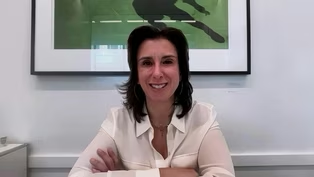
NDAs and the Shadow Docket: How SCOTUS has Become “Even More Secretive”
Video has Closed Captions
Clip: 2/6/2026 | 17m 33s | Jodi Kantor discusses her new piece about NDAs in the Supreme Court. (17m 33s)
Providing Support for PBS.org
Learn Moreabout PBS online sponsorship
- News and Public Affairs

Top journalists deliver compelling original analysis of the hour's headlines.

- News and Public Affairs

FRONTLINE is investigative journalism that questions, explains and changes our world.











Support for PBS provided by: