
Experts debate future of U.S.-Russia nuclear arms treaty
Clip: 2/4/2026 | 7m 29sVideo has Closed Captions
GOTTEMOELLER, MILLER DIS
As the New START nuclear arms treaty between the United States and Russia expires, there is debate over whether the U.S. should extend the agreement or walk away. For two perspectives on that debate, Nick Schifrin speaks with Rose Gottemoeller, who was chief U.S. negotiator for the treaty during the Obama administration, and nuclear weapons and national security expert Frank Miller.
Problems playing video? | Closed Captioning Feedback
Problems playing video? | Closed Captioning Feedback
Major corporate funding for the PBS News Hour is provided by BDO, BNSF, Consumer Cellular, American Cruise Lines, and Raymond James. Funding for the PBS NewsHour Weekend is provided by...
Support provided by:

Experts debate future of U.S.-Russia nuclear arms treaty
Clip: 2/4/2026 | 7m 29sVideo has Closed Captions
As the New START nuclear arms treaty between the United States and Russia expires, there is debate over whether the U.S. should extend the agreement or walk away. For two perspectives on that debate, Nick Schifrin speaks with Rose Gottemoeller, who was chief U.S. negotiator for the treaty during the Obama administration, and nuclear weapons and national security expert Frank Miller.
Problems playing video? | Closed Captioning Feedback
How to Watch PBS News Hour
PBS News Hour is available to stream on pbs.org and the free PBS App, available on iPhone, Apple TV, Android TV, Android smartphones, Amazon Fire TV, Amazon Fire Tablet, Roku, Samsung Smart TV, and Vizio.
Providing Support for PBS.org
Learn Moreabout PBS online sponsorshipNICK SCHIFRIN: Back on New START, there is a debate over whether the U.S.
should extend or walk away from the treaty.
So, for that debate, we get two perspectives.
Rose Gottemoeller was the chief U.S.
negotiator for the New START agreement during the Obama administration and is now a distinguished lecturer at Stanford University.
And Frank Miller had a 30-year career in government focusing on nuclear weapons and national security.
He's now a principal at The Scowcroft Group, an international consulting firm.
Thanks very much to you both.
Welcome back to the "News Hour."
Rose Gottemoeller, let me start with you. '
You think the U.S.
should continue to abide by the limits in New START.
Why?
ROSE GOTTEMOELLER, Former U.S.
Undersecretary of State for Arms Control and International Security Affairs: I think that the limits of the New START treaty are important because they keep not only the United States under limits, but they keep the Russians under limits, at a time when the Russians could move rather quickly to upload warheads and put more warheads on each of their missiles and, therefore, I think, outrun us in this period when we are looking at China building up, as Secretary Rubio quite rightly said.
They're building up quickly.
So it's, to my mind, a no-brainer to keep the Russians under limits as we ponder and plan and prepare to confront the Chinese on this matter.
NICK SCHIFRIN: Frank Miller, is it a no-brainer to extend the treaty for one year?
FRANK MILLER, Former Defense Department Official: Absolute -- no, absolutely not.
Paradoxically, getting rid of the treaty makes us stronger, makes the world more peaceful.
The treaty kept U.S.
force levels, deterrence force levels, at the 2010-2011 levels.
The world is vastly different.
We now face an antagonistic Russia and a growing, antagonistic China.
And so if we are kept at deterrence levels that are inadequate to deter Russia and China simultaneously, which is a conclusion that a commission that Rose and I both served on in '23, then, by signaling that we're not prepared to keep our deterrent at current levels, we suggest to the Russians and the Chinese that we are bluffing, not that we have a real deterrent.
NICK SCHIFRIN: Rose Gottemoeller, do the caps limit our ability to deter?
ROSE GOTTEMOELLER: Well, Frank and I differ on this quite clearly.
And he's a greatly respected colleague.
But I will say that it's a question of how fast do we have to move right now.
President Putin was talking about extending the limits of New START for one year in order to prepare for new negotiations and strategic stability talks.
And I don't think anybody denies, certainly I do not, that we have a very severe development here with China building up its nuclear forces all of a sudden.
And so we need to plan and prepare carefully at this moment for what we do about China.
But what concerns me is the immediate tactical move that the Russians might make.
They are prepared to put more warheads on their missiles.
That was also a finding of the Strategic Posture Commission that frank and I served on.
And it concerns me that the commission report said, as soon as Russia's release from New START limits, it may start to build up and put more warheads on its missiles immediately.
NICK SCHIFRIN: So, Frank Miller, would Russia do that if the caps are lifted?
FRANK MILLER: Russia could do that.
And to be perfectly honest, that doesn't bother me one bit.
What bothers me is that the United States doesn't have a deterrent force adequate to deter China and Russia simultaneously.
And if the Russians want to make the rubble bounce, that's up to them.
But we can build up slowly.
Nothing's going to happen overnight.
We're talking about taking warheads out of storage and putting them on existing submarines, on an existing land-based missiles.
This is a process that will take several years to do.
So there will be nothing sudden.
And we could always engage during those years in new arms control negotiations with the Russians and perhaps the Chinese.
But this treaty has run its course.
NICK SCHIFRIN: Rose Gottemoeller, what's wrong with taking more warheads out of storage?
ROSE GOTTEMOELLER: Well, there's nothing wrong with that.
And, in fact, we are planning and preparing to do so.
But Frank said very clearly this is going to take a couple of years to do.
So why would we take a chance in this coming year?
As we're preparing and planning for new talks with both China and, I stress, Russia, why not take a little time with an insurance policy in place, the New START Treaty limits, to plan and prepare and prevent the Russians from suddenly starting to build up?
Whether or not they're making the rubble bounce, one could say we're making the rubble bounce if we're building up also.
But I think it's important to bear in mind this is not a question of disagreement between Frank and me.
We need to counter both of these powers, these nuclear powers.
It's, can we take a year to plan and prepare and do it carefully, when we know it's going to take us some time to begin to upload our missiles anyway, to put more warheads on our missiles anyway?
NICK SCHIFRIN: Frank Miller, I saw you shaking your head during that answer.
FRANK MILLER: Well, my counter to my friend Rose is that we have taken two years.
The report from the commission came out in '23.
The Biden administration embraced the report's conclusions in '24.
We have given the Russians time.
It's now incumbent upon us to begin to take our deterrent to the levels -- and we're not talking large numbers of warheads, but to slowly build up our force so that it can deter Russia and China simultaneously, as U.S.
policy stresses.
And if we can deter simultaneously, the risk of their aggression, their attack on us or our allies is dramatically reduced.
NICK SCHIFRIN: In the two minutes that I have left, can I bring us back to the argument you heard from the Norwegian colonel in our story?
And, Frank Miller, let me actually start with you.
Is it a good idea for U.S.
allies who are doubting U.S.
nuclear credibility today to consider their own nuclear weapons?
FRANK MILLER: No.
Nuclear proliferation is not a good thing.
I don't know the colonel.
He's clearly very young.
The fact is, from the beginnings of NATO in 1949, allies have always questioned, would the U.S.
come to their aid in extremis?
We have done so for 80-odd years.
We have deterred attack against the NATO alliance.
And so people are going to have to put their faith in the United States, just as their fathers and grandfathers did.
NICK SCHIFRIN: But, Rose Gottemoeller, there is clearly some European doubt, some European loss of faith, if you will, in the U.S.
nuclear guarantee.
Do you believe that Europe, or, frankly, even Asian allies today should doubt the U.S.
nuclear guarantee?
ROSE GOTTEMOELLER: This is one thing that Frank and I do agree squarely on, that the notion of friendly deterrence is not going to -- I'm sorry -- friendly proliferation, rather -- we need friendly deterrence, right?
But friendly proliferation will not serve us well, because, for one thing, the NATO European allies, as well as our Asian allies, need to concentrate on conventional force buildup and conventional force modernization.
These nuclear programs are vastly expensive and cost a grave amount.
And these countries have other things to spend their resources on.
NICK SCHIFRIN: Well, it's always nice to end... FRANK MILLER: And possibly have them within 10 years.
NICK SCHIFRIN: Yes, within 10 years, absolutely.
It's also -- it's always nice to end with an agreement.
So, Rose Gottemoeller and Frank Miller, thank you very much to you both.
FRANK MILLER: Thanks for having us.
ROSE GOTTEMOELLER: Thank you.

Alicia Graf Mack on leading the Alvin Ailey dance company
Video has Closed Captions
Clip: 2/4/2026 | 6m 58s | Alicia Graf Mack reflects on leading the legendary Alvin Ailey dance company (6m 58s)

Former editor discusses The Washington Post’s mass layoffs
Video has Closed Captions
Clip: 2/4/2026 | 6m 53s | Sweeping layoffs at The Washington Post will do ‘enormous damage,’ former editor says (6m 53s)
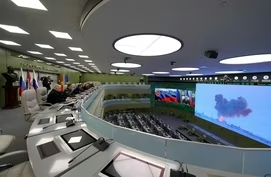
Key U.S.-Russia nuclear arms reduction treaty expires
Video has Closed Captions
Clip: 2/4/2026 | 3m 11s | Expiration of U.S.-Russia nuclear weapons treaty sparks concerns of new arms race (3m 11s)

News Wrap: Georgia election officials challenge FBI in court
Video has Closed Captions
Clip: 2/4/2026 | 6m 24s | News Wrap: Georgia election officials seek return of materials taken during FBI raid (6m 24s)

Researchers meet big setback to measuring ‘Doomsday Glacier’
Video has Closed Captions
Clip: 2/4/2026 | 5m 28s | Researchers face serious obstacles to measuring Antarctica’s fastest-melting glacier (5m 28s)

Stephen Miller’s influence on the Trump administration
Video has Closed Captions
Clip: 2/4/2026 | 8m 45s | Stephen Miller’s rise to prominence and influence on the Trump administration (8m 45s)

What to know about immigration agents’ surveillance tactics
Video has Closed Captions
Clip: 2/4/2026 | 7m 9s | Immigration agents’ surveillance tools and tactics raise questions about civil liberties (7m 9s)
Providing Support for PBS.org
Learn Moreabout PBS online sponsorship
- News and Public Affairs

FRONTLINE is investigative journalism that questions, explains and changes our world.

- News and Public Affairs

Amanpour and Company features conversations with leaders and decision makers.











Support for PBS provided by:
Major corporate funding for the PBS News Hour is provided by BDO, BNSF, Consumer Cellular, American Cruise Lines, and Raymond James. Funding for the PBS NewsHour Weekend is provided by...