
What international law says on bombing bridges, power plants
Clip: 4/6/2026 | 6m 10sVideo has Closed Captions
What international law says about Trump's threats to bomb Iran's bridges and power plants
For perspective on President Trump’s talk about bombing Iran’s bridges and power plants and whether that's legal under international law, Geoff Bennett spoke with retired Lieutenant Colonel Rachel VanLandingham. She spent 20 years in the Air Force and is now a professor at Southwestern Law School.
Problems playing video? | Closed Captioning Feedback
Problems playing video? | Closed Captioning Feedback
Major corporate funding for the PBS News Hour is provided by BDO, BNSF, Consumer Cellular, American Cruise Lines, and Raymond James. Funding for the PBS NewsHour Weekend is provided by...
What international law says on bombing bridges, power plants
Clip: 4/6/2026 | 6m 10sVideo has Closed Captions
For perspective on President Trump’s talk about bombing Iran’s bridges and power plants and whether that's legal under international law, Geoff Bennett spoke with retired Lieutenant Colonel Rachel VanLandingham. She spent 20 years in the Air Force and is now a professor at Southwestern Law School.
Problems playing video? | Closed Captioning Feedback
How to Watch PBS News Hour
PBS News Hour is available to stream on pbs.org and the free PBS App, available on iPhone, Apple TV, Android TV, Android smartphones, Amazon Fire TV, Amazon Fire Tablet, Roku, Samsung Smart TV, and Vizio.
Providing Support for PBS.org
Learn Moreabout PBS online sponsorshipAMNA NAWAZ: For perspective now on# President Trump's talk about bombing## all of Iran's bridges and power plants and# whether that's legal under international law,## we turn to retired Lieutenant# Colonel Rachel VanLandingham.## She spent 20 years in the Air Force and is# now a professor at Southwestern Law School.
Welcome back to the show.
You heard in our reporting there the repeated# .. infrastructure.
He said specifically there's a# plan to decimate every bridge in Iran, to destroy## every power plant.
You have heard the concerns,# Colonel, about this potentially being a war crime.
Based on your expertise, is it?
LT.
COL.
RACHEL VANLANDINGHAM (RET.
), Southwestern# Law School: He's both threatening a war crime and## he's engaging in a war crime through that# rhetoric itself.
And I will explain that.
First of all, the law of war, that's not# just international law.
It's U.S.
law.
And## our military members are deeply# trained and steeped in this law.## The law of war prohibits measures of intimidation# against a civilian population, including threats## of violence whose primary purpose is to sow# terror amongst that civilian population.
Those civilians whose electricity ensures that# there's refrigeration for their medicine for those## that are dependent on refrigerated medicine,# that provides electricity to hospitals,## where there are lifesaving operations# ongoing, where babies are being born,## whose electricity is helping ensure that the# water is purified and clean, they are terrified.
It's reasonably foreseeable to believe# that such rhetoric will sow terror amongst## the civilian population, and, therefore,# one can infer that that's what President## Trump intends.
So he's committing a# war crime just through that language.
Second of all, he's threatening to make our# military engage in war crimes and therefore## stain their honor and their soul and# come back with moral injury.
Why?## Because threatening to destroy every# bridge and every single power plant## in the entire state of Iran is called an# indiscriminate attack.
That is a war crime.
Why?
Because the law of war says we# don't engage in total war for anymore.## We don't believe that children are the enemy and# that civilians are the enemy.
The law of war says,## look, we're going to divide the battlefield,# which in modern days is often a city like Tehran,## into civilian objects, and they're protected,# and civilian people, they're protected.
And then there's military targets, lawful military# objectives that make an effective contribution## to military action and whose destruction provides# a definite military advantage.
We divide the world## into those two camps.
By saying we're just going# to bomb everything, bomb every single bridge,## every single power plant that serves civilians,# that is threatening indiscriminate attack.
And it is one of the most# horrible war crimes there are## because it brings us back, straight back# down the slippery slope to total warfare.
AMNA NAWAZ: Well, Colonel, let me ask you, if I# may, if the military and their lawyers can argue## that, yes, the power plants provide electricity# to civilians and they use these bridges,## but that the regime also gets electricity from# these power plants, that these same bridges## are used by members of the Iranian military# forces, does that justify making them targets?
LT.
COL.
RACHEL VANLANDINGHAM (RET.
): You have# to make an individual case-by-case analysis of## each bridge and every power plant that is being# considered to be a lawful military objective,## because, first of all, just saying, by# its use or intended use, has to make an## effective contribution to military action, not# the regime in general, but to military action.
Second -- and so a bridge, therefore, like# the bridge that was destroyed last week,## a bridge could make an effective contribution# to military action because it's being used as## a resupply line.
Logistical lines are often a# legitimate lawful military objectives in war,## despite the fact that they# also have a civilian use.
Their destruction at the time has to# provide a definite military advantage,## but that's not the end of the analysis.
The# law of war goes even further to say, OK,## once you have determined that there's# some kind of military connection here,## there's a connection to military action,# and this destruction or disablement## will produce a military advantage, then you# have to look at, will civilians be harmed?
And, of course, by taking out power plants that# are civilian in nature, civilians will be harmed,## because civilian power plants provide# civilians electricity to their homes,## to water purification plants, to# hospitals, you name it, right?
This is why the United States strongly condemned# Russia and our State Department concluded that## Russia was engaged in war crimes of indiscriminate# attacks because it was taking out power plants,## electrical infrastructure in Ukraine# during the dead of winter, in which## Ukrainians were plunged into life-threatening# cold without the definite military advantage.
AMNA NAWAZ: So, Colonel... LT.
COL.
RACHEL VANLANDINGHAM.. AMNA NAWAZ: If I may, let me just# ask you .. in time -- we have a minute or so# left -- what would your advice be## to U.S.
military commanders if they receive these# kinds of orders?
What's your message to them?
LT.
COL.
RACHEL VANLANDINGHAM (RET.
): Follow your# oath to the Constitution and to the law.
Follow,## trust your training.
Ensure that there's# discrete analysis done on every single## power plant that's on a targeting list,# on every single bridge to ensure that,## not only it's a lawful military objective, but# that proportionality, that the harm to civilians,## right, is not excessive compared to the direct# and concrete military advantage to be gained.
And that means that most of these# indeed will not pass that test.## And that's what our military professionals# are trained on.
And I really hope they go## back to that training and that they're# taking these threats of war crimes## given by the commander in chief and filtering# them through their own training and their## own conscience and their own legal# obligation to follow the law of war.
Because these are war crimes that# they don't follow those steps.## And those war crimes do not# have a statute of limitations.## And many of our -- and it has universal# jurisdiction.
And so many of our allies## could -- if you want to travel to Europe,# ensure you don't get engaged in a war crime.
AMNA NAWAZ: That is retired# Lieutenant Colonel Rachel## VanLandingham joining us tonight.# Thank you so much for your time.
LT.
COL.
RACHEL VANLANDINGHAM (RET.
): Thank you.
 New
NewArtemis crew sets distance record on mission around moon
Video has Closed Captions
Artemis II crew breaks distance record on mission around far side of moon (6m)
 New
NewFarmers warn of food price spike as war drives up costs
Video has Closed Captions
Farmers warn of food price spike as war drives up fuel and fertilizer costs (8m 53s)
 New
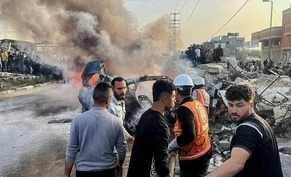
NewFears of escalation grow as Trump, Tehran exchange threats
Video has Closed Captions
Iran war on verge of escalation as Trump and Tehran exchange threats (6m 14s)
 New
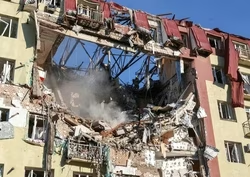
NewNews Wrap: Russian strikes on Ukraine kill at least 4
Video has Closed Captions
News Wrap: Russian strikes on southern Ukraine kill at least 4 (4m 9s)
 New
NewPeople in recovery find fresh start by crafting instruments
Video has Closed Captions
People in recovery find a fresh start by crafting Troublesome Creek instruments (7m 8s)
 New
NewPeople in Tehran on edge as Trump’s deadline for Iran looms
Video has Closed Captions
People in Tehran on edge as Trump’s deadline for Iran looms (3m 4s)
 New
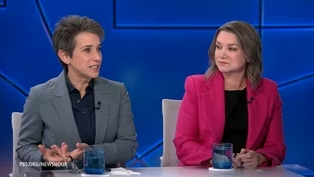
NewTamara Keith and Amy Walter on Trump’s messaging on Iran war
Video has Closed Captions
Tamara Keith and Amy Walter on Trump’s shifting messaging on Iran war (7m 18s)
 New
NewTrump says Iranians 'want to hear bombs,' want to be free
Video has Closed Captions
Trump claims Iranians 'want to hear bombs' because they want to be free (3m 39s)
Providing Support for PBS.org
Learn Moreabout PBS online sponsorship
- News and Public Affairs

FRONTLINE is investigative journalism that questions, explains and changes our world.

- News and Public Affairs

Amanpour and Company features conversations with leaders and decision makers.












Support for PBS provided by:
Major corporate funding for the PBS News Hour is provided by BDO, BNSF, Consumer Cellular, American Cruise Lines, and Raymond James. Funding for the PBS NewsHour Weekend is provided by...