
Light of the Setting Sun
Season 27 Episode 11 | 1h 12m 19sVideo has Audio Description
One family. Four generations shaped by displacement and trauma.
A Chinese family’s multigenerational trauma unfolds across time, place, and identity. Turning the camera inward, filmmaker Vicky Du traces her family’s mental illness back to the Chinese Communist Revolution of 1949. Spanning Taipei, Taiwan, and New Jersey, Light of the Setting Sun explores identity, gender roles, and whether or not healing can break the cycle for future generations.
See all videos with Audio DescriptionADProblems playing video? | Closed Captioning Feedback
Problems playing video? | Closed Captioning Feedback
Light of the Setting Sun
Season 27 Episode 11 | 1h 12m 19sVideo has Audio Description
A Chinese family’s multigenerational trauma unfolds across time, place, and identity. Turning the camera inward, filmmaker Vicky Du traces her family’s mental illness back to the Chinese Communist Revolution of 1949. Spanning Taipei, Taiwan, and New Jersey, Light of the Setting Sun explores identity, gender roles, and whether or not healing can break the cycle for future generations.
See all videos with Audio DescriptionADProblems playing video? | Closed Captioning Feedback
Where to Watch Independent Lens
Independent Lens is available to stream on pbs.org and the PBS app.
Aesthetics and Unraveling the AI Hype
Ghost in the Machine seeks to unravel the AI hype to find the untold origins of “artificial intelligence.”Providing Support for PBS.org
Learn Moreabout PBS online sponsorshipMore from This Collection
Captivating films exploring AAPI experiences
Video has Audio Description
A filmmaker honors his father’s legacy of art, activism, and resilience across generations. (1h 25m 34s)
Video has Audio Description
An elusive photographer uses street art tactics to share his previously unknown work with the world. (41m 44s)
Video has Audio Description
See how the Philippines' tense race for president in 2022 became the nation's fight for its soul. (1h 23m 38s)
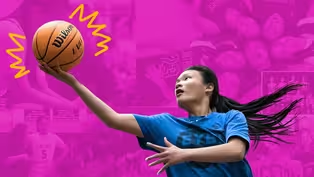
Video has Audio Description
The coming-of-age story and rise of Ashley Chea, a Cambodian American basketball prodigy. (1h 24m 52s)
Providing Support for PBS.org
Learn Moreabout PBS online sponsorship♪ ["Bailando" by Enrique Iglesias playing] ♪ I need your love, I need you closer ♪ ♪ Because me need it, baby girl ♪ ♪ Keep me begging ♪ ♪ Keep me hoping that the night don't stop ♪ ♪ Rock that body cah we don't stop party, girl ♪ ♪ Bailando, bailando Bailando, bailando ♪ ♪ Tu cuerpo y el mío llenando el vacío, subiendo y bajando ♪ ♪ Subiendo y bajando ♪ ♪ Bailando, bailando ♪ ♪ Bailando, bailando ♪ ♪ Ese fuego por dentro me 'tá enloqueciendo ♪ ♪ Me va saturando ♪ ♪ Girl, I like the way you move ♪ ♪ Come and show me what to do ♪ ♪ You can tell me that you want me, girl ♪ ♪ You got nothing to lose ♪ ♪ I can't wait no more ♪ ♪ Ya no puedo má' ♪ ♪ I can't wait no more Ya no puedo má' ♪ Huihsin: [Speaking Chinese] Mom: [Speaking Chinese] And then, yeah.
Flip.
OK.
Vicky: [Speaking Chinese] You know what I mean?
Uh-huh.
[Speaking Chinese] Sound Recordist: It's OK.
[Speaking Chinese] [Laughs] [Speaking Chinese] Maybe one day.
[Speaking Chinese] [Laughs] [Birds chirping] I don't know.
What kind of questions are these?
These are like yes-no questions.
Vicky: OK, so... Um... How would you describe our home growing up?
Yeah, I don't know.
I think about this a lot.
It's kind of weird because... if you look at it... back at it objectively, you know, there was... There were a lot of happy moments, and we actually probably don't have a lot of... We don't have a right to complain too much.
I mean, we were really comfortable, well-fed.
I don't think we ever were wanting for any of life's basic needs.
Um... You know, our parents were overall good parents, especially Mom.
I have some fond memories of some interactions with her, and even Dad.
But despite all that, yeah, when I look back on our childhood, I always see... The dominant themes are, like... Fear and anxiety were the big ones.
Um... I guess in a lot of ways, there's a lot of sadness also.
Vicky: My main memory of childhood, I feel, like, is a combination of not talking... Mm-hmm.
And... or yelling.
[Chuckles] Yeah.
Yeah.
So... And, like, the people, it would be me, you, as kids, and then Mom and Dad, but also Grandma.
Mm-hmm, mm-hmm.
But I'm also curious why they couldn't even just talk to us just about life, or the day-to-day, or, like, literally anything.
I assume that's a cultural thing.
So you would know better than me, again, because you've been to China, Taiwan, so many times, but I assume no one does that with each other there.
Is that right or no?
You assume in China and Taiwan that parents don't talk to their children?
About, like, that type of stuff.
About, like, their lives?
Yeah.
That's not true.
[Laughs] So then, yeah, it's because there's something specific to our family.
[Children speaking indistinctly] Andrew: The other part is talking about their lives.
I think it was way too painful for them.
[Speaking Chinese] Vicky: Here we are in New Jersey.
My uncle is visiting from Taiwan and recording footage of us to share with my grandparents back home, to show them what our family's life is like in the United States.
Maybe once a year, we would trade photos with our aunts, uncles, and cousins still living in Taiwan.
Growing up, all I had were these images to tell the story of who we all were, as if nothing else had ever existed.
[Singing] ♪ ♪ [Cat meows] [TV playing] Vicky: [Speaking Chinese] [Speaking Chinese] [Laughs] [Speaking Chinese] ♪ ♪ [Speaking Chinese] [Speaking Chinese] [Laughs] [Speaking Chinese] [Speaking Chinese] ♪ Vicky: I first leaned about our family book in college.
It contains over 30 generations or 900 years leading to us.
♪ ♪ 18th generation Syungching, my dad, born in 1953, studied in the United States, working as a computer engineer.
Wife, Yang Huihsin, my Mom.
Gave birth to a son, Er Chun, my Brother and a daughter.
Er Hong.
That's a typo.
It should be Er Chi.
And that's me.
I realized I was part of a family lineage that had existed for hundreds of years in a small town in southern China.
When all of a sudden my Dad's was the first generation born in Taiwan and mine was the first born in the States.
But it doesn't explain why these migrations happened.
♪ I remember Uncle once told me that a blank square means that something bad happened.
♪ There was so much that couldn't be recorded.
♪ [Sounds of traffic] [Singing in Chinese] [Speaking in Chinese] Vicky: Mmmm.
Uncle: OK?
[Speaking in Chinese] [Speaking in Chinese] [Speaking in Chinese] I can't see, really.
You do it!
Vicky: Andrew, do you remember this?
Mom and Auntie Helen are parading me around the living room, announcing the new bride has arrived.
1, 2, 3!
Vicky: I think that's my happiest childhood memory, our family all playing together.
At the same time, it's hard to watch.
I see something else.
[Speaking in Chinese] Vicky: I remember the curse words in particular because they were in Mandarin and we couldn't understand them.
[Speaking Chinese] [Speaking Chinese], Mom would say.
"You had it coming."
[Birds chirping] Vicky: When have you felt most at home?
Andrew: I don't know.
Maybe in grad school.
Even growing up here in New Jersey, you know, there weren't many people in my grade that looked like me and you didn't really see that on TV or in movies or any type of popular media.
So, no matter what, I always felt like an outsider.
[Drumming] Friend: My what?
My what?
[Singing "Smells Like Teen Spirit" by Nirvana] Andrew: You had, I feel, like a triple whammy.
So, I was the first born son, so I feel like I was favored in many ways.
So, you were second born, you were female, and then you came out to Mom and Dad.
Mom did not take it well when I came out to her.
She took it very, very poorly.
Somehow she almost took it worse when I cut my hair short.
She took that very badly.
And it's funny, I even got her a DVD when I was in college.
I mailed her a DVD about Christian moms learning to accept their gay kids.
I thought it was good documentary, and I mailed it to her.
And I actually just found it again the other day, and it's still in its plastic.
But she hasn't, like, thrown it away either.
It's, like, very interesting.
So, um... But she seemed to accept it over time.
I'd say maybe it took, like, 10 years.
You can tell you were favored?
Andrew: Yeah, it was pretty obvious.
Wait, how could you tell?
You never said that.
I mean, looking back on it, you could definitely see it.
♪ ♪ [Birds chirping] ♪ ♪ ["Total Entertainment Forever" by Father John Misty playing] ♪ [Speaking in Chinese] [Chuckles] [Speaking in Chinese] [Recorded applause] Vicky: Dupi, do you remember the first time we met?
I must have been 22, and I showed up at your house in Taipei.
I saw your Dad outside, and he looked just like mine.
He even hunched his shoulders the exact same way.
He told me endless stories about our family, stories I'd never heard before.
In an instant, my understanding of home completely opened up.
It all felt like looking into a strange new mirror for the first time.
[Speaking Chinese] I trust.
[Laughs] [TV playing] [Speaking Chinese] [Speaking Chinese] ♪ [Speaking Chinese] ♪ [Fireworks crackle] ♪ ♪ [Applause and cheering] [Whistling] Host: [Speaking Chinese] [Applause] [Speaking Chinese] [Laughter] [Applause] [Applause and cheering] Uncle: [Speaking Chinese] [Applause] [Birds squawking] [Ducks quacking] [Singing in Chinese] [Speaking Chinese] Mm.
[Speaking Chinese] Oh.
Vicky: [Speaking Chinese] Mom: [Speaking Chinese] ♪ ♪ [Busy traffic] ♪ [Crickets chirping] ♪ ♪ [Crickets stop] ♪ Grandma: [Humming] Vicky: [Speaking Chinese] Grandma: [Speaking Chinese] Vicky: Mm.
[Humming] [Speaking Chinese] [Humming] [Speaking Chinese] Mom: [Speaking Chinese] Vicky: [Speaking Chinese] [Speaking Chinese] OK.
Vicky: Take 5.
[Speaking Chinese] [Chuckles] [Water rushing] Vicky: [Speaking Chinese], you used to say.
"You had it coming".
[Speaking Chinese] Ah Gong used those same words when he was dying in the hospital.
I remember thinking, "Oh, that's familiar.
"So that's where that came from."
Something else was being replayed.
[Water rushing, birds squawking] Ah Po passed away when I was just a little kid, so I knew her even less.
I've heard only a few stories.
That she used to sew you and your siblings brand new outfits for Lunar New Year.
And that she loved to gamble.
And when she won, everything was great.
But if she lost, you were terrified.
[Waves crashing] [Birds chirping] Andrew: There are only two times I've ever seen Mom cry.
One was... I think it was when I was like 3 or 4.
The second time was after family therapy.
When we talked about how she physically abused us.
I had never seen her cry so hard, and she hugged me and begged for my forgiveness, and I didn't quite know how to react.
Vicky: Do you remember why we went to family therapy?
Do you know why?
Vicky: Yeah, I know why.
Was it because of me?
Vicky: Yes.
Oh, that's interesting.
OK.
So I had, like, a... two-year mental breakdown that, like, really, I... that really affected my life, the way I think and look at things, and etcetera, etcetera.
I felt like my brain was rewired during that time period.
And actually, when I look back on my life, it's always like pre mental breakdown, post mental breakdown.
And so everything post mental breakdown is actually quite clear, but everything pre mental breakdown, like, it's almost like looking at my life through, like... like frosted glass.
It's really... it doesn't feel like my life.
It feels like a lifetime ago.
So, is that right?
Is that why it happened?
Was it something else?
Therapy.
Family therapy.
Vicky: Yeah, I have a different story.
So, do you remember... One time you came home for the holidays.
Mm-hmm.
I think at this point you had switched your medication.
Mm-hmm.
Um, and you said... You were telling us about a really bad, like, breakdown.
Oh, yeah.
Yeah, I was going to commit suicide.
Right.
Yeah.
So you kind of... You just, like, kind of blurted it out.
Um... Yeah.
Um... And then... I don't know if you remember, but like, Mom and Dad basically had... They, like, didn't say anything in response.
[Wind blowing] Vicky: Mom and Dad didn't talk to us about it for days.
It was heartbreaking.
There's an expectation of what we owe one another, what we're obligated to do as family.
That when something bad happens, we speak up.
It's painful that our family and history are defined by silence.
Vicky: Um... [Speaking Chinese] Vicky: No, no, no.
[Speaking Chinese] I think it's called... [Speaking Chinese] String?
You mean string?
Vicky: [Speaking Chinese] [Speaking Chinese] ♪ ♪ Aunt: [Speaking Chinese] Uncle: [Speaking Chinese] Dad: [Speaking Chinese] [Speaking Chinese] [Speaking Chinese] Vicky: [Speaking Chinese] [Speaking Chinese] Vicky: Dad, did I ever tell you about the film "Dead Souls"?
It's 8 hours long.
It's almost entirely survivor testimonies of the reeducation labor camps in China.
It was hard to watch, but it also felt really familiar.
The survivors reminded me of Ye Ye and Nai Nai.
During intermission, I called you and asked if our family [Speaking Chinese] And then you told me about this letter written to Ye Ye.
Aunt: [Speaking Chinese] Vicky: July 31, 1960.
"You may feel strange when you receive this letter.
"I am your nephew, Guanquan, "and I am a survivor of Tiger's Mouth.
"I have achieved my goal of over 10 years.
"I escaped from the ruling of the Iron Curtain, "escaped from the Communist Bandits' iron heels.
"It is so sad that only 3 of us escaped "out of the entire Du family.
"In 1950, my father and brothers "fell into the Communist Bandits' devilish hands.
"They were part of the first group "executed in our hometown.
"My mother couldn't stand their cruel treatment, "so she drowned herself.
"Your mother committed suicide the same way mine did.
"And your father was paraded through the streets "and then publicly executed.
"I was sent to a re-education labor camp "under the crimes of spreading rumors "and inciting the people.
"During that time, I did think about committing suicide.
"It was only when I thought of revenge afterwards "that I decided to try and survive.
"I endured freezing, torture, and starvation.
"Now let me update you about our family members.
"Great Uncle Zhu Yue "was freed from the labor camps after many years.
"Now he is a doctor in the rural area.
"Brother Tong Xun was released "from the labor camp in Inner Mongolia "and now he is living with Uncle Sung Yi.
"I am not going to mention the rest "since very few survived.
"I am not going to mention those who joined the Communist Bandits "because they are the trash of the Du family "and enemy of our Mother Country."
Dad: [Speaking Chinese] [Speaking Chinese] Vicky: Ye ye received this letter 10 years after he fled to Taiwan.
That's how he learned how his family was killed.
It was the only time Nai Nai saw him cry.
This is a photo of Ye Ye mourning at his father's grave.
♪ And this is a photo of our family's old home.
♪ It was the only time he returned to China.
♪ When we are aware of our loss, we can grieve it.
And with time, move on.
We can even create something new.
But what if we don't know what we've lost?
Then, it's a mourning without end.
♪ ♪ [Rain falls] [Buddhist chanting] ♪ ♪ [Horn] [Birds chirping] ["Cachondea" by Fruko y Sus Tesos playing] ♪ Woman: [Cheers] Yeah!
Whoo, whoo, whoo!
[Cheering] ♪ ♪ ♪ Como que te cachondea, vagabundo ♪ ♪ Como que te cachondea, vagabundo ♪ ♪ Como que te cachondea, vagabundo ♪ ♪ Como que te cachondea ♪ ♪ La rumba buena te llama ♪ ♪ Vagabundo ♪ ♪ ♪ Vicky: Mom, do you remember the only time we went to Taiwan together?
You packed our bags and booked flights for the next day.
Auntie Helen always tells the story of how I was a child possessed that trip.
I remember how Andrew and I got chicken pox and we learned how to use chopsticks.
We visited Ah Po in the hospital.
She was really sick, but she still had this big booming voice.
You told me she had cancer, but later I learned the doctors diagnosed her with hysteria.
She passed away a few months later.
I don't think I ever saw you cry.
That was the only time you returned.
Vicky: [Speaking Chinese] [Speaking Chinese] ♪ ♪ I thought it was gonna be not that good, but this is pretty good.
[Speaking Chinese] ♪ ♪ [Speaking Chinese] [Sobs] [Cries] [Speaking Chinese] Oh.
[Speaking Chinese] [Sighs] [Sighs] [Gasps] [Speaking Chinese] [Cries] [Cries] [Speaking Chinese] [Sighs] [Speaking Chinese] [Sighs] [Speaking Chinese] [Sighs] Vicky: Mom.
Do you remember when you told me what [Speaking Chinese] meant?
You saw it happen all the time when you were working at the nursing home.
When patients were close to the end, they would lose the ability to suppress their thoughts and everything would come out.
It's the moment of clarity before death.
What if it's the tragic moments that bring things to light?
But what if some things are too painful to hold?
Too blinding to see?
What if it's the very things I struggle against the most that have helped you survive?
[Speaking Chinese] [Singing "The Moon Represents my Heart"] ♪ [Singing in Chinese] ♪ ♪ ♪ ♪ Announcer: Independent Lens is made possible by the Action Circle for Independent Lens with major funding from the John D. and Catherine T. MacArthur Foundation; Acton Family Giving; the Ford Foundation; the Jonathan Logan Family Foundation; and contributions from the following... Additional support for this series has been provided by the Corporation for Public Broadcasting and by contributions to your PBS station from viewers like you.
Thank you.
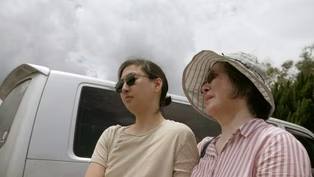
Light of the Setting Sun | Trailer
Video has Closed Captions
Preview: S27 Ep11 | 30s | A filmmaker traces the history of her Chinese family’s trauma and questions if healing is possible. (30s)
Providing Support for PBS.org
Learn Moreabout PBS online sponsorship






Support for PBS provided by: