
Powering Change: Offshore Wind
Episode 4 | 27m 35sVideo has Audio Description
A former mobster hunter turned mayor bets his fading city’s future on offshore wind.
New Bedford, Massachusetts, made its fortune hunting whales for oil. Nearly two centuries later, Mayor Jon Mitchell is wagering the city’s comeback on offshore wind. Miles O’Brien flies out to the turbines, rides with fishermen wary of losing their scallop grounds, and examines the political storm, from whale die-off claims to President Trump’s stop-work orders, testing the future of wind power.
See all videos with Audio DescriptionADProblems playing video? | Closed Captioning Feedback
Problems playing video? | Closed Captioning Feedback
Made possible in part by support provided by Sue Hart-Wadley and Searle Wadley with additional support from Jerry Cox.
Powering Change: Offshore Wind
Episode 4 | 27m 35sVideo has Audio Description
New Bedford, Massachusetts, made its fortune hunting whales for oil. Nearly two centuries later, Mayor Jon Mitchell is wagering the city’s comeback on offshore wind. Miles O’Brien flies out to the turbines, rides with fishermen wary of losing their scallop grounds, and examines the political storm, from whale die-off claims to President Trump’s stop-work orders, testing the future of wind power.
See all videos with Audio DescriptionADProblems playing video? | Closed Captioning Feedback
Where to Watch Resolve to Solve with Miles O'Brien
Resolve to Solve with Miles O'Brien is available to stream on pbs.org and the PBS app.
Providing Support for PBS.org
Learn Moreabout PBS online sponsorship♪ ♪ You never know where you're going to find a good solution.
I've got one sitting in my garage.
But my electric car is only as climate-friendly as the grid that produces the electricity.
And where I live in Massachusetts, two-thirds of those electrons come from burning methane, or natural gas.
But just an hour from here, they're working hard on that-- generating electricity from wind turbines built far offshore.
It's a fossil-free way to meet the surging demand for power, driven by electric cars like mine, and the power-hungry data centers behind artificial intelligence.
I'm heading to the wind capital of Massachusetts: New Bedford.
♪ ♪ In the early 19th century, it was one of the wealthiest cities in the country because of a grim industry.
It was the whaling capital of the world.
The oil produced from the carcasses lit cities before the transition to fossil fuels.
This city, ironically, is on the cusp of becoming a center of energy once again.
This time, the resource is blowing in the wind.
New Bedford is at the center of this revolution in offshore wind because of geography, sure, but also because it is led by an entrepreneurial mayor who sees this as a once-in-a-lifetime opportunity to revitalize a city that's been dying on the vine.
I met Mayor Jon Mitchell at the New Bedford Whaling Museum in the heart of the historic downtown.
It's good to see you.
He resolved to solve his city's economic woes in a way that fights climate change.
Thinking globally, acting locally.
JEN DOWNING: It is an honor to introduce Mayor of the City of New Bedford, Jon Mitchell.
(applause) O'BRIEN: Mitchell is a long-time advocate of offshore wind, pioneered in Europe about 30 years ago.
MITCHELL: It was creating jobs in Europe, so that's why we've pursued it.
O'BRIEN: It's not the only thing Jon Mitchell has pursued in his career.
He was a prosecutor in the U.S.
Attorney's Office in Boston.
REPORTER: The Boston mob boss who... O'BRIEN: On the hunt for the notorious mobster Whitey Bulger for years.
In 2011, he got recruited to run for mayor.
The tip came in one business day after I went off the payroll.
REPORTER: James Whitey Bulger was captured in southern... MITCHELL: And I was like, uh, I've never been in politics before, but I better win this election.
(laughter) O'BRIEN: Yeah.
Ladies and gentlemen, the Honorable Jon Mitchell.
(applause) O'BRIEN: He did win.
And didn't waste any time letting New Bedford know which way the wind would blow.
MITCHELL: The advent of offshore wind is by far the single most important business opportunity for New Bedford in my lifetime.
O'BRIEN: But for years, the industry has faced gale-force economic, political and regulatory headwinds.
MITCHELL: I figured, this would take like four years or so to, you know, for-- to materialize and for windmills to start running and feeding the grid.
O'BRIEN: Instead, it took 12 years for that to happen.
AIR TRAFFIC CONTROL: November 95808 Runway 5 taxi via Bravo Alpha.
O'BRIEN: Bravo Alpha to Runway 5 for Cessna 808.
One of the first utility-scale projects is called Vineyard Wind One-- 15 miles offshore.
AIR TRAFFIC CONTROL: November 1720 you have Runway 5 clear for the action.
O'BRIEN: Too far to see from terra firma.
Cessna 808, clear for takeoff on Runway 5.
So we took off from New Bedford and flew out to take a look.
New Bedford Tower, Cessna 808, can I proceed on course?
AIR TRAFFIC CONTROL: Cessna 808, on course approved, we'll see you.
O'BRIEN: Thank you, sir.
Have a good day.
We flew due south over Martha's Vineyard and beyond.
Providence 95808, we're going to do some photo work at the wind turbines out there, requesting flight following.
And there they were.
You can't miss them.
The size of these turbines is, uh, pretty stunning.
♪ ♪ These giant offshore windmills are about twice the size of those built on land.
That, combined with stronger, steadier winds over the ocean, allow them to generate more energy.
Inside the turbine, magnets rotate past coils of wire, generating electricity.
And some jobs, too.
At least, that's the way Mayor Mitchell sees it.
MITCHELL:... established in the 1760s... O'BRIEN: He gave me a walking tour of downtown.
Seems like an unlikely place to be, like, this kind of nexus of, of forward-thinking on climate.
New Bedford started out as the center of the world's energy industry.
So it's sort of poignant that we're also playing a really important role in advancing the cause of climate action.
What it represents is an opportunity to expand what we already do very well here, and that is to work on the water.
O'BRIEN: Like in any working waterfront, there are many colorful tales to tell.
If only the cobblestones could talk.
If we were here in your teenage years, how different would it be?
Like, what would... MITCHELL: A lot different.
Yeah, it was pretty-- it was just really run down.
All along here were a number of fisherman bars, and there's some nostalgia about those fisherman bars, although nostalgia doesn't match up with the reality.
They were pretty rough places.
O'BRIEN: I imagine.
We peeked into the former marine supply and provisioning store his family owned for years.
The place was a New Bedford institution run by a legend, the mayor's uncle, Bill Kruger.
MITCHELL: He worked at this store from the age of 14 to the age of 93, with interruptions for the war.
He was a guy who only had an eighth grade education, but had an encyclopedic memory, just was very well-respected on the waterfront.
He was kind of a tough guy.
He was still getting in bar fights in his 50s, so.
(chuckles) People didn't mess with him, but, but it was someone that was widely respected.
O'BRIEN: Right across the street, probably.
MITCHELL: Oh, he did, oh, he did.
O'BRIEN: The city took great pride in its identity as a prosperous port filled with tough, self-sufficient people like Bill Kruger.
But when industries began leaving, New Bedford lost much of its swagger.
MITCHELL: I grew up around here and watched factories close, watched people lose their jobs.
You see pessimism metastasize.
And what we're trying to do is turn that around and say, "No, we're not victims.
We're going to compete.
We're going to beat everybody."
O'BRIEN: These tall pylons towering over the harbor are the most conspicuous proof the mayor has notched some victories in his sometimes quixotic quest.
♪ ♪ KLAUS MOELLER: It's basically where we store all the turbine equipment before it goes offshore.
O'BRIEN: This is the New Bedford Marine Commerce Terminal.
When I visited, the Vineyard Wind project was under construction, and Klaus Moeller was the C.E.O.
What is the total dollar figure for Vineyard Wind?
MOELLER: So, we're about $4 billion.
O'BRIEN: The project has persevered despite serious manufacturing flaws that caused a blade failure, steep regulatory hurdles, supply chain shortages, rising prices and political opposition.
It's one of about a half-dozen utility-scale offshore wind farms under construction or operating along the East Coast.
They were part of a Biden administration push to build enough offshore wind to supply about ten million homes by 2030.
DONALD TRUMP: Those big windmills are so pathetic and so bad.
O'BRIEN: But the Trump administration is determined to pull the plug on offshore wind well-short of that goal.
TRUMP: The wind, it sounds so wonderful.
The wind, the wind, the wind is (bleep) I'll tell you.
It's horrible.
So expensive.
O'BRIEN: On the first day of his second term as president, Trump signed an order halting new offshore wind leases and reviewing federal permitting practices for wind projects.
TRUMP: We don't allow windmills.
we're not allowing any windmills to go up.
O'BRIEN: The attacks on wind power have continued ever since.
The administration issued a series of stop-work orders and lease suspensions targeting projects already under construction.
NEWSCASTER: ...including Revolution Wind in Rhode Island and Vineyard Wind out of New Bedford.
O'BRIEN: Each of them was ultimately reversed in federal court.
NEWSCASTER: Federal judge has ruled work on Vineyard Wind can resume.
O'BRIEN: The arguments against offshore wind have been all over the map.
NEWSCASTER: The Bureau of Ocean Energy Management wrote that it needed time to consider concerns, including for national security.
O'BRIEN: In some cases, officials claimed windmills interfere with Defense Department radar systems.
DOUG BURGUM: They create radar clutter, they create radar shadows.
O'BRIEN: At other times, Trump himself has argued they threaten whales.
TRUMP: Their windmills are causing whales to die in numbers never seen before.
It's driving them loco, it's driving them crazy.
O'BRIEN: Many offshore wind opponents continue to echo the claim that wind development is killing whales, despite a lack of supporting evidence.
PROTESTERS: Whale lives matter!
NEWSCASTER: At least we should do studies to see what's killing the darn whales.
O'BRIEN: But these whales died before a single turbine was built in the supposedly culpable wind farm.
That seemed pretty fishy.
So I asked an expert-- Charles "Stormy" Mayo, a marine biologist and co-founder of the Center for Coastal Studies in Provincetown, Massachusetts.
RESEARCHER: We're seeing, uh, at least one individual that looks like it might be skim feeding.
O'BRIEN: I joined him on this research cruise in Cape Cod Bay.
We were surrounded by dozens of North Atlantic right whales skimming the surface, gorging on the tiny copepods they savor.
These are some of the most critically endangered animals in the world, and they migrate along the East Coast, right through the offshore wind farms.
There's a little one, see it?
Right behind?
O'BRIEN: That little one was a rare sighting, embedded in a special moment.
There are only about 70 breeding females left in the world.
MAYO: The future of right whales is dire because the mortality rate is outstripping the birth rate.
The arrow points to zero.
O'BRIEN: So what's putting them on this course to extinction?
MAYO: We know it's ship strike, we know it's entanglement.
O'BRIEN: Entanglement is what first introduced me to Stormy Mayo back in the '90s.
(water spouting) I was a reporter on a chartered boat nearby while he was cutting free a 40-foot humpback whale entangled in fishing gear.
At great peril.
MAYO: We worked from an inflatable and used a bunch of methods that we were developing at the time.
They're now used across the world.
O'BRIEN: Ship strikes and entanglements with fishing gear are in fact, killing all kinds of whales as they migrate up and down the East Coast-- not wind turbine construction.
Not so far.
So, you got to pick your poison here.
There's no free lunch, there's always a trade-off.
Whatever, choose your cliche, right?
MAYO: Yep, absolutely.
We're gonna have to figure out a way of coping with those techniques that are used to reduce carbon, and one of them is offshore wind.
So, given the onslaught they already face, climate could be the final straw.
Climate could be the final straw for all of us.
MITCHELL: This is the central waterfront.
This is Pier 3 right here.
This is the state pier.
O'BRIEN: And yet, the skepticism that persists about the urgency of the climate crisis and the wisdom of building offshore wind makes Mayor Mitchell's job a little harder.
MITCHELL: This is the biggest fishing port in America.
O'BRIEN: But he gets it.
He, too, was a wind skeptic at first.
MITCHELL: I thought it was, like, this European thing, like Nutella-- it sounded good, but didn't really, didn't really know whether, what to, what to make of it, right?
O'BRIEN: He realized the pro-wind argument had to be about the economy.
As much as I embrace the idea that offshore wind can be part of the solution for, in our efforts against climate change, our work here has been primarily about economic development.
O'BRIEN: You're really remaking this port, aren't you?
MITCHELL: Yeah.
We really are.
O'BRIEN: It's pretty significant.
You got construction all up and down this harbor, so, what's the total dollar amount right now?
MITCHELL: It's about a $1.1 billion.
O'BRIEN: Would that have happened without wind?
MITCHELL: A lot of it wouldn't.
In fact, most of it would not.
We're trying to modernize the port for any industry that can use it well.
Any industry that can gain an advantage, invest here, create jobs, that's the idea.
O'BRIEN: He showed me the huge Marine Commerce Terminal where the wind turbines were being staged.
Nearby we saw a pier built in the 19th century to support the whaling fleet.
Later, it was home to a coal-fired power plant.
So from whaling to coal to offshore wind, the full-- it's all right there.
Run the gamut.
There's something compelling about the fact that we're leading the way in this brand-new energy industry that will contribute positively to America's efforts against climate change.
O'BRIEN: New Bedford has a geographic advantage.
It's close to the major wind energy areas-- and it has a seafaring workforce.
INSTRUCTOR: Swim over to the platform.
O'BRIEN: Although the workers are new to offshore wind, the city is now home to the country's first offshore wind training site.
INSTRUCTOR: Now let it go, here we go.
(water splashing) O'BRIEN: 21st-century jobs in a city written off in the latter half of the 20th century.
Are you worried at all that offshore wind is still, if you'll excuse the expression, not on firm ground politically and otherwise?
It is here in the United States.
It's here to stay.
There's just too much that's been sunk in the way of major investment for it to stop entirely.
The horse is out of the barn in offshore wind.
It's a question of how rapidly that horse is going to run at this point.
♪ ♪ O'BRIEN: But the mayor is also navigating some tricky political shoals right here on the waterfront.
With all the factories shuttered, commercial fishing is the largest industry in New Bedford.
In fact, it's the most lucrative fishing port in the United States, catching between $400 and $500 million worth of seafood each year.
♪ ♪ A few piers down from the wind terminal is the largest fish auction on the East Coast.
All kinds of species come through here, but in this port, scallops are king.
CASSIE CANASTRA LARSEN: We don't know, are my scallops that I harvest now going to be there in 20 years in the same spot that they've always been?
O'BRIEN: Cassie Canastra Larsen and her family run the Buyers and Sellers Exchange.
Nearly 50 million pounds of scallops land in this port annually.
The fattest ones can fetch about $20 a pound, and there are eager buyers for every last morsel.
LARSEN: Scallops are just such a high-value product, and so that's just what made us such a lucrative port.
O'BRIEN: Many scallop fishermen are worried wind could hurt their business.
ERIC HANSEN: I've been involved in the scallop commercial fishery since I was a teenager.
O'BRIEN: Scalloper Eric Hansen comes from a long line of fishermen, who, until now, have had these waters all to themselves.
The wind farms operating, or under construction, are located far from prime scallop grounds.
And yet, Eric Hansen is very wary of what may lie ahead.
In raising your concern now, you're trying to get out ahead of this, is that the idea?
Get, get out ahead is a... (chuckles) ...interesting way, way to say it.
I envision that we have a bunch of steamrollers coming to steamroll our fishery, and we're just trying to steer them.
I don't think we can stop them.
O'BRIEN: Long before Trump put the brakes on wind farms, Eric was urging the industry to slow down.
He is seeking more research to try to uncover the unintended consequences of wind farms in the ocean.
How much slower do you think?
HANSEN: I think they need seven years to have something constructed and studied for seven years to get some kind of a time series of what the effects are.
O'BRIEN: The Federal Bureau of Ocean Energy Management has funded a lot of research to understand the impact that these huge structures have on the ocean ecosystem.
Much of the work happened here in Woods Hole, Massachusetts, a picture-postcard harbor on Cape Cod.
It is quintessential New England, the kind of place Winslow Homer or Norman Rockwell might have painted.
Serene.
(loud thud) (thudding repeats) Well, not so much on this afternoon.
(loud thud) ARAN MOONEY: They're dropping that weight down and it basically hammers that piling in.
(loud thud) O'BRIEN: That's Aran Mooney.
We're doing is basically measuring how animals are responding to the sound.
O'BRIEN: He's a marine biologist at the Woods Hole Oceanographic Institution, where I met him as he was pile driving for data.
MOONEY: We have actually cameras and sensors on animals under this water, as we... ...sort of measure their behavior and their physiological, sort of, responses to this.
O'BRIEN: In the lab, he showed me how the sensors work.
They contain small accelerometers and magnetometers to capture the motion.
MOONEY: So, we have basically this custom-built tag.
This is kind of like a little scallop Fitbit.
On the back here is just... O'BRIEN: Scallop Fitbit.
MOONEY: Yup, a scallop Fitbit.
O'BRIEN: Sort of like fish bits, I suppose.
MOONEY: That allows us to kind of get the orientation of the animal and its movement.
Closed or opened up, and how often it closes, and the rates it closes as well.
O'BRIEN: They've been conducting tests on the dock... (repeated thudding) ...and in smaller tanks in the lab.
They started with black sea bass and squid.
Can we say for certain that it causes stress in these animals?
So, it really depends on which species and the context that they're in.
O'BRIEN: And what they're doing.
MOONEY: So, resting squid were very sensitive to the sound.
Mating squid couldn't care less.
(chuckles) O'BRIEN: Scallops close up tight each time a pile driver strikes.
MOONEY: Those responses, repeated again over hours and days, may tire them out and make them more susceptible to predation.
O'BRIEN: Typically, it takes a day or two of pile driving to install a windmill monopole.
Aran is proposing a solution.
MOONEY: At the beginning of a day, start off with a low amplitude sound, and then just increase that over the course of, you know, a few minutes, and so you kind of give those animals a warning that that's coming.
O'BRIEN: Not all fishermen see the wind farms as a threat.
Gentlemen, permission to come aboard.
I went to New London, Connecticut, to meet a fishing captain who sees it all as an opportunity.
Do you enjoy being out here?
GARY YERMAN: I love being out here.
Fishing isn't a way to make a living.
Fishing's a way of life.
O'BRIEN: His name is Gary Yerman, and he's been fishing for 50 years.
We steamed east southeast, toward the Revolution and South Fork Wind Farms, at the time under construction.
What's it been like, watching these turbines kind of, rise out of the water here?
YERMAN: I think, from a fisherman's standpoint, I think it's very intimidating.
O'BRIEN: But after he reached out to fishermen in Europe who had experience with offshore wind, he decided not to fight it.
YERMAN: Defiance, stand by channel 16.
O'BRIEN: In fact, he leaned in, founding a company called Sea Services, which hires captains and their vessels to provide scouting and security services for the wind farms.
But they also play a diplomatic role with their fellow captains.
YERMAN: Even though they might not be happy that we're here, they can talk to somebody that speaks their language.
We speak fish.
O'BRIEN: Gary's company is suffering collateral damage as a result of Trump's war on wind.
Sea Services is a co-op of 200 people on two dozen vessels.
In the Northeast, thousands of jobs were sustained by offshore wind projects and their supply chains.
YERMAN: There's a lot of people that are counting on that, a lot of families that are counting on it.
O'BRIEN: And so is the electric grid.
Across the country, demand for electricity is rising sharply.
Some forecasts say the United States may need 50% more electric power in just the next two decades.
There's a lot of money that's been spent to, you know, create, uh, this green energy, which I believe that we need, uh, we need more energy in this country.
O'BRIEN: My voyage aboard Gary's boat gave me my first chance to see and hear these giant windmills up close.
Listen carefully.
You can hear it whoosh.
(whooshing) The tips of those blades are moving about 120 miles an hour.
And here's a rule of thumb to remember.
One revolution of one blade on one turbine powers one house for one day.
♪ ♪ So, there goes my house.
I'm done.
For the day.
This is why people like Mayor Jon Mitchell will not be easily deterred in their efforts to make offshore wind a major contributor to the Northeast grid.
But Mitchell is driven by something else as well-- a deep affection for his hometown and a determination to prove New Bedford can come back.
We met one last time, at a seafood restaurant on the Waterfront.
What'd you get?
MITCHELL: I think you had-- I had the swordfish.
O'BRIEN: I ordered scallops, of course.
MITCHELL: It used to be that scallops were sort of the sideshow of sorts.
Scallops have moved to the center of the American plate.
O'BRIEN: Jon Mitchell serves up his politics right at the center of the plate.
He might have found a recipe for success in cities trying to reinvent themselves.
It has tested his resolve for sure.
It's altogether easy to frame complex policy decisions in black and white, but at the end of the day, you make decisions based on the gray area.
That's where the best decisions come from.
And that's harder to do, just, given given the national discourse these days.
Do you ever get tired of it?
I mean, this is overly idealistic, but, you know, we could set an example as an older industrial city that is actually progressing, but also a place that is... ...doing big things by encouraging people to work together, by lowering the temperature a little bit.
♪ ♪ PILOT: Falmouth Traffic, Cessna 95838 departing Runway 07 Falmouth.
O'BRIEN: I took one last flight out to the Vineyard wind farm.
PILOT: Straight head at 12:00.
O'BRIEN: Oh, yeah.
There they are.
The turbines are all installed, but only about a quarter of them were spinning on this day.
Given all that's happened here with politics and failures of blades and lawsuits, I guess we probably shouldn't expect much more.
But it is feeding the grid.
PILOT: Yeah.
O'BRIEN: There's no question about that.
For Mayor and former prosecutor Jon Mitchell, it's the closing argument in a case he has been making for years.
Still, the once bustling Marine Commerce Terminal is now vacant.
There are no new wind projects in the pipeline.
This has slowed the city's momentum, but here they're playing the long game, and when the political winds shift again, New Bedford will be ready with a solution.
♪ ♪ ♪ ♪ ♪ ♪
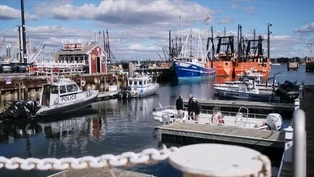
The Economic Power of Offshore Wind
Video has Closed Captions
Clip: Ep4 | 3m 15s | The mayor of New Bedford, Massachusetts, bets his city's future on offshore wind. (3m 15s)
Providing Support for PBS.org
Learn Moreabout PBS online sponsorship New Episode
 New Episode
- Science and Nature

Explore scientific discoveries on television's most acclaimed science documentary series.
Winnipeg In Bloom








 Recently Added


Support for PBS provided by:
Made possible in part by support provided by Sue Hart-Wadley and Searle Wadley with additional support from Jerry Cox.