Prairie Pulse
Prairie Pulse: Josh Askvig and Project 412
Season 23 Episode 5 | 26m 46sVideo has Closed Captions
AARP North Dakota State Director Josh Askvig talks about social security's impacts and future.
For over 90 years, social security has provided protection and a path toward retirement for many Americans. AARP North Dakota State Director Josh Askvig talks about the impacts of this program and what could happen to it if action is not taken to address the current challenges facing it. Also, take a look at how Project 412 transforms the Detroit Lakes, MN area into an artistic and cultural hub.
Problems playing video? | Closed Captioning Feedback
Problems playing video? | Closed Captioning Feedback
Prairie Pulse is a local public television program presented by Prairie Public
Prairie Pulse
Prairie Pulse: Josh Askvig and Project 412
Season 23 Episode 5 | 26m 46sVideo has Closed Captions
For over 90 years, social security has provided protection and a path toward retirement for many Americans. AARP North Dakota State Director Josh Askvig talks about the impacts of this program and what could happen to it if action is not taken to address the current challenges facing it. Also, take a look at how Project 412 transforms the Detroit Lakes, MN area into an artistic and cultural hub.
Problems playing video? | Closed Captioning Feedback
How to Watch Prairie Pulse
Prairie Pulse is available to stream on pbs.org and the free PBS App, available on iPhone, Apple TV, Android TV, Android smartphones, Amazon Fire TV, Amazon Fire Tablet, Roku, Samsung Smart TV, and Vizio.
Providing Support for PBS.org
Learn Moreabout PBS online sponsorship(upbeat music) - Hello, and welcome to "Prairie Pulse."
Coming up a little bit later in the show, we'll learn a little bit about Project 412 in Detroit Lakes, Minnesota.
But first, joining me now is the executive director or the state director of AARP North Dakota, Josh Askvig.
Josh, sorry about that, but welcome to the show.
- I've been called much worse, John, so no problem.
- As we get started, tell the folks a little bit about yourself.
- Sure.
Born and raised in North Dakota.
Been the state director for AARP for going on about 9, 10 years now.
Been with AARP for 15 years there.
I have a broad background in campaigns and elections.
Having served in elected office, been a consultant for others, but really my job every day is to show up to work and figure out how can we make life better for aging in North Dakota.
- Okay.
For those who may not know, what is AARP?
- Yeah, AARP's a nonprofit, nonpartisan membership-based organization.
Our mission is to empower people to choose how they live as they age.
Really, we spend our days as a state office really doing three things.
One, advocating for public policy that positively impacts aging for those age 50 and older in North Dakota.
Obviously, we think if it impacts, if it positively impacts those over the age of 50, it's gonna positively impact everybody.
Two, we do community education and outreach going around the state, and particularly focused in areas where we have a lot of members, talking about what are the issues that they need, unbiased information to help them make decisions that are best for them and their family.
And then last, we promote volunteerism and engagement in the communities where people live.
We know that through volunteerism continues to give folks purpose and help folks stay engaged, and age with dignity and purpose.
- Of course, as I said, you're state director of AARP North Dakota.
Do you partner with other states at all, or are they different?
Can you tell us a little bit about that?
- Yeah, I mean, we have state offices in all 50 states, plus the District of Columbia, Puerto Rico, and the Virgin Islands.
I still say I have the best job assignment out of all of them, even on days when it's snowing out and whatnot.
But we do partner across state lines.
I know we do a lot of work, for example, in Fargo, and we partner with our Minnesota office across state lines.
We've done webinars with the South Dakota office, but the other partnerships we do is work with other partner organizations and nonprofits and folks that continue to help folks get unbiased information.
- Yeah, well, we're here to talk about maybe some big topics.
First of those being Social Security.
- It's just a small item on the minds of older adults.
- It is.
And I think everybody knows, but just for the sake of doing this, what is Social Security, and what's it used for?
- Yeah, so Social Security is a program that you pay in through for a lifetime of work.
So as you are working, John, and you know, a part of your paycheck goes to fund Social Security, and then it's there for you when you reach either age 62, your full retirement age, or age 70, those are the typical ages that people start drawing Social Security, to provide a basic level of income based on your work history to help folks stay out of poverty.
So we know, for example, 40,000 North Dakotans age 65 and older would be in poverty without their Social Security benefits.
That's a huge part of the impact, but it's not strictly a social insurance program.
It's an earned benefit through that lifetime of work.
- Yeah.
Well, you said seniors, but is Social Security only for seniors?
- No, Social Security also provides benefits for survivors.
So folks who may have had a spouse or a loved one pass away.
They also provide benefits to kids in the instances where a parent has passed away and helps provide it.
They also provide disability benefits, Social Security also provides disability benefits, so if folks who are fully or totally disabled, it pays out benefits as well.
- Talking about seniors now.
So how can seniors access Social Security?
- Well, again, that's a, physically you access it by communicating with Social Security Administration.
I know one of the things we've really been pushing folks to do is to sign up for their my Social Security account.
It's an online account.
You can go in and see what will impact your benefits, where are your benefits projected to be at based on your work history, and those things.
But I think it's important to recognize that part of the work we do is to fight for ensuring that folks have that access.
There were some efforts to reduce customer service in North Dakota, including in rural areas, and AARP stepped up to the plate here, and across the country, and said, "Hold on."
Making somebody drive a hundred miles one way just to get access to benefits doesn't make sense.
And so there are Social Security Administration offices in all 50 states.
I think there are four or five in North Dakota today where folks can get access to it.
But typically you access that when you reach, again, age 62 is the first age for retirement purposes, that you can start drawing on benefits, or there's what's called your full retirement age, which is generally based on what month and year were you born in.
So for example, for me, my full retirement age is gonna be 67, and then there's age 70, which is you can continue to allow your benefits to essentially bank, and increase your benefit amount up to age 70 if you choose, and if that's what's best for you and your family.
- Well, let's talk about some legislation, I guess.
How has the recent federal legislation, like President Trump's Tax and policy bill, known as the One Big Beautiful Bill, affected Social Security for seniors?
- Well, there was no direct impact.
Now, if you're alluding to the fact that there was an expanded tax credit around older adults, we can talk about that.
So there's a temporary $6,000 tax credit that allows older adults, I think it's those 65 and older, to claim this credit.
It's on top of any other credits that they may be able to add to their benefit, including the standard deduction and whatnot.
And it essentially reduces their tax liability by what they typically would've paid.
Now, it's been pitched by some, wrongly, that it's an elimination of federal taxation of Social Security benefits.
It is not, but it does essentially eliminate for those under, I think it's $75,000 for an individual, $150,000 for a couple, would eliminate their tax liability.
But it is not an elimination of the Social Security taxation.
- And the way I understand that, or it's written, that is only from 2025 to to 2028, at least for now.
- Yeah, at least for now it's a three-year exemption, yes.
- Okay.
So you explained a little bit about what that reduction means, and they can get more information other places.
So who's gonna qualify for the reduction?
- It's typically those gonna be age 65 and older.
Again, in terms of the exact qualifications, I'd encourage folks, if they're interested in whether they qualify or not, talk to your tax professional, talk to your accountant.
They'll be able to get into the nuts and bolts, because it is gonna depend on your income, your age.
There's a whole series of pieces of how that's calculated.
- Well, I may be asking you, what do you, do you have any information for seniors who are looking to retire during that period while it's active?
- Yeah, if you go to aarp.org/socialsecurity, there's a whole bunch of information about Social Security, including this topic.
In fact, we have a volunteer who's doing a presentation on Social Security benefits later this month, and they were asking about it.
And there's a great article that kind of summarizes all of the changes from the One Big Beautiful Bill around this tax deduction.
- But, you know, so what else can people do to stay educated about changes that well may or may not happen, you know, with the newest tax and spending policy?
- So the first thing we recommend is people, if you don't have a my Social Security account, is that you set that up.
I think that's really helpful in terms of it allows you to get into your individual situation, and allows you to see what does your projected benefit go out to be based on your work history, those types of things.
Second is, as I mentioned, AARP has numerous resources.
Protecting and fighting for and strengthening Social Security for today and future generations is a top priority for AARP.
And so we have a whole host of resources at aarp.org/socialsecurity.
If you go to aarp.org and click Search, you can type in Social Security and find it.
But aarp.org/socialsecurity is where you can find all of that information and get into the details of what you're looking for.
- You know, how much does the Social Security program cost the federal government?
- Well, I know this, more than one in five residents, so that's 69 million Americans, receive Social Security.
It pays out $1.3 trillion in benefits every year.
And so you're looking at a huge impact when you realize one in five US residents receive Social Security benefits.
Just to put a finer amount and bring it, you know, we started here and kind of to focus in, in North Dakota, one in six North Dakotans receive Social Security benefits.
It's 146,512 individuals.
Put another way, that's 113,000 retirees receiving benefits.
And then the rest are either receiving disability benefits, survivor benefits, or spousal benefits.
So it's a huge impact.
Economically, $3 billion into the North Dakota economy every year from Social Security benefits.
That's folks, you know, paying for their healthcare in their local community.
They wanna stay and age in place.
We know that's a top concern for older adults in North Dakota, and around the country, I would say.
And Social Security provides that basic income.
I earlier had mentioned to you, 40,000 North Dakotans would be in poverty if they didn't have Social Security benefits.
That's 40,000 more North Dakotans we have to find state resources to help cover, versus through their lifetime of work, they're now getting a benefit that allows them to be productive, active, engaged members in their communities where they live.
So really important.
- Is there a projected date that Social Security will more or less run out?
- You're getting now to the crux of the issue.
So I, and I'm gonna take it just a second to kind of walk through this, because I think it's really important for folks to understand.
So as of today, Social Security can pay 100% of the benefits it's owed.
So if it owes a dollar in benefits, it can pay a dollar in benefits.
Starting in 2034, so that's just a simple eight years away, that goes down to Social Security's gonna be able to pay 80 cents on the dollar, or 80% of the benefits it's owed.
I wanna be clear, that doesn't mean Social Security's going bankrupt.
That doesn't mean it's going to go away.
It's still going to be able to pay with nothing changing.
If nothing changes today, 80 cents on the dollar, and then it projects out to be able to pay around 78 to 79% of benefits in perpetuity.
So when you hear this statement of "Social Security's not gonna be there for me," I'm 44 years old, I'm counting on Social Security.
I want it to be at 100%, but even if it's not at 100%, we know it's gonna be somewhere between 78 and 80% without any changes.
The reason I outline all of that is it's really important that Congress start having bipartisan conversations today.
Let's not wait till that crisis happens in eight years.
Think about eight years ago.
It doesn't seem like that long ago.
And it's gonna go by really fast.
And so starting to think about how can we find solutions from both sides of the aisle, because it is gonna take both sides of the aisle, to come together and say, "Hey, $1.3 trillion, real impacts on real people in North Dakota and across the country.
What are we gonna do to ensure that 100% of benefits owed gets paid?"
Last thing, because I know you're gonna tell me to shut up, but I think it's really important for folks to to recognize this and realize this, Social Security's been around for 90 years.
In 90 years, it's never missed a payment.
90 years of not missed payments.
I'm 44, I've missed a few payments in my lifetime.
And so to think about that's pretty incredible, and we're looking forward to continuing to encourage Congress to make sure that continues for the next 90.
- Well, you talked about this, but why is it running out?
We're paying in, businesses are paying in.
Why is it running out?
- Yeah, it's simple demographics.
The Baby Boom generation has reached the age where they're starting to draw on Social Security benefits.
You know, we had a huge influx in the '50s and '60s, it's the reason they're called the Baby Boom generation, where more kids were born.
I think at that time we were around six to eight to one individuals.
Today we're around three to four to one.
And by 2034, I think it'll be two to three to one of beneficiaries paying in versus drawing.
And so it doesn't take a mathematician to figure out, when you shrink from a large amount of people paying into beneficiaries to a small amount, that it starts to impact the ability to pay, the trust fund being paid down.
And so it's a demographic issue.
It's a numbers issue in terms of fewer workers today.
- Well help me out a little bit.
Misinterpretation of some people think that it's gonna be fully depleted.
- So the trust fund would be, and so where you get to the 80% figure is essentially the trust fund today, I can't give you the exact figure of what it is today, but that is slowly being paid down when it's paying out more benefits than than what's coming in.
But money is still coming in.
And so even when the trust fund hits zero, there's still gonna be folks paying in today that will be used to pay out the benefits today.
And so that's where, when people say it's gonna be gone or bankrupt, that's what they mean.
- Well, let's move on then.
What steps are being taken to advocate for keeping this going?
- Hey, it's an election year, and I think it's important to remind folks that, hey, we don't endorse candidates, we don't give money, we don't have a PAC.
We have a long, proud nonpartisan history.
So this isn't a partisan statement, this is a factual statement.
Folks who are elected to Congress and the US Senate in 2026 are likely going to be a part of the discussions of what happens with the future of Social Security.
And so one of the things we know, Social Security is on the minds of older voters.
It's one of the top concerns for folks going to the polls.
We also know that those age 50 and older typically make up the majority of the electorate.
So for example, in North Dakota in 2024, I think they were over 52% of the general election, and right around 60% of the primary election, excuse me, were older voters.
And this cuts across lines.
95% of Republicans, 98% of Democrats, 93% of independents say that Social Security is an important government program.
And so we're encouraging folks to talk to candidates running for federal office, whether you're in North Dakota, South Dakota, or Minnesota.
What is their plan for ensuring the future of Social Security is protected?
And that when we say we're gonna pay 100% of benefits, that that's what gets paid.
- You know, we are running short on time.
But what does it mean to create a meaningful retirement?
- Well, I think that's the crux of the question, right?
And that's what we in part are trying to do.
And we do programs around the state, and online programs to encourage people to say, "What is the future of your retirement?
What do you want it to look like?
And then what are the financial means to make sure that happens?
You know, what's your Social Security benefit gonna be?
What money have you put away in savings and investments?"
Hopefully you've had access to a pension or a 401k through your work, and really answering that question because what a meaningful retirement means to you, John, is gonna be different for me in that.
- Yeah.
Well, let's switch to what are some of the challenges providing healthcare to seniors in rural areas?
- Yeah, I think when you see the, again, this gets back to a demographic issue.
The demographics in rural America continue to get older.
We have at least five counties that would qualify for AARP eligibility.
In other words, the average age in the county is over the age of 50, is part of it.
And then, you know that there are fewer and fewer providers in those rural settings.
And we typically see your healthcare needs rise as you age.
And so when you have an aging population, fewer providers, that creates a real crunch in how it is.
However, I think it's really important those rural providers often keep folks in their communities, keep them at home where they want to stay in place and age.
And so continuing to find solutions, I know we were part of the discussions during the special session this year about the Rural Health Transformation Fund, and trying to ensure that we support family caregivers.
You know, there are a number of family caregivers in North Dakota who provide unpaid, uncompensated care.
It's folks like my friend George, who every day gets up and makes sure that his wife gets the care she needs to stay independent.
I think she's now moved to a facility, but he's still there to help provide the care for those folks that are also providing her care.
It's folks like my parents, and even myself who have a caregiving journey of helping a loved one stay independent.
And without them, the stress on the backs of healthcare, especially rural healthcare providers, would increase dramatically.
- Okay.
Well, you know, what can people look forward to for next year's regular session?
- Well, I think it's a loaded question, John.
And given the time of year, I think you're gonna see, just look at what you're seeing in the news in terms of, we've seen signals that there are concerns that some of our fiscal good times might be tightening.
And we'll see some budget and belt-tightening, which is gonna have impacts on all kinds of policy.
From an AARP perspective, we're still gonna be there championing how do folks have financial security in retirement, how do they make sure they have access to good quality healthcare?
Really continuing to think about prescription drugs.
And then really thinking about fraud prevention.
You know, how are we ensuring that older adults, who are often targeted because of their access to liquidity and in their finances for fraud and scams.
And so trying to ensure that we have policy in place that helps protect older North Dakotans.
- Josh, a lot of information we've hit around, but if people want more information, where can they go?
Who can they contact?
- Yeah, absolutely, aarp.org/nd is your best site.
We have events all around, and so check out aarp.org/NorthDakota, and then you can always reach out to our office.
- Well, Josh, good luck to you, and thank you for joining us.
- Time flies when you're having fun, John.
Good to be with you.
- Stay tuned for more.
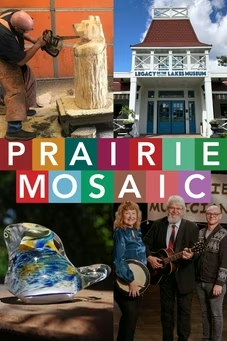
(lively music) Named after the 412 lakes in the Detroit Lakes, Minnesota area, Project 412 is an organization whose goal is to bring a positive impact to the area.
They strive to invest in the community by working with local artists to build exciting features.
(lively music) - We are creating joy and spreading joy through art and public trails in nature.
(lively music continues) Project 412 is a small, nonprofit placemaking organization.
We are based in Detroit Lakes, Minnesota.
Project 412 has been in existence since September of 2022, and we have one simple purpose, which is we are just trying to do cool stuff throughout Detroit Lakes.
Our mission is really to elevate the cultural and economic vibrancy of the 412 lakes area.
We have just really kinda hit the ground running, doing a whole bunch of things, trying things, seeing what sticks, seeing what works.
We lit up the park, which was kind of a carryover from the Ice Palace days.
We did some paved people in the city park.
We did a giant mammoth.
In the summertime, we do a series called Trucks and Toons, and they're free concerts down in our city park.
We got a grant from the Blandin Foundation to help fund murals in the community.
We worked with a variety of artists on our murals and our utility boxes.
Hannah Jurina is the artist who did all of our small art surprises.
We're just trying to find ways to celebrate the great local talent that we have.
This is Ortenstone Gardens and Sculpture Park.
This was a farm, but we've saved it.
And instead of turning it into development, we're leaning into all the natural environments.
This land has a special nuance to it.
You can see Big Detroit Lake from here.
There's great hills and valleys.
This is a beautiful area where the three biomes that come together in Minnesota are all here.
So you see deciduous trees, you see coniferous trees, you see the prairies and the grasslands.
We're working with a local artist named Hans Gilsdorf, who's adding three bronze pieces to Ortenstone Gardens here.
And those will represent the three different biomes.
- The Sprites are Greek mythology, they're spirits that are born of the earth itself that are protectors of nature.
And I thought that'd be kind of a fun storyline to kinda create three characters, three female forms, that would actually represent these biomes.
And what I wanted to create was just a moment of reflection.
So when you're sitting there looking at these sculptures, you're taking in the female form, but at the same time, you're reflecting on why you're here in nature.
And it's to slow you down, to respect, and to be grateful of what's around us.
And just to take in all that's around you.
(playful music) - Our first really giant project was the trolls.
The whole exhibit is called Alexa's Elixir.
So you start your troll journey with Alexa in the Detroit Lakes City Park.
And there's a book there that you can read and hear the story.
And then from there, you go to find the five other trolls.
Each of the trolls has a challenge for you.
For example, the troll behind me, her name is Barefoot Frida, and her challenge for you is to walk a mile barefoot.
And the idea is that if you can find each of the trolls, and do the challenge that each troll has, then you'll find the Golden Rabbit, and defeat the Golden Rabbit.
(lively music) Olek Zolkiewska is a fabulous American-Polish artist, and she does giant, large, natural pieces.
She really talks about how landscape informs her art and informs who we are as people.
The three pieces that are here right now are called Here, Strata, and Ona.
They are just wonderful pieces.
You can stand there, you can talk about them.
You can just be in their presence, and kinda feel the message that she as an artist was trying to convey.
Charlie Harper was an illustrator, a really prolific artist in the '50s and '60s and '70s.
There's 13 of his pieces in Ortenstone Gardens.
There's another 27 of his pieces at the Becker County Museum.
His pieces are really fun, they're whimsical.
He talks about the animals, and makes them almost like characters.
So we also added here out at Ortenstone Gardens, a story walk about one of his books that highlights his illustrations, written by Zoe Burke, called "What's in the Woods?"
Jim Dolan is an artist out of Montana, and we commissioned him to do a piece called "Togetherness."
It's in honor of our friend Mark Knutson, who passed away a couple years ago.
It's two horses.
They are overlooking Detroit Lake.
When the sun is setting, they just glow.
They're just beautiful pieces.
(lively music) We're still trying to figure out the economic impact, but we know very, very conservatively that we've had over 100,000 visitors to see the trolls.
And coming here to Ortenstone Gardens, it's probably been about another 30,000 just this summer.
We know that people are staying in the hotels, they're buying gasoline, they're eating in our area restaurants, they're doing some shopping downtown.
And so we know the economic impact.
It is making a difference.
This Detroit Lakes area is extraordinary.
I mean, the people here are great.
They're creative, they're resilient.
They come up with really fun ideas, and they embrace different things.
And I love that what we've thrown out for Project 412, the community has just been like, "Yeah, we want trolls."
There's so many different reasons art makes a difference.
And I really wanna encourage people to know that art is everywhere.
It is in nature, but it's also in a sculpture that somebody makes.
It really has made a difference in Detroit Lakes.
And we see that in other communities around the country and around the world.
- Art is everywhere.
Art is everything.
Whether it's music, poetry, sculpture, writing, design, everything.
Public art actually helps calm people down, helps them slow down, helps them appreciate and have respect and passion for their own communities.
But what this is gonna grow on to become is something I think that's bigger than any of us combined, 'cause it's just a project that speaks of our community, the power of our community, and the abilities of our community.
When it comes together with an idea, great things happen.
(lively music) - Well, that's all we have on "Prairie Pulse" this week.
And as always, thanks for watching.
(upbeat music) - [Narrator] Funded by the Minnesota Arts and Cultural Heritage Fund, with money from the vote of the people of Minnesota on November 4th, 2008, and by the members of Prairie Public.













Support for PBS provided by:
Prairie Pulse is a local public television program presented by Prairie Public