
The Brain, The Pain, and Psychedelics
Episode 8 | 28m 18sVideo has Audio Description
Could psychedelics cure phantom limb pain? Amputee Miles O’Brien puts it to the test.
When explorer Albert Lin’s phantom limb pain vanished after one dose of psilocybin, he sought the science behind it. Miles O’Brien, also an amputee living with phantom pain, joins a UC San Diego trial testing whether psychedelics can reopen the brain’s capacity to rewire itself. From octopus experiments to his own emotional psychedelic journey, O’Brien investigates a new frontier in pain medicine.
See all videos with Audio DescriptionADProblems playing video? | Closed Captioning Feedback
Problems playing video? | Closed Captioning Feedback
Made possible in part by support provided by Sue Hart-Wadley and Searle Wadley with additional support from Jerry Cox.
The Brain, The Pain, and Psychedelics
Episode 8 | 28m 18sVideo has Audio Description
When explorer Albert Lin’s phantom limb pain vanished after one dose of psilocybin, he sought the science behind it. Miles O’Brien, also an amputee living with phantom pain, joins a UC San Diego trial testing whether psychedelics can reopen the brain’s capacity to rewire itself. From octopus experiments to his own emotional psychedelic journey, O’Brien investigates a new frontier in pain medicine.
See all videos with Audio DescriptionADProblems playing video? | Closed Captioning Feedback
Where to Watch Resolve to Solve with Miles O'Brien
Resolve to Solve with Miles O'Brien is available to stream on pbs.org and the PBS app.
Providing Support for PBS.org
Learn Moreabout PBS online sponsorship♪ ♪ ♪ ♪ MILES O'BRIEN: When research scientist, engineer, and explorer Albert Lin is home, and that isn't that often, you'll find him here most mornings.
This is Black's Beach, La Jolla, California.
I came to Black's Beach to meet Albert fresh out of the water.
Good to see you, my friend.
- (laughing) Yeah.
- Good to see you.
Albert's missing right leg barely slows him down.
He lost it in 2016 in an off-road accident.
As a fellow amputee, I wanted to understand the study he inspired.
It may be on the cusp of finding an effective treatment for phantom limb pain, a chronic and sometimes excruciating condition nearly all amputees endure.
LIN: When you feel it, it's a reality, and it's, it's a wild reality.
I'm sure... Do... Have you had phantom limb pain?
- All the time.
It was all-consuming.
How can you move through the world if every few minutes, you're just writhing on the floor, floor as if an electric bolt has shot through you, right?
O'BRIEN: A deep dive into the scientific literature led him to a provocative idea: studies suggesting that psychedelic compounds can temporarily increase neuroplasticity, the brain's ability to rewire itself and form new connections.
Perhaps that newfound flexibility could help reshape the neural circuits underlying phantom pain.
LIN: There was no protocol for this, there was no... We went a bit renegade, you know?
- (chuckles) But in a moment of desperation, I needed it.
I needed to find a solution.
Otherwise, I wouldn't be able to let go of this thing that was holding me back.
Holding me down, really.
O'BRIEN: So he obtained some magic mushrooms.
Their active ingredient, psilocybin, is a naturally occurring psychedelic compound that profoundly alters perception, emotion, and consciousness.
Maybe it could also relieve his phantom pain.
Psilocybin remains illegal under both federal and California law.
But Albert was out of ideas.
♪ ♪ LIN: I was pretty nervous.
I thought, "Well, maybe this is not a good idea," in the back of my head.
O'BRIEN: He went to the desert and had his first psychedelic experience.
LIN: I remember feeling, like, a sensation of this "oneness" with everything.
And almost instantly, the pain went away.
It felt like this giant cloud had been lifted off of me.
And I started doing handstands in the sand.
(laughs) And I started rolling around and giggling and laughing with joy.
- (chuckling) And the pain didn't come back.
And, you know, that... - Instant relief?
Instant.
One-time.
♪ ♪ O'BRIEN: This set him on a quest for answers.
It led him to Fadel Zeidan, an experimental psychologist at the University of California San Diego, Albert's academic home.
Fadel was giving a lecture on using meditation to treat chronic pain.
Albert took a seat in the audience and asked a question that would change both of their lives.
ZEIDAN: Albert asked me if I thought that meditation works through the same mechanisms as psychedelics.
And, after looking around the room and not seeing any cops, I said, "Yes, I do think that perhaps psychedelics work in similar fashion."
O'BRIEN: They quickly became collaborators.
Although Fadel was appropriately skeptical of Albert's seemingly magical cure.
I couldn't believe that one dose of any medicine could eradicate a pain that many of us term as suicide pain.
O'BRIEN: Suicide pain.
Meaning so severe and relentless that some sufferers grapple with suicidal thoughts.
While I have never thought seriously about taking my own life, I can empathize.
When you look at me, you say, "There's a guy with one arm," but my brain really doesn't agree.
I have a phantom limb.
Imagine a mirror of this.
It's kind of tucked up just like this.
It feels like the hand is locked in concrete, and oftentimes, I get a distinct burning sensation.
And relatively frequently, I get really strong electrical jolts, which are way off the charts high-pain moments.
They come in like a, a big wave here in the Pacific, and you can't ignore them.
There is no FDA-approved drug specifically for the condition.
Some amputees rely on opioids.
Others turn to ketamine or the anti-seizure medication gabapentin.
But they can lose their effectiveness over time and they pose a significant risk of dependence and addiction.
Finding an alternative to this for chronic pain is what propelled Fadel Zeidan's research into meditation.
ZEIDAN: We were handing out opiates like it was candy.
And creating an, um, an opiate addiction problem that still lives today.
Yes.
- And what we found was that meditation can be used almost immediately to directly reduce the pain.
O'BRIEN: He wondered if psilocybin could work in the same way.
But it remains a Schedule I drug, the federal government's most tightly restricted category.
Zeidan needed approval from his institution's review board, the Food and Drug, and Drug Enforcement administrations.
The process took four years.
ZEIDAN: We weren't necessarily biasing ourselves with our own ideas of what psychedelics should or shouldn't be, or how they can or can't be used.
We were essentially being objective scientists and letting the data do all the talking.
O'BRIEN: In 2022, the first amputees who volunteered for the study started arriving at the U.C.
San Diego research clinic.
They received either a placebo or 25 milligrams of psilocybin-- a big dose.
We put two hospital beds together.
Yeah.
Two experienced monitors are in the room and a physician is down the hall just in case.
A robust safety net.
I was intrigued.
Could this actually reduce, or even erase, my phantom limb pain?
I qualified for the study and volunteered.
It was double-blind, so neither the researchers nor I knew whether I would receive psilocybin or a placebo.
But I figured I'd know soon enough.
About an hour in, it became pretty clear I'd lost the coin toss.
My phantom pain remained right where it was.
♪ ♪ So I decided to enroll in the next round of the study.
JENNIFER MILLER: Good morning.
O'BRIEN: Hello, hello.
Before long, I found myself back in the same room with the same monitors, and, unfortunately, the same pill-- the placebo.
By that point, my curiosity had turned into determination.
If I wasn't going to experience psilocybin myself, I at least needed to talk to some amputees who had.
One of them lives 25 miles up the coast from San Diego, in Cardiff.
You're lucky you landed here.
BRUCE MEZAN: Yeah, it's a good life here.
O'BRIEN: Bruce Mezan is living his best life despite what happened.
He was a huge motorcycle enthusiast.
So in 2020, I had just gotten certified to teach motorcycle safety classes, and I was on my way to teach my first class, and I was struck by a drunk driver.
O'BRIEN: There's some irony.
MEZAN: Yes.
O'BRIEN: He suffered all kinds of serious injuries, including the amputation of his leg below the knee.
He had a lot of pain in a lot of places, but nothing was worse than what he felt in his phantom limb.
MEZAN: It would feel like someone is walking by my leg with an ice pick and stabbing it two or three times.
And it was the worst pain I'd ever felt.
How often would that happen?
Every day.
O'BRIEN: He was prescribed opioids, and for a while, became way too dependent.
He powered through with an active life, and yet the pain stubbornly persisted.
When his prosthetist told him about Fadel's study on psychedelics and phantom pain, he didn't hesitate.
MEZAN: I've never experimented, um, with them because of fear.
But this was a controlled environment, and so it felt safe, and, uh, I just embraced it from the beginning.
O'BRIEN: He came to the research facility, and in less than an hour, he knew he got the real thing.
♪ ♪ MEZAN: I saw two beams of light.
And I knew they represented me and this young man who struck me, and I could see them crossing over together and having this turbulence.
And I knew it was this crash.
And then this beam of light continued on as one.
♪ ♪ And it became very clear that this young man who struck me and I are, in some ways, interwoven.
O'BRIEN: Later, a woman appeared before him.
MEZAN: And she was standing over my right side, over my residual limb, and she said, "Move your leg."
It was trying to connect pathways to, to recircuit it, and I just moved it.
I moved it around, I wiggled it, I, left and right, and I just kept moving it.
♪ ♪ O'BRIEN: So what about his excruciating phantom?
Were the ice picks gone?
MEZAN: If the ice picks were a ten, this was a seven.
And it would last maybe four or five seconds.
And then the day after that, never again.
It, it, didn't have anything, and I haven't had anything since.
And that's been two years.
Two years, and within a day... Yes.
- Wiped away.
Gone.
That's kind of stunning.
It is.
Would you have expected that?
No-- no.
♪ ♪ O'BRIEN: But how?
How could a psychedelic drug possibly relieve phantom limb pain?
In search of answers, I made a pilgrimage to the mountains east of Berkeley, California, to Shulgin Farm.
(knocks) Hi, Gül.
- How are you?
(laughing) Oh, good to see you again.
- Good to see you, too.
O'BRIEN: My guide into this fascinating world was Gül Dölen, who clearly feels right at home here.
After all, she's devoted much of her career to understanding psychedelic compounds and their effects on the brain.
Much like the man who once worked in this tiny hillside lab.
Often warmed by a fireplace, the late Alexander "Sasha" Shulgin synthesized hundreds of psychedelic compounds right here, often testing them on himself, his wife, Ann, and close collaborators.
It was foundational research that helped lay the groundwork for the current surge of interest in these drugs.
DÖLEN: Sasha Shulgin would not necessarily identify himself as a hippie in any way.
He thought of himself as a scientist.
And a... - Mm-hmm.
And a serious scientist who, uh, wanted to continue to do what he loved, which was to make new compounds and test them, um, and discover potential therapies.
O'BRIEN: Gül's regular stomping grounds are 20 minutes away, at the University of California Berkeley, where she is a professor of neuroscience and psychology.
I dropped by as she was setting up her new lab after a move from Johns Hopkins.
It's a long way from Sasha Shulgin's shack.
Ah, the tight security.
Yeah, come on in.
- It's good to be here.
All right, okay, good.
(device beeps) DÖLEN: So, this is the new office.
O'BRIEN: Wow, it's gleaming.
Her lab performs something called electrophysiology-- recording the electrical signals that individual neurons use to communicate.
Functional MRIs of the brain are like looking at a city at night from an airplane and seeing what neighborhoods are lit up.
Electrophysiology is like tapping the phone lines and listening to the conversations.
You go in deep here, right?
- We're going deep.
What we are doing is literally poking into a single neuron, and then asking, "What is a psychedelic drug doing to the electrical activity of a single neuron?"
O'BRIEN: Her work has unlocked some key insights into what are called critical periods.
There are critical periods when we develop vision, recognize faces, become attached to parents, learn language, and form social bonds.
During these periods, the brain is extraordinarily plastic, assimilating a lot of new data from the outside world.
DÖLEN: I don't know if you've ever gone on a walk in the woods with a three-year-old, right?
It, it's brutal.
(both laugh) You know?
They... They are noticing everything, like... "Look at this leaf!
Oh, my God, that's a bug!
Is that a bird I hear?"
you know, and, and it's just, like, what would normally take an hour takes four hours to do with a, with a child, because they're noticing everything.
So if you could turn that on and off, though... DÖLEN: Right, exactly.
O'BRIEN: It's pretty cool.
DÖLEN: It's pretty cool.
O'BRIEN: This is the question at the heart of Gül's research.
She and her team conducted a groundbreaking series of experiments with mice.
They found that a wide range of psychedelic drugs can, in fact, reopen critical periods.
Older mice on psychedelic drugs regained a youthful openness to social experiences that fades with age.
DÖLEN: Animals were suddenly behaving exactly the way that they did when they were juveniles.
They were able to learn from their social environment again.
If there was some reliable way to induce awe, it would be easier to study as a scientist.
O'BRIEN: Lab mice are one thing, but Gül has delved even deeper into the roots of neural plasticity.
At the California Academy of Sciences aquarium, she introduced me to a creature similar to the subjects of her study: octopuses.
Octopuses are solitary, territorial creatures whose brains evolved independently from ours more than 500 million years ago.
Gül wondered how such an alien intelligence would respond to psychedelics.
So she put one octopus in a tank with another.
DÖLEN: The octopus stayed all the way on the other end of the tank, as far away as possible from the other octopus.
O'BRIEN: In another tank, she gave one of the octopuses a 30-minute bath in water containing MDMA, the drug better known as Ecstasy.
This psychedelic compound appears to temporarily reopen critical periods of brain plasticity.
She then returned the octopus to its companion.
This time, instead of keeping its distance, it spent nearly all of its time beside the other octopus.
DÖLEN: But in addition to that, we noticed them doing playful behaviors, maybe a sort of dancing type of behavior, really swimming around and enjoying the water, and playing with the air stone and doing backflips and, you know, they really seemed to be enjoying themselves.
O'BRIEN: This is great!
Look at this.
- This is... I have never, in, in any aquarium... - Wow.
(gasps) DÖLEN: ...ever seen such an active and playful, joyous octopus.
Miles, you must bring out the best in this guy.
I, okay, I did sprinkle a little.
You did... (both laughing) O'BRIEN: Maybe I have a way with enigmatic sea creatures.
Gül remains intrigued.
DÖLEN: We want to ask really big questions about critical periods.
You know, why do they exist?
So, for example, an octopus, when it loses its arm, it grows it right back.
Whoa!
- So maybe it doesn't have a critical period for motor learning.
O'BRIEN: So, a critical period to grow back an arm?
(guffaws) I think that'll be many, many years.
I would not hold my breath if I were you.
O'BRIEN: In the meantime, can reopening a critical period at least address my phantom pain?
DÖLEN: The working hypothesis around why there is phantom pain is that even though you've lost the limb itself... - Mm-hmm.
...the representation of the arm... Mm-hmm.
- ...is still there.
And so the brain understanding of what's happening in that lost limb is that it's in this, like, super-clenched state.
O'BRIEN: Yeah.
- And it, because it's clenched all the time, it's in pain.
So the idea, you know, around critical periods would be that you could reopen the motor learning in that area.
Mm-hmm.
- And enable the brain to sort of learn that there isn't an arm there anymore.
And that it's, not only is there no arm, it's not clenched, and it's not in pain.
All right, my old room.
Welcome back!
O'BRIEN: It's good to be back.
WOMAN: It looks familiar.
O'BRIEN: Maybe this would be the day that my brain learned that I'm missing an arm.
I was excited and a little bit nervous on the morning I arrived for my dosing with the real medicine, not the placebo I received twice before.
By now, I was well acquainted with the team: my session monitors, psychologists Kayla Knopp and Jennifer Miller, and postdoc researcher Morgan Gianola.
GIANOLA: Yes, and then I'll sign.
O'BRIEN: You sign that.
GIANOLA: That's the addendum for the open-label extension.
O'BRIEN: Open-label.
In other words, the blind is lifted.
Participants who got the placebo, as I did, can choose to come back and receive psilocybin, this time knowing for certain that it's the real thing.
GIANOLA: So, assuming you want to participate in the open-label part.
O'BRIEN: I am in.
- Yeah, okay.
(Miller laughing) GIANOLA: All right, you're officially re-enrolled.
O'BRIEN: All right GIANOLA: For the third time.
(all laugh) O'BRIEN: And then it was time to take my medicine.
Let's address this thing, and who knows what else comes up, right?
MILLER: Mm-hmm.
It's probably all related somehow, anyway, right?
Everything is.
(Miller chuckles) MILLER: More will be revealed, as they say.
O'BRIEN: I put on eye shades and headphones designed to encourage an inward journey.
KNOPP: You don't have any work to do other than to just be.
(laughs) O'BRIEN: All right.
I will be.
- We're gonna do the rest.
(soft, gentle music playing) O'BRIEN: I relaxed and listened to the music.
For at least an hour, I felt nothing.
Then, gradually, I entered an ornate world that seemed part-cathedral, part-palace-- something out of the 18th century.
There, I found myself in the presence of family members who had died before me.
It seemed like I was presenting my new body to them, almost for approval.
(crying softly) (sniffles) I wept uncontrollably, but I wasn't frightened.
I emerged more than four hours later, although I had no sense of how much time had passed.
That was so intense.
(Miller and Knopp murmuring) I saw my sister and... ...my mom and... ...my dad, and I just... KNOPP: Yeah.
- Just wished they were back.
MILLER: I know.
- I miss them.
Throughout my inward journey, I felt unusual pain in my stump and shoulder.
Not phantom pain-- more like something caused externally.
This hurts like crazy.
(crying) MILLER AND KNOPP: Yeah.
O'BRIEN: It's hurting a lot.
But it went away almost immediately.
I went home exhausted from my mental workout.
The next day, I returned for a debrief with Kayla and Jen.
Had a good night's sleep.
And I woke up this morning feeling refreshed and, most important, the pain in my stump, the phantom pain, seems diminished.
I'm hesitant to declare victory here.
It's awfully early.
I went through details of the experience.
What do you think I should do?
You should integrate.
O'BRIEN: They told me I should work on integration.
What does that mean?
That means give your brain and consciousness time and space... - Mm-hmm.
...to sit with these insights.
Right.
- And for these experiences to kind of fully come into your consciousness in a way that you can make sense of.
Yeah, I mean, I guess that is the insight, right?
The solution is not the psilocybin.
The solution is confronting... KNOPP: The experience, yes.
MILLER: Mm-hmm, yeah.
...the experience.
KNOPP: Yeah.
The root causes of the pain.
KNOPP: Right.
The, the real... MILLER: Yeah.
Getting deep in the neural roots of it, if you can.
KNOPP: Right.
♪ ♪ (gulls calling) Maybe the neural roots of emotional and physical pain are more intertwined than we fully appreciate.
My encounters with my relatives who have died were by far the most profound experiences of my psychedelic journey.
It was deeply therapeutic and it helped me let go of a lot of emotional pain.
Eight weeks later, my phantom pain is still with me.
In fact, I've had some fairly significant flare-ups.
But I address it differently.
I'm able to set it aside more easily, for some reason, and this is exactly what researchers are seeing as they go through the brain scans.
ZEIDAN: The greater deactivation of brain regions that are associated with the ego, with the self, with rumination, worrying a lot, the greater the pain relief.
Psilocybin isn't necessarily taking your pain away, but it's changing the relationship that one has with their pain.
It doesn't bother them anymore.
And this is very consistent with what we've found in our meditation research.
O'BRIEN: I learned firsthand how powerful reopening a critical period can be.
That kind of plasticity comes with inherent danger.
Psychedelics may increase the risk of psychosis, especially for people with pre-existing mental issues.
But researchers say for most users, psychosis remains a rare outcome.
The, the experience of the trip is very, very dependent on what, you know, people call the set and setting.
O'BRIEN: Set and setting.
In other words, context.
Her animal experiments show that specific critical periods reopen only when the drug is paired with training for a particular task.
DÖLEN: This insight has a number of really important implications.
O'BRIEN: First, treatment is likely to work best when paired with talk therapy.
DÖLEN: Second, it means that ethically, we should be doing a good job of taking care of people for a long time after the drug has worn off, because essentially, you know, we've returned them to this childlike state of vulnerability and susceptibility and suggestibility.
So it's not all good.
♪ ♪ O'BRIEN: I returned to the cliffs of La Jolla one last time.
At a restaurant near a hang glider port, I met up with Albert and Fadel.
It was his first chance to share the early results of the study.
ZEIDAN: We saw basically a 70% reduction.
Of pain?
- In phantom limb pain after just one dose.
And what was remarkable is that it's one month after that one singular dose, which is something that we've never seen in pain medicine.
Wait, so, so everybody's confirming what I experienced?
ZEIDAN (laughing): More-- yes, yes.
Yes.
O'BRIEN: Novel solutions rarely get off the ground when they fall far outside conventional wisdom, much less the law.
Still, after one chance meeting and one unexpected question from left field, Albert Lin and Fadel Zeidan resolved to solve anyway.
LIN: Well, if it can have an effect on any other amputee out there, including you, then, then I'm very grateful for having lost my leg and... For me, becoming this person has been one of the greatest journeys in my life.
ZEIDAN: And we're just getting started.
LIN: That means a lot.
ZEIDAN: Means a lot to me.
I love you, man.
- You, too.
O'BRIEN: Not long after we met near the hang gliders, Fadel got the news that would propel his scientific quest to new heights.
The National Institutes of Health awarded his team $4 million to expand the study to 60 amputees.
Will the remarkable results from the pilot trial hold up?
That's the question this next phase is designed to answer.
♪ ♪ For millions of people living with chronic pain, a new solution may finally be taking flight.
♪ ♪ ♪ ♪ ♪ ♪
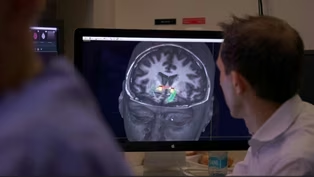
Ultrasound Brain Therapy for Addiction
Video has Closed Captions
Clip: Ep8 | 5m | Patients struggling with addiction are benefitting from ultrasound brain therapy. (5m)
Providing Support for PBS.org
Learn Moreabout PBS online sponsorship

- Science and Nature

Explore scientific discoveries on television's most acclaimed science documentary series.
Winnipeg In Bloom


 New Episode








Support for PBS provided by:
Made possible in part by support provided by Sue Hart-Wadley and Searle Wadley with additional support from Jerry Cox.