Prairie Sportsman
The Lab at the Falls
Clip: Season 17 Episode 12 | 11m 52sVideo has Closed Captions
Look at the research taking place at the University of Minnesota’s St. Anthony Falls Laboratory.
We get a behind the scenes look at the research taking place at the University of Minnesota’s St. Anthony Falls Laboratory. This unique facility is designed to take in water from the Mississippi for use in scientific experiments. The lab once focused primarily on managing river systems, but today the facility covers a wide range of research, often with an eye toward environmental protection.
Problems playing video? | Closed Captioning Feedback
Problems playing video? | Closed Captioning Feedback
Prairie Sportsman is a local public television program presented by Pioneer PBS
Production sponsorship is provided by funding from the Environment and Natural Resources Trust Fund and Shalom Hill Farm. Additional funding provided by Big Stone County, Yellow Medicine County, Lac qui...
Support provided by:


Prairie Sportsman
The Lab at the Falls
Clip: Season 17 Episode 12 | 11m 52sVideo has Closed Captions
We get a behind the scenes look at the research taking place at the University of Minnesota’s St. Anthony Falls Laboratory. This unique facility is designed to take in water from the Mississippi for use in scientific experiments. The lab once focused primarily on managing river systems, but today the facility covers a wide range of research, often with an eye toward environmental protection.
Problems playing video? | Closed Captioning Feedback
How to Watch Prairie Sportsman
Prairie Sportsman is available to stream on pbs.org and the free PBS App, available on iPhone, Apple TV, Android TV, Android smartphones, Amazon Fire TV, Amazon Fire Tablet, Roku, Samsung Smart TV, LG TV, and Vizio.
Providing Support for PBS.org
Learn Moreabout PBS online sponsorship(soft music) - [Bret] The waterfall in the heart of Minneapolis has many names.
The Dakota call it Owámniyomni, meaning turbulent waters.
The Ojibwe Gakaabikaang, loosely translated to the place of the falls, and in English it's known as St.
Anthony Falls.
This cascade is the only major waterfall on the entire Mississippi River and it's rushing waters were once harnessed by the historic industries that help shape Minneapolis.
While the old mill buildings no longer use water power to process flour, the falls still drive scientific research at the University of Minnesota's St.
Anthony Falls laboratory.
(water falling) (soft music) - The St.
Anthony Falls laboratory is a unique laboratory to study all manner of fluid processes, but probably especially river processes, in all their dimensions that is situated on and is actually in a way part of a living river, the Mississippi River (soft music) - Water is within the building and our site is right on the Mississippi.
We're actually in the Mississippi on Hennepin Island.
There aren't any other labs that are sitting at a 45 foot waterfall that can take water in the building and let it flow through the building, through research studies, (soft music continues) and then let the water back into the river.
(soft music continues) - [Bret] The motivation to create the lab grew out of the occasionally volatile river in which it sits.
- [Reporter] A hundred thousand men to fight the old River.
We sent every branch of the service down the river to help the sleepless engineers hold the old river off the valley.
(soft music) - So in the 20s and 30s, there was a real need for hydraulic modeling and there were a number of issues, big floods down south on the Mississippi, other issues wanting to build structures and not having the know-how.
And actually Europe was farther ahead at the time.
There was a fairly well established in Europe of building hydraulic labs and doing hydraulic research, physical modeling.
(light music) And so the US government established a scholarship to send a number of individuals to Europe for a year to study labs.
And our first director was one of those people.
Lorenz Straub was the first director and he received the Freeman Fellowship, which sent him to Germany and around Europe.
And when he came back here, ended up in Minnesota and Dr.
Straub was able to design, he was actually a structural engineer as well as a hydraulics engineer, and did the design.
He actually oversaw the construction.
He fought for the funding to happen and got the laboratory built and commissioned in November of 1938.
- [Bret] Straubs unique design allowed early researchers to use the waters of the upper Mississippi to devise methods to manage river systems throughout the country.
(lively music) - There was a time when to build structures in and around water bodies like rivers, you made a scale model of the system and there was a, there's a whole art and science to correctly building those and scaling them and translating the measurements that you make in the model into the field, the full reality.
Right below us, there's a floor that we refer to as the model floor.
And the reason we call it that is that it originally housed a scale model of the entire Mississippi River system through the Twin Cities and all of the infrastructure, the locks, the dams, all the construction that was done on the river to manage it was designed using scale modeling techniques in that facility right under our feet, basically.
- [Bret] During its early years, the lab's primary focus was civil engineering, but eventually it began to branch out into other research areas.
- The whole enterprise of solving civil engineering river problems through scale modeling has greatly diminished because it is now cheaper to solve those problems by computation.
(soft music) So we have had to gradually evolve away from that and in the direction of new and, and in my opinion, more interesting areas.
So for example, when I came here, I was the first non-civil engineer to ever be formally a part of the laboratory.
And that was because I had an interest in rivers, but it wasn't so much the engineering of rivers and structures and rivers as the natural processes by which rivers evolved.
It's an indication of the gradual evolution of the lab away from hard civil engineering towards natural processes.
(soft music) - So I am running an experiment here to study how a sediment is transferred from river channels to floodplains.
We have water and sediment entering this channel.
What I'm planning to study is to increase the flow rate and the discharge in the river channel to cause some floods, and then study where the sediment is transferred over the surface of the floodplain and how fast that sediment is deposited.
And then develop theory to predict that in real natural environments (soft music continues) - We study a lot of sediment, mud, dirt.
We think it's so common, we often ignore it, but it plays a critical role in our life and we still cannot not fully understood it after so many decades, even centuries of study.
- [Bret] It's rumored that the complexity of sediment transport intimidated one of history's great physicists.
- Albert Einstein's son, Hans Albert Einstein studied sediment transport and there has been anecdotes saying that Albert once told his son not to study sediment transport because it was too complicated.
(soft music) - [Bret] The intricacies of sediment transport inspired Professor Judy Yang to examine the process at the finest of scales.
- I worked inside a wetlands in Massachusetts and I realized this fine clays and the bacteria, they glue sediment together make it harder to move and they act like a gel.
They're completely different than sand that we usually study.
I get very intrigued.
And in bioengineering there is a technique called micro fluidics.
They are these tiny channels we can fabricate in a clean room and the sizes can be less than the diameter of a hair, and we can inject bacteria, clay, fluids, a different flow condition to visualize what the interact as microscopic scale and how this microscale interaction affect larger scale processes.
There are already a lot of studies showing that when their microbial presents, they can change sediment transport by several orders magnitude.
I'm hoping to combine this different technology to understand how these tiny ecosystem engineers can change our earth.
(soft music) - [Bret] The work being done by Judy and her students may help explain river behavior far beyond our planet.
- People have been hypothesizing that there are microbes in Mars because they observed this meandering patterns on Mars and they hypothesizing microbes.
And recently we have experiments showing that synthetic microbial biofilms can change a braided river into meandering river.
- The rivers that we can find on Mars are pretty similar with this morphology.
So is the the main thing that why we hypothesize that basically the biofilm also can have, play a pivotal role in the surface on Mars.
And recently some researchers found a potential biosignatures on Mars.
So probably those problems are linked also with our project and our research.
(soft music continues) - [Bret] Other research currently underway at the lab includes projects with potential impacts ranging from improved water filtration and algal bloom remediation to improve stormwater treatment and wetland health.
Though the lab has expanded to include a wide array of sciences, it still does work that connects to its earliest days.
A team is starting on a scale replica of the Mississippi River through the Twin Cities.
- So in 1917, Lock and Dam number one, which is located down by the old Ford Motor Company plant was constructed and it created pool one, which is a 28, 30 foot deep pool in the river.
I think if you do the math, there's nobody alive today that has seen the Mississippi River through the Twin Cities as a river.
We've only seen it as a system of pools and locks and dams.
This project was really initiated because the corps of engineers that owns these locks has started a study called the disposition studies where they're evaluating whether those locks and dams fit their mission anymore.
And one of the outcomes could be they, they'll decide they don't.
And so what's important is that's a big change.
This this lock has been lock and damn one, 117 some years it's been there.
What happens if it's removed?
Estimates of three million cubic yards of sands and gravel behind that dam.
Where does it all go?
Can we stabilize it?
What impacts does it have?
If we take the dam out, how long does it take the river to find a new equilibrium?
One where fish and mussels can all grow and expand within that system.
One where we as citizens can come down and go fishing or access or kayak, canoe through that system.
So those are the questions we can answer by doing a model, by doing a study like this.
- [Lab Worker] Watch yourself.
- [Bret] Central to the lab's scientific endeavors is its support staff.
(soft music) - One of the elements of the magic that makes this place work so well is we have fantastic staff who know how to build things, who know how to make things work.
Those are real pragmatic people, but you can't do scientific research without them.
- I've worked here since 1999 as a staff member.
It's just been a fantastic place.
I love the diversity and the international flavor of the people that pass through.
There's been probably hundreds of engineers, graduate students that have come through that I've got to meet from around the world.
And that's wonderful.
The research is very interesting.
It's complicated, water moving, sediment moving, bugs and living things all interacting.
And so it's really stimulating to work here.
- It feels very historic.
It constantly reminds me of the scientists who, who build this knowledge that I can build upon.
(soft music continues) - My hope for the future of the lab is that it will continue to grow and evolve in the same unpredictable and surprising ways that it has for the 40 years I've been here.
I just think it's unbelievable to have been able to make a living, working on natural river processes and also working in a building that is part of a major river.
It's just pure magic.
(soft music)
 New
NewVideo has Closed Captions
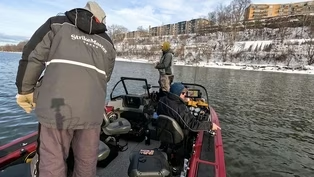
Clip: S17 Ep12 | 9m 57s | Host Brett Amundson's family brave the February cold to go fishing in Pool 2 of the Mississippi. (9m 57s)
 New
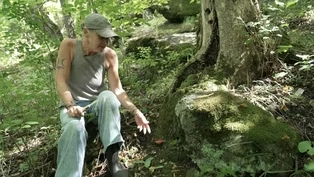
NewFast Forage: Beefsteak Fungus, Harvesting Nature’s Bounty
Video has Closed Captions
Clip: S17 Ep12 | 3m 30s | Forager Nicole Zempel shows us how to identify the Beefsteak Fungus. (3m 30s)
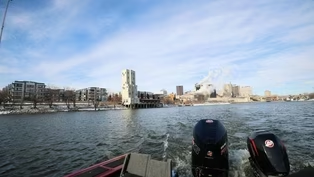
On the Great River and Beefsteak Fungus
Video has Closed Captions
Preview: S17 Ep12 | 30s | Mississippi River midwinter fishing; the St. Anthony Falls Laboratory; and the Beefsteak Fungus. (30s)
Providing Support for PBS.org
Learn Moreabout PBS online sponsorship
- Science and Nature

Explore scientific discoveries on television's most acclaimed science documentary series.

- Science and Nature

David Attenborough tells the story of the wildlife blockbuster that would change his life forever.
Winnipeg In Bloom








Support for PBS provided by:
Prairie Sportsman is a local public television program presented by Pioneer PBS
Production sponsorship is provided by funding from the Environment and Natural Resources Trust Fund and Shalom Hill Farm. Additional funding provided by Big Stone County, Yellow Medicine County, Lac qui...